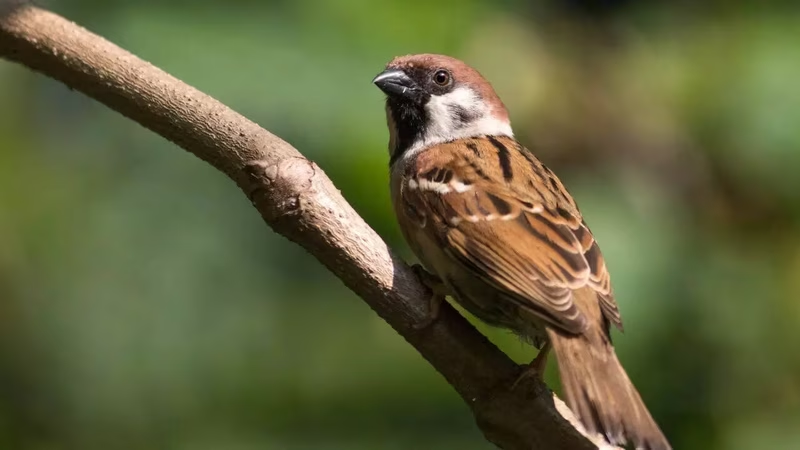
You’ve probably walked past one a hundred times without a second thought. That small, brown-and-grey bird chirping from a telephone wire or pecking at crumbs on the sidewalk—the house sparrow. But what if I told you this everyday creature is one of the most powerful teachers we have on the planet? Forget distant rainforests or deep-sea vents; the story of evolution, survival, and our own future is playing out right in our urban backyards, starring the unassuming house sparrow.
Far from being just a symbol of a bygone era, the house sparrow (Passer domesticus) is a master of adaptation. Its global journey, from its origins in the Middle East to its presence on six continents, is a real-time case study in how species respond to human-altered environments. And as our planet faces unprecedented challenges, the lessons hidden in its DNA and behavior are more relevant than ever.
Table of Contents
- The Global Conqueror: A Brief History
- House sparrow evolution: A Real-Time Case Study
- Adapting to the Urban Jungle
- Sparrows on the Front Lines of Climate Change
- Why Their Decline Is a Warning Signal
- Conclusion: Learning from Nature’s Tiny Teacher
- Sources
The Global Conqueror: A Brief History
The house sparrow’s story begins in the Fertile Crescent over 10,000 years ago, where it formed a unique partnership with early human agricultural societies . As humans built granaries and settlements, sparrows found a reliable source of food and shelter. This commensal relationship was the first step in their global expansion. With the rise of global trade and exploration, humans inadvertently carried these birds to new continents. By the 19th century, they had been introduced to North America, Australia, and beyond, often with the misguided hope of controlling insect pests . Their success was immediate and overwhelming, making them one of the most widespread wild birds on Earth.
House sparrow evolution: A Real-Time Case Study
What makes the house sparrow such a fascinating subject for scientists is the speed and visibility of its evolutionary changes. Researchers have documented rapid adaptations in response to new environments. For instance, studies comparing house sparrows in their native range versus those in newly colonized areas like Kenya or North America show significant differences in body size, beak shape, and even plumage color within just a few dozen generations . This is evolution happening fast enough for us to observe and measure—a rare window into a process that usually takes millennia.
Adapting to the Urban Jungle
Cities are extreme environments: noisy, polluted, and full of artificial structures. Yet, house sparrows have thrived here for centuries. Their adaptations are both behavioral and physiological:
- Dietary Flexibility: They’ve shifted from a seed-based diet to one that includes a wide variety of human food waste, from bread to processed snacks.
- Noise Adaptation: Research shows urban sparrows sing at a higher pitch to be heard over the low-frequency rumble of traffic .
- Nesting Innovation: They’ve abandoned natural cavities for man-made structures like building eaves, traffic lights, and even the engines of parked cars.
Sparrows on the Front Lines of Climate Change
As the planet warms, the house sparrow is once again demonstrating its remarkable plasticity. Scientists are studying how rising temperatures affect their breeding cycles, migration patterns (in some populations), and overall health. One critical area of research is how heat stress impacts their ability to regulate their body temperature, especially in chicks. These findings don’t just tell us about sparrows; they serve as an early warning system for how other, less adaptable species might fare in a hotter world .
Why Their Decline Is a Warning Signal
Ironically, in many of the very cities they once dominated, house sparrow populations have plummeted. In places like London and parts of India, their numbers have dropped by over 70% in recent decades . This decline is a complex puzzle, likely caused by a combination of factors: loss of green spaces, a reduction in insect populations (a crucial food source for chicks), increased pollution, and competition from other urban birds like pigeons and mynas. Their disappearance isn’t just a nostalgic loss; it’s a stark indicator that our urban ecosystems are becoming too hostile even for one of nature’s most resilient survivors. The Cornell Lab of Ornithology, a leading authority on bird conservation, highlights such declines as a key metric for urban environmental health .
Conclusion: Learning from Nature’s Tiny Teacher
The story of the house sparrow evolution is a powerful narrative of resilience, adaptation, and the intricate dance between humans and the natural world. It teaches us that evolution is not a distant, abstract concept but a dynamic, ongoing process that shapes life all around us. By paying attention to this small bird, we gain invaluable insights into our own impact on the planet and the urgent need to build more sustainable, biodiverse cities. The next time you see a house sparrow, don’t just walk by—take a moment to appreciate the epic journey and profound lessons it carries. For more on urban biodiversity, explore our guide on [INTERNAL_LINK:creating-wildlife-friendly-cities].
Sources
- “What house sparrows can teach us about evolution…”, Web Search Result.
- “History of the house sparrow’s global spread”, Web Search Result.
- “Rapid evolution in introduced house sparrow populations”, Web Search Result.
- “Urban noise drives song frequency shift in house sparrows”, Web Search Result.
- “House sparrows as bioindicators for climate change impacts”, Web Search Result.
- “Dramatic decline of house sparrows in urban centers”, Web Search Result.
- “All About Birds: House Sparrow”, Cornell Lab of Ornithology, https://www.allaboutbirds.org/guide/House_Sparrow