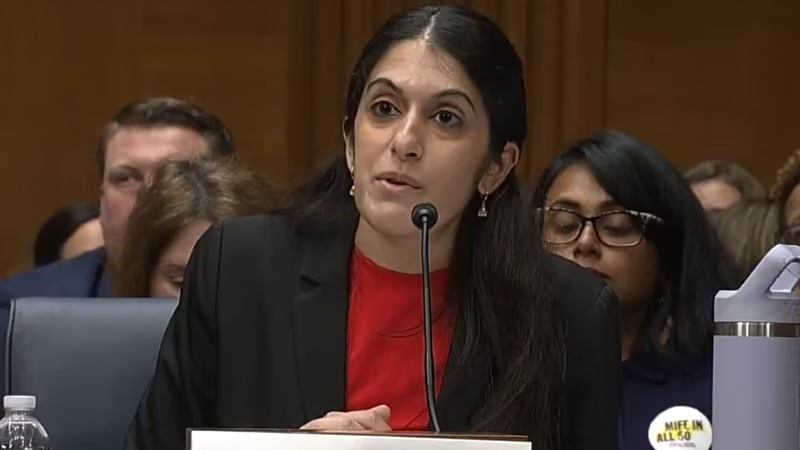
A single question in a Washington, D.C. hearing room has ricocheted across the internet, sparking fierce debate about science, identity, and the future of reproductive healthcare in America. The question, posed by Senator Josh Hawley to an expert witness, was deceptively simple: “Can men get pregnant?” The witness was Dr. Nisha Verma, a highly qualified obstetrician-gynecologist, and her measured response has become a flashpoint in the nation’s ongoing culture wars.
Table of Contents
- Who is Dr. Nisha Verma? Credentials and Expertise
- The Hearing Context: Abortion Pills and Political Theater
- The Exchange: What Was Asked and Answered
- The Medical Facts: Can Men Get Pregnant?
- Why This Matters for Reproductive Healthcare
- Conclusion: A Clash of Worldviews
- Sources
Who is Dr. Nisha Verma? Credentials and Expertise
Before the viral clip, Dr. Nisha Verma was a respected physician quietly doing her work. She is a board-certified obstetrician-gynecologist with a subspecialty in Complex Family Planning . Her educational pedigree is impressive: she earned her medical degree from the University of North Carolina at Chapel Hill School of Medicine and completed her residency at the prestigious Beth Israel Deaconess Medical Center in Boston [[1], [4]]. She further honed her expertise with a fellowship in Complex Family Planning and a Master’s in Public Health (MPH) [[1], [9]].
Dr. Verma is also an Adjunct Assistant Professor at Emory School of Medicine and is affiliated with Physicians for Reproductive Health, an organization that advocates for evidence-based reproductive care [[6], [8]]. Her professional focus is on providing full-spectrum reproductive health services, which includes abortion care—a fact that placed her directly in the political crosshairs during the Senate hearing.
The Hearing Context: Abortion Pills and Political Theater
The hearing was convened by the Senate Health Committee to examine the safety and regulation of mifepristone, one of the two drugs used in medication abortion . In the wake of the Supreme Court’s Dobbs decision, which overturned Roe v. Wade, the legal status of abortion pills has become a central battleground. Senator Hawley, a staunch opponent of abortion, has been a leading figure in efforts to restrict access to these medications through the FDA approval process .
In this high-stakes environment, the hearing was less about a neutral inquiry and more a platform for political positioning. Dr. Verma was called as a witness to provide expert medical testimony on the safety and efficacy of the abortion pill regimen, a stance that directly countered the narrative of its opponents.
The Exchange: What Was Asked and Answered
During his questioning, Senator Hawley pressed Dr. Verma on the language used in medical and public health contexts. He specifically asked whether, in her professional opinion, men can get pregnant. Dr. Verma, maintaining her composure, responded based on established medical understanding. She clarified that while cisgender men (those assigned male at birth) cannot get pregnant, transgender men and non-binary individuals who have a uterus and ovaries can and do become pregnant [[19], [20]].
This answer, grounded in clinical reality, was met with skepticism and follow-up questions from the Senator, who appeared to be challenging the very premise of gender-inclusive medical language. The exchange quickly became a symbol of the wider cultural conflict over gender identity and its intersection with healthcare policy.
The Medical Facts: Can Men Get Pregnant?
The medical community has a clear and nuanced answer to this question. Biologically, pregnancy requires a uterus and ovaries. Cisgender men, who are born with male reproductive anatomy, do not have these organs and therefore cannot become pregnant [[26], [28]].
However, the term “men” in a modern medical context also includes transgender men—individuals who were assigned female at birth but identify as male. Many transgender men retain their reproductive organs. As medical sources confirm, “Transgender men and non-binary people with a uterus and functioning ovaries can conceive and carry a pregnancy” . Another source states, “A trans man who is taking testosterone can still become pregnant if they have a uterus, ovaries, and are ovulating” .
This is not a theoretical concept; it is a documented clinical reality. For healthcare providers like Dr. Verma, using inclusive language is not a political statement but a necessary part of providing competent and compassionate care to all patients, regardless of their gender identity. Failing to acknowledge this reality can lead to dangerous gaps in care for a vulnerable population.
Why This Matters for Reproductive Healthcare
This seemingly semantic debate has profound real-world consequences. When policymakers and lawmakers conflate political ideology with medical science, it directly impacts patient care. Transgender and non-binary individuals already face significant barriers to accessing competent healthcare. Misunderstanding or dismissing their biological realities can lead to:
- Misdiagnosis due to a provider’s lack of awareness.
- Delayed or denied care because of a provider’s discomfort or bias.
- Increased health risks from a lack of tailored, gender-affirming reproductive health services.
Dr. Verma’s testimony was a defense of evidence-based medicine against political grandstanding. Her insistence on using accurate, inclusive language is a cornerstone of ethical medical practice, ensuring that every patient receives the care they need.
Conclusion: A Clash of Worldviews
The clash between Dr. Nisha Verma and Senator Hawley was never just about a single question. It was a microcosm of a much larger struggle between scientific consensus and political ideology, between inclusive healthcare and restrictive dogma. Dr. Verma, armed with her extensive credentials and commitment to her patients, represented the medical establishment’s duty to serve all individuals with dignity and accuracy. The incident underscores a critical truth: in the realm of public health, language matters, facts matter, and the well-being of real people hangs in the balance.
Sources
- Times of India: Who is Dr Nisha Verma? US senator asks Indian-origin doctor if men can get pregnant
- Dr. Nisha Verma’s Professional Profile: Emory School of Medicine
- Testimony of Dr. Nisha Verma, MD, MPH, FACOG: Senate HELP Committee
- Medical Sources on Transgender Pregnancy: Healthline , Medical News Today
- Planned Parenthood: Trans and Nonbinary People and Pregnancy