Table of Contents
- Fire in the Himalayas: A National Emergency
- Nanda Devi Forest Fire: IAF Steps In with Precision
- Why the Mi-17 V5 Was Chosen for This Mission
- Ecological Stakes: Protecting a UNESCO World Heritage Site
- Valley of Flowers and Hemkund Sahib: Safe for Now
- Climate and Human Factors Behind the Blaze
- Broader Implications for Himalayan Forests
- Conclusion: A Race Against Time in the High Himalayas
- Sources
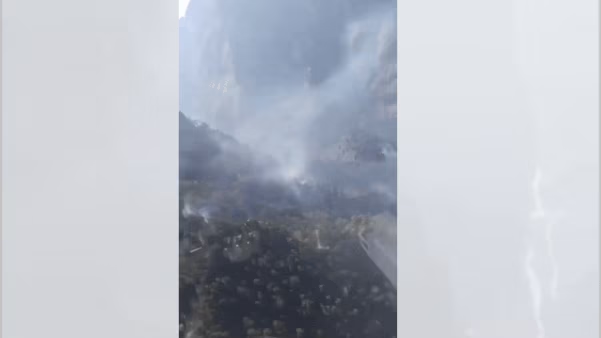
A thick plume of smoke rising from the heart of the Garhwal Himalayas has triggered a national alarm. A massive wildfire is tearing through the Nanda Devi Biosphere Reserve—one of India’s most pristine and ecologically vital regions. With ground crews struggling to access the remote, rocky terrain, the Uttarakhand government urgently requested military assistance. Within hours, the Indian Air Force (IAF) responded, deploying a Mi-17 V5 helicopter from its Central Air Command to join the firefighting operation. This isn’t just another forest fire; it’s a battle to save a global biodiversity hotspot from potential devastation. The Nanda Devi forest fire has become a symbol of the growing climate vulnerability of the Himalayas.
Fire in the Himalayas: A National Emergency
Located in Chamoli district, the Nanda Devi Biosphere Reserve spans over 2,200 square kilometers and includes the iconic Nanda Devi National Park—a UNESCO World Heritage Site since 1988. Known for its alpine meadows, rare flora like the Brahma Kamal, and endangered species such as the snow leopard and Himalayan musk deer, the region is both ecologically irreplaceable and extremely fragile.
Dry winter conditions, coupled with unusually high temperatures in early January 2026, have created a tinderbox environment. Once ignited—whether by lightning, accidental human activity, or deliberate causes—the fire spread rapidly across dry pine and rhododendron forests. Local forest department teams, though valiant, were quickly overwhelmed by the scale and inaccessibility of the blaze.
Nanda Devi Forest Fire: IAF Steps In with Precision
Recognizing the gravity of the situation, the Uttarakhand state government formally requested IAF support. The response was swift and decisive. An Mi-17 V5 helicopter, known for its versatility in high-altitude operations, was dispatched to Joshimath—a strategic base near the fire zone .
From there, the aircraft began conducting aerial water-dumping sorties, using a ‘bambi bucket’ system to scoop water from nearby rivers and lakes and douse hotspots inaccessible to ground personnel. The IAF’s involvement marks a critical escalation in the firefighting effort, bringing military-grade logistics, real-time surveillance, and rapid deployment capabilities to a civilian crisis.
Why the Mi-17 V5 Was Chosen for This Mission
The Mi-17 V5 isn’t just any helicopter—it’s the workhorse of the IAF in mountainous regions. Here’s why it’s uniquely suited for this operation:
- High-altitude performance: Capable of operating above 6,000 meters, essential for the Himalayas.
- Heavy-lift capacity: Can carry up to 4,000 liters of water in external buckets.
- All-weather capability: Equipped with advanced avionics for navigation in poor visibility.
- Proven track record: Previously used in disaster relief during the 2013 Kedarnath floods and 2021 Chamoli avalanche.
This aircraft represents the perfect blend of power, precision, and reliability needed for such a delicate and dangerous mission.
Ecological Stakes: Protecting a UNESCO World Heritage Site
Losing even a fraction of the Nanda Devi reserve to fire would be an ecological tragedy. The area is home to over 300 species of vascular plants, many found nowhere else on Earth. Its glaciers feed the Alaknanda River, a major tributary of the Ganges—making it a critical water source for millions downstream.
UNESCO has long emphasized the need for “strict protection” of this site due to its outstanding universal value . A large-scale fire could trigger soil erosion, landslides, and long-term habitat loss, setting back conservation efforts by decades. The IAF’s intervention isn’t just about stopping flames—it’s about preserving a legacy for future generations.
Valley of Flowers and Hemkund Sahib: Safe for Now
Amid the anxiety, there’s a sliver of good news. Aerial surveillance conducted by the IAF and forest officials confirms that two of the region’s most revered sites—the Valley of Flowers National Park and the Sikh pilgrimage site of Hemkund Sahib—remain untouched by the fire .
Both locations lie in adjacent valleys, separated from the main fire zone by ridgelines and snow-covered slopes. However, authorities remain on high alert, as shifting winds could still pose a threat. Preventive measures, including controlled burning of dry undergrowth and creating fire lines, are being implemented around these sensitive zones.
Climate and Human Factors Behind the Blaze
While the exact cause of the fire is still under investigation, experts point to a dangerous combination of factors:
- Record-low winter rainfall: Uttarakhand received less than 30% of its average December precipitation.
- Rising temperatures: January 2026 saw daytime highs 4–6°C above normal in the hills.
- Human activity: Unattended campfires, discarded cigarettes, or even intentional clearing can spark disasters in dry forests.
This incident underscores a troubling trend: Himalayan forests, once considered too wet to burn, are now increasingly vulnerable due to climate change and land-use pressures.
Broader Implications for Himalayan Forests
The Nanda Devi forest fire is not an isolated event. Similar blazes have occurred in Himachal Pradesh, Sikkim, and Nepal in recent years. Scientists warn that without a comprehensive Himalayan fire management strategy—including early warning systems, community-based monitoring, and investment in aerial firefighting assets—such disasters will become more frequent and severe.
India must treat its mountain ecosystems with the same urgency as coastal or urban climate risks. The IAF’s current role is heroic, but it should be part of a permanent, integrated disaster response framework—not an ad hoc emergency measure.
Conclusion: A Race Against Time in the High Himalayas
As the Mi-17 V5 continues its sorties over the smoldering ridges of Nanda Devi, the nation watches with bated breath. The successful containment of this fire would be a testament to inter-agency coordination and the IAF’s humanitarian commitment. But the deeper lesson lies beyond the headlines: the Himalayas are burning, and they need more than helicopters to survive. They need policy, prevention, and public awareness. For now, every drop of water dropped from the sky is a lifeline for one of Earth’s last great wildernesses.
Sources
- Times of India: Watch: IAF joins op to fight massive Nanda Devi forest fire
- UNESCO World Heritage Centre: Nanda Devi and Valley of Flowers National Parks
- [INTERNAL_LINK:himalayan-climate-crisis-explained]
- [INTERNAL_LINK:indian-air-force-disaster-relief-operations]