The courtroom gavel has spoken—and it wasn’t kind to Mamata Banerjee.
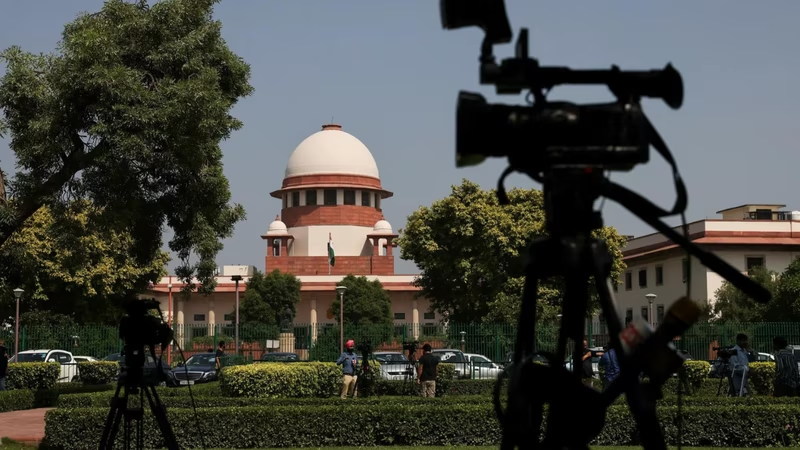
In a landmark order on January 15, 2026, the Supreme Court of India delivered a sharp rebuke to the West Bengal government, staying all First Information Reports (FIRs) filed by Kolkata Police against Enforcement Directorate (ED) officers and issuing a formal notice to Chief Minister Mamata Banerjee and her top officials. The case stems from violent clashes during ED raids on the offices of I-PAC (Indian People’s Action Council), a Trinamool Congress-affiliated NGO under scrutiny in a money laundering probe .
This isn’t just another legal skirmish—it’s a high-stakes constitutional clash over who controls law enforcement in India’s federal framework. And right now, the Centre’s agencies appear to be winning.
Table of Contents
- The Spark: What Happened During the I-PAC Raids?
- Why Did Bengal Police File FIRs Against ED?
- What Exactly Did the Supreme Court Say?
- Federalism vs Central Agencies: The Bigger Battle
- Political Fallout for Mamata and TMC
- What Happens Next in the Mamata Banerjee vs ED Case?
- Conclusion: A Warning Shot Across State Lines
- Sources
The Spark: What Happened During the I-PAC Raids?
On December 18, 2025, ED teams arrived at I-PAC’s Kolkata headquarters as part of an investigation into alleged misuse of foreign funds under the Foreign Contribution (Regulation) Act (FCRA). I-PAC, though officially an NGO, is widely seen as a strategic arm of the Trinamool Congress, managing voter outreach and data analytics .
Within minutes, hundreds of TMC supporters and local police personnel surrounded the building. Videos showed officers physically blocking ED officials, snatching documents, and even detaining agents briefly. The ED later filed a complaint alleging “criminal conspiracy” and “obstruction of justice” by state authorities acting under political direction .
Why Did Bengal Police File FIRs Against ED?
In a retaliatory move, Kolkata Police registered two FIRs against unnamed ED officers, accusing them of:
- Unauthorized entry into private premises
- Assault on police personnel
- Creating public disorder
Legal experts called this a textbook example of “weaponizing local police” to shield political allies—a tactic previously seen in states like Tamil Nadu and Punjab. The Bengal government argued the ED lacked proper search warrants, though the agency countered that its powers under the Prevention of Money Laundering Act (PMLA) supersede state-level objections .
What Exactly Did the Supreme Court Say?
Hearing a petition filed by the Union of India, a bench led by Chief Justice Sanjiv Khanna issued a strongly worded interim order:
- Stayed all FIRs filed by West Bengal police against ED officials.
- Issued notice to CM Mamata Banerjee, DGP Manoj Verma, and Kolkata Police Commissioner Vineet Goyal, demanding their response within four weeks.
- Reaffirmed ED’s authority under PMLA, stating that “state police cannot obstruct central agencies functioning under parliamentary statutes.”
Crucially, the court noted that allowing states to prosecute central investigators would “create chaos in the enforcement of national laws” .
Federalism vs Central Agencies: The Bigger Battle
This case sits at the heart of a growing tension in Indian democracy: Can state governments resist investigations by central agencies perceived as politically motivated?
While opposition parties cry “misuse of ED,” the Supreme Court has consistently upheld the primacy of central laws like PMLA and FEMA. In 2024’s Vijay Mallya judgment, the court ruled that PMLA investigations are “sovereign functions” immune from state interference .
“The Constitution doesn’t allow states to become sanctuaries for financial crime,” says constitutional expert Dr. Arvind Sharma. “Federalism means cooperation, not obstruction.”
Political Fallout for Mamata and TMC
For Mamata Banerjee, already battling anti-incumbency ahead of the 2026 assembly elections, this verdict is a double blow:
- It undermines her narrative of “defending Bengal’s dignity” against Delhi’s overreach.
- It exposes I-PAC—a key election machinery—to deeper scrutiny, potentially damaging TMC’s campaign infrastructure.
Opposition BJP leaders have seized the moment, calling the SC order “a victory for truth over thuggery.”
What Happens Next in the Mamata Banerjee vs ED Case?
The timeline ahead is critical:
- February 2026: West Bengal government must file its affidavit responding to the SC notice.
- March 2026: Final hearing likely, with potential contempt proceedings if obstruction continues.
- Ongoing: ED expected to resume I-PAC raids with central paramilitary support.
Meanwhile, similar cases in Kerala and Rajasthan are being watched closely—this SC precedent could shape their outcomes too.
Conclusion: A Warning Shot Across State Lines
The Mamata Banerjee vs ED standoff has always been about more than one raid or one NGO. It’s about the balance of power in India’s federal structure. With this verdict, the Supreme Court has sent an unambiguous message: no state, however powerful its leader, is above national financial laws. For Mamata, the path forward is narrow—fight legally, not through street protests. And for other chief ministers watching? The message is clear: obstruct central agencies at your peril. For deeper insights into India’s federal tensions, see our analysis on [INTERNAL_LINK:centre-state-relations-in-modern-india].
Sources
- Times of India: SC stays FIRs by West Bengal police against ED over I-PAC raids
- The Hindu: What is I-PAC and its link to Trinamool Congress?
- Supreme Court Observer: Union of India vs State of West Bengal (PMLA Enforcement)
- Supreme Court of India: Order dated January 15, 2026 in Writ Petition (C) No. 112 of 2026