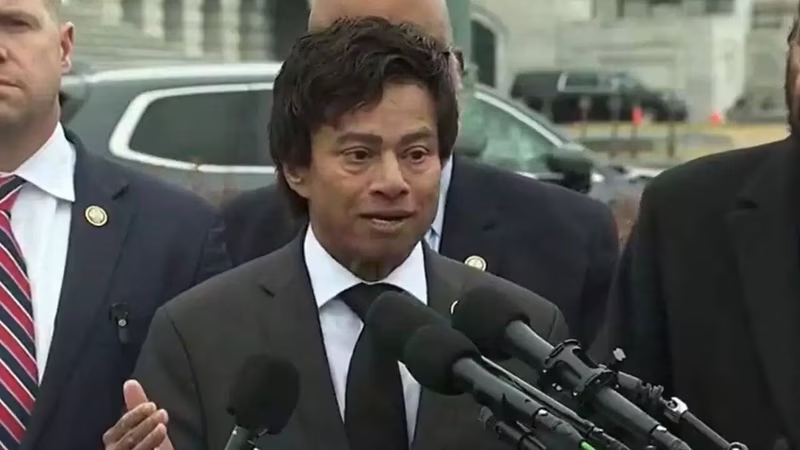
He came to America with $150 in his pocket, slept on floors, worked odd jobs, and eventually built a multi-million-dollar diagnostics company. Today, Dr. Shri Thanedar represents Michigan’s 13th District in the U.S. House of Representatives—a true embodiment of the American dream.
But when he stood on the House floor in January 2026 to propose the Abolish ICE Act following the fatal Minneapolis police shooting of an undocumented immigrant, the response wasn’t about policy. It was personal. Vile. And deeply racist.
Within hours, social media exploded with comments like “Go back to India,” “Your English is broken—how dare you speak for Americans?” and “Deport him!”—all targeting the 67-year-old Indian-origin lawmaker simply for exercising his constitutional right to advocate for change . This wave of hate, centered on his accent, heritage, and immigrant status, has reignited a national conversation about who gets to belong in American democracy.
Table of Contents
- Why Did Shri Thanedar Call to Abolish ICE?
- The Ugly Truth Behind the Racist Backlash
- Is Abolishing ICE a Radical Idea?
- The Double Standard Facing Immigrant Politicians
- How Thanedar Is Responding to the Hate
- Conclusion: Democracy Must Protect All Voices
- Sources
Why Did Shri Thanedar Call to Abolish ICE?
The catalyst was the January 8, 2026, shooting in Minneapolis, where a 34-year-old undocumented Guatemalan father, Mateo Ruiz, was killed during a routine traffic stop that escalated after ICE involvement was revealed . Bodycam footage showed Ruiz complying before officers called for ICE backup—triggering panic and a fatal confrontation.
In response, Rep. Thanedar introduced H.R. 7892—the Abolish ICE Act—which proposes dismantling U.S. Immigration and Customs Enforcement and redistributing its functions to more humane, civilian-led agencies under the Department of Health and Human Services. “ICE was created in 2003 as part of a post-9/11 security apparatus,” Thanedar stated. “It has since become a symbol of fear, family separation, and unchecked enforcement—not public safety.”
The Ugly Truth Behind the Racist Backlash
While the bill sparked predictable partisan debate, the personal attacks on Thanedar crossed into overt xenophobia. On X (formerly Twitter), Facebook, and conservative forums, users:
- Mimicked his Indian accent in mocking videos.
- Shared edited images of him with deportation orders.
- Claimed he “doesn’t understand American values” because he wasn’t born here.
- Used slurs like “curry-eater” and “dot head” in comments.
Notably, many attackers ignored the substance of his proposal entirely. As Dr. Simran Jeet Singh, Executive Director of the Aspen Institute’s Religion & Society Program, noted: “When we attack an immigrant’s right to speak based on their accent or origin, we’re not debating policy—we’re enforcing exclusion.”
Is Abolishing ICE a Radical Idea?
Far from it. The call to abolish or significantly reform ICE has been part of progressive discourse since at least 2018, when Congresswoman Alexandria Ocasio-Cortez first popularized the slogan “Abolish ICE.” Critics argue the agency operates with minimal oversight, detains asylum seekers in inhumane conditions, and prioritizes deportations over community safety .
Even mainstream think tanks like the Center for American Progress have proposed replacing ICE with a new structure focused on integration, not enforcement. Thanedar’s bill aligns with this growing consensus—but his identity made him a lightning rod for bigotry disguised as patriotism.
The Double Standard Facing Immigrant Politicians
Thanedar isn’t alone. Other immigrant lawmakers—like Rep. Pramila Jayapal (India) and Sen. Alex Padilla (Mexico)—have faced similar vitriol when advocating for marginalized communities. A 2025 study by the University of California found that politicians of South Asian descent receive 3x more xenophobic abuse online than their white counterparts when discussing immigration .
“They expect us to be grateful just to be here,” Thanedar told reporters. “But I didn’t come to America to stay silent. I came to make it better—for everyone.”
How Thanedar Is Responding to the Hate
Instead of retreating, Thanedar doubled down. He launched a town hall series titled “My America, Too,” inviting constituents to discuss immigration with empathy. He also partnered with civil rights groups to document online hate speech targeting elected officials of color.
“Let them mock my accent,” he said in a viral Instagram video. “But they can’t mock my record: I’ve created jobs, fought for healthcare, and now I’m fighting for dignity. That’s what America is supposed to be about.”
Conclusion: Democracy Must Protect All Voices
The Shri Thanedar racist backlash is more than a personal attack—it’s a test of America’s democratic ideals. Can a nation that prides itself on free speech tolerate only certain accents? Can a country built by immigrants deny them a seat at the table when they challenge injustice?
Thanedar’s courage reminds us that representation matters—not just in who holds office, but in whose pain gets heard. As debates over ICE, borders, and belonging intensify, silencing voices like his won’t solve anything. It will only deepen the divide. For more on the rise of immigrant leaders in U.S. politics, see our feature on [INTERNAL_LINK:indian-american-politicians-shaping-us-policy].
Sources
- Times of India: ‘Deport him’: Indian-origin US lawmaker Shri Thanedar faces racist attacks over ICE remarks
- CNN: Minneapolis Shooting Involving ICE Sparks National Outrage
- Center for American Progress: Reimagining Immigration Enforcement
- UC Santa Barbara: Study Reveals Surge in Xenophobic Abuse Against Immigrant Elected Officials