Table of Contents
- The Ancient Whisper from the Edge of Time
- What Exactly Are Cosmic Dawn Signals?
- The Groundbreaking (and Controversial) Detection
- Why Earth-Based Telescopes Changed the Game
- The Heated Scientific Debate: Signal or Noise?
- What It All Means for Our Cosmic Story
- Conclusion: A New Chapter in Cosmic Exploration
- Sources
The Ancient Whisper from the Edge of Time
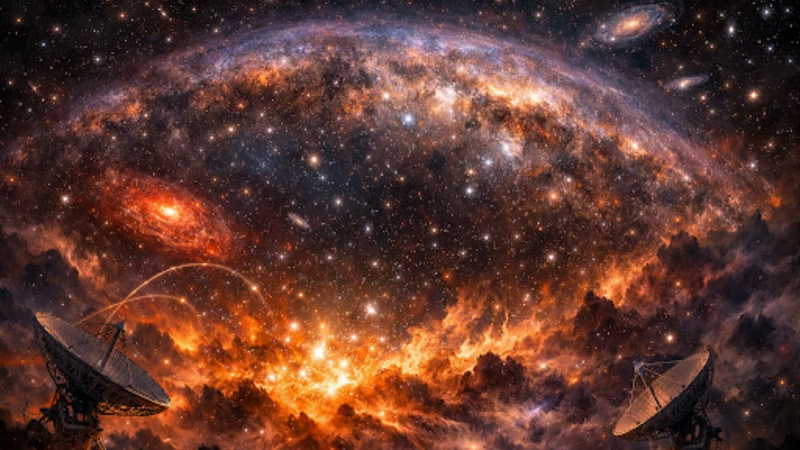
Imagine listening to a sound so old, it predates not just humanity, but our entire galaxy, the Milky Way. That’s the staggering claim at the heart of a recent scientific breakthrough. Researchers using sophisticated ground-based telescopes have reportedly captured Cosmic Dawn signals—faint radio echoes from a time when the universe was a mere toddler, just a few hundred million years old . These signals, older than 13 billion years, offer a potential direct line to the era of the very first stars, a period shrouded in mystery until now.
What Exactly Are Cosmic Dawn Signals?
To understand these signals, we need to talk about hydrogen—the most abundant element in the universe. In its neutral state, hydrogen has a unique property: its electron can flip its spin relative to the proton. This tiny flip releases (or absorbs) energy at a very specific wavelength: 21 centimeters. This is the famous 21 cm signal.
During the Cosmic Dawn, the first stars began to shine. Their intense ultraviolet light interacted with the vast clouds of cold, neutral hydrogen that filled the early universe. This interaction subtly altered the 21 cm signal, imprinting a unique signature on it. By detecting this altered signal, scientists can effectively “see” the influence of those first stars, even though the stars themselves are far too distant and faint to observe directly .
This signal is distinct from the Cosmic Microwave Background (CMB), which is the leftover radiation from the Big Bang itself, released when the universe was just 380,000 years old . The CMB is like a baby photo of the universe, while the Cosmic Dawn signal is a diary entry from its rebellious teenage years.
The Groundbreaking (and Controversial) Detection
The initial excitement stemmed from an experiment called EDGES (Experiment to Detect the Global Epoch of Reionization Signature). In 2018, the EDGES team announced they had detected this elusive 21 cm absorption signal, suggesting the early universe was much colder than previously thought—a finding that sent shockwaves through the cosmology community .
However, the plot thickened. A rival experiment, India’s SARAS 3 (Shaped Antenna measurement of the background RAdio Spectrum), designed specifically to verify or refute the EDGES claim, reported a non-detection. Their data strongly suggested that the signal picked up by EDGES was likely due to instrumental errors or unaccounted-for foreground noise from our own galaxy, not a genuine whisper from the Cosmic Dawn .
As one scientist from the SARAS 3 team put it, “As far as we are concerned, it is not [a cosmic signal]” . This ongoing debate highlights the immense difficulty of this type of observation. The signal is incredibly faint, buried under layers of much stronger radio noise from the Milky Way and human-made sources.
Why Earth-Based Telescopes Changed the Game
For decades, scientists believed that detecting the global 21 cm signal would require space-based observatories to escape the Earth’s ionosphere and human radio interference. The fact that experiments like EDGES and SARAS 3 are attempting this from the ground is a testament to incredible engineering and data analysis techniques.
These projects use highly sensitive, specialized antennas placed in remote radio-quiet zones, like the deserts of Chile or India. They don’t create images; instead, they measure the total radio power across a range of frequencies, looking for the subtle dip or bump that would signify the 21 cm signal from the early universe . This approach, while challenging, is far more cost-effective than launching a dedicated space mission, opening a new frontier for exploration right here on Earth.
The Heated Scientific Debate: Signal or Noise?
The conflict between EDGES and SARAS 3 is at the heart of modern cosmology’s most intriguing puzzle. Here’s a quick breakdown:
| Experiment | Claim | Status |
|---|---|---|
| EDGES | Detected a strong 21 cm absorption signal from the Cosmic Dawn. | Challenged by SARAS 3; many in the field remain skeptical. |
| SARAS 3 | Found no evidence of the EDGES signal, ruling out its astrophysical origin. | Provides the strongest upper limits on the signal to date . |
This isn’t just academic squabbling. If the EDGES signal were real, it would imply new physics, possibly involving interactions between normal matter and dark matter. The SARAS 3 results, however, suggest our current models of the early universe might be sufficient after all . The scientific process is working as it should: a bold claim is met with rigorous attempts at independent verification.
What It All Means for Our Cosmic Story
Regardless of the outcome of the EDGES-SARAS debate, the pursuit of these 13 billion year old microwave signals is revolutionizing our field. It’s pushing the boundaries of radio astronomy and forcing us to develop ever more sophisticated methods to listen to the universe’s faintest murmurs.
Successfully detecting the true Cosmic Dawn signal will allow us to answer fundamental questions: When exactly did the first stars ignite? What were they made of? How quickly did they heat and ionize the surrounding gas? This information is crucial for building a complete and accurate timeline of our universe’s evolution, from its fiery birth to the complex web of galaxies we see today .
It also connects deeply with other areas of research, such as the study of the Cosmic Microwave Background interaction with later structures, helping to paint a holistic picture of cosmic history .
Conclusion: A New Chapter in Cosmic Exploration
The hunt for the Cosmic Dawn signals is one of the most exciting quests in modern science. While the initial claims have been met with healthy skepticism, the effort itself is invaluable. It demonstrates human ingenuity in our relentless drive to understand our origins. Whether the signal is confirmed by a future experiment like MIST or PRIZM, or whether our models are refined based on the non-detections, we are learning more about the universe’s first chapter than ever before. The story of the cosmos is being rewritten, one faint radio wave at a time.
Sources
- Times of India: Older than Milky Way: Scientists study signals older than 13 billion years
- NASA’s Universe 101 on the Cosmic Microwave Background
- Raman Research Institute: SARAS 3 radio telescope refutes recent claim of the detection of radio wave signal from Cosmic Dawn
- Nature Astronomy: Astrophysical constraints from the SARAS 3 non-detection of the global 21-cm signal from Cosmic Dawn