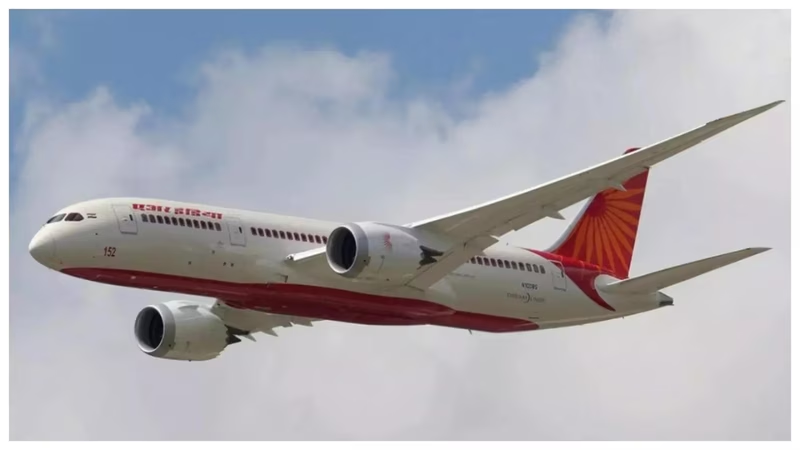
Passengers aboard Air India’s Singapore-bound flight experienced a heart-stopping moment of uncertainty when their aircraft was forced to make an emergency return to Indira Gandhi International Airport (DEL) in Delhi just minutes after takeoff. The Boeing 787 Dreamliner, operating as flight AI-317, turned back following what the airline described as a “minor technical snag” detected mid-air—a decision that prioritized safety but left travelers stranded and anxious .
The incident, which occurred during a routine evening departure, underscores the razor-thin margins of modern aviation safety protocols. While no injuries were reported, the event has reignited public conversations about aircraft maintenance standards, crew preparedness, and the psychological toll of mid-air emergencies—even when they end without catastrophe.
Table of Contents
- What Happened: The Timeline of Events
- Passenger Experiences: Fear and Relief
- Air India’s Response and Official Statements
- How Common Are Mid-Air Technical Snags?
- Safety First: Why Turning Back Is Standard Procedure
- What Passengers Should Know About Flight Diversions
- Conclusion
- Sources
What Happened: The Timeline of Events
According to air traffic control logs and airline sources, here’s how the incident unfolded:
- 6:45 PM IST: AI-317 departs from Delhi’s Terminal 3 en route to Singapore Changi Airport with 247 passengers and 12 crew members on board.
- 7:02 PM IST: Approximately 17 minutes into the flight, pilots receive an alert related to an unspecified aircraft system. Following standard operating procedures, they declare a “pan-pan” (an urgency signal, less severe than “mayday”).
- 7:15 PM IST: The aircraft begins its return maneuver and lands safely back in Delhi by 7:40 PM.
- 8:30 PM IST: Passengers are disembarked and provided with refreshments and accommodation arrangements while Air India works to deploy a replacement aircraft.
The airline later confirmed the issue was “non-critical but required immediate inspection,” emphasizing that the decision to return was purely precautionary .
Passenger Experiences: Fear and Relief
Social media quickly filled with firsthand accounts from those onboard. One passenger posted on X (formerly Twitter): “We heard a loud noise, then the plane started descending rapidly. The cabin crew stayed calm, but I’ve never been so scared in my life.” Another wrote: “Grateful to the pilots for bringing us back safely. Never taking a smooth flight for granted again.”
Many travelers expressed frustration over the lack of immediate information. “They didn’t tell us what was wrong for nearly an hour,” said a business traveler heading to a conference in Singapore. “All we knew was we were turning around.”
Air India’s Response and Official Statements
In a statement issued hours after the incident, Air India said:
“Flight AI-317 returned to Delhi as a precautionary measure following an indication of a minor technical anomaly. The safety and well-being of our passengers and crew remain our utmost priority. A replacement aircraft has been arranged, and affected passengers will be accommodated on the next available flight.”
The Directorate General of Civil Aviation (DGCA) has since launched a routine investigation to determine the exact nature of the fault and whether it points to broader maintenance or operational issues. Air India, now under the Tata Group’s ownership, has invested heavily in fleet modernization—making this incident particularly scrutinized by aviation watchdogs.
How Common Are Mid-Air Technical Snags?
While any in-flight anomaly sounds alarming, such events are more common than most realize—and rarely lead to disasters. According to the International Air Transport Association (IATA), modern commercial aircraft experience minor system alerts on roughly 1 in every 1,000 flights . Most are resolved automatically or require no action beyond monitoring.
Critical failures that necessitate a return or diversion occur far less frequently—estimated at fewer than 1 in 100,000 flights. This is thanks to redundant systems, rigorous maintenance schedules, and highly trained crews. As one retired pilot explained, “Turning back isn’t a sign of failure—it’s proof the system is working exactly as designed.”
Safety First: Why Turning Back Is Standard Procedure
Aviation operates on a simple principle: if there’s doubt, don’t take the risk. Pilots are trained to err on the side of caution, especially during the initial phase of flight when the aircraft is still near its origin airport and fuel loads are high.
Key reasons for returning include:
- Proximity to base: Easier to troubleshoot with home-ground engineers and spare parts.
- Fuel efficiency: Less fuel burned means safer landing weight and lower costs.
- Passenger logistics: Rebooking is simpler from the departure city.
This conservative approach has contributed to commercial aviation being one of the safest modes of transport globally.
What Passengers Should Know About Flight Diversions
If you ever find yourself on a diverted flight, here’s what to expect:
- Stay calm: Crews are trained for emergencies. Follow their instructions.
- Ask for updates: Airlines are required to provide timely information under DGCA guidelines.
- Know your rights: In India, passengers are entitled to meals, hotel stays, and rebooking in case of delays over 2 hours due to technical issues [INTERNAL_LINK:passenger-rights-india-flights].
- Document everything: Keep boarding passes and receipts for potential compensation claims.
Conclusion
The emergency return of this Air India flight serves as a powerful reminder that aviation safety isn’t about avoiding all problems—it’s about managing them flawlessly when they arise. While inconvenient and frightening for those onboard, the incident ultimately reflects a system functioning as intended: prioritizing human life above schedule or cost. As investigations continue, passengers can take comfort in knowing that behind every smooth landing—or safe return—is a web of technology, training, and protocol working in silent harmony.
Sources
- Times of India. “Mid-air scare: AI’s Singapore-bound flight returns to Delhi; technical snag reported.” https://timesofindia.indiatimes.com/india/mid-air-scare-air-indias-singapore-bound-flight-returns-to-delhi-technical-snag-reported/articleshow/126542267.cms
- International Air Transport Association (IATA). “Safety Report 2025.” https://www.iata.org/en/publications/safety-report/
- DGCA India. “Civil Aviation Requirements – Passenger Rights.” https://dgca.gov.in/