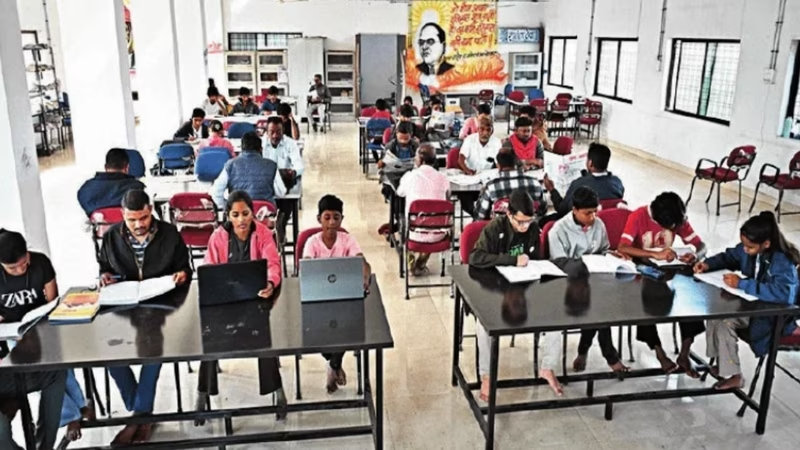
In the heart of Nagpur, where the Pili River flows quietly and the air carries the weight of both life and loss, an extraordinary transformation is taking place. Just steps away from the Nari Takshashila Nirvan Ghat crematorium—a place traditionally associated with endings—young IAS aspirants are building their futures. Here, in a modest municipal study center, silence isn’t just golden; it’s the secret weapon behind some of Maharashtra’s most promising civil service candidates.
This unlikely classroom, nestled between the solemnity of the ghat and the gentle rustle of riverside trees, has become a haven for students preparing for India’s toughest competitive exams: the UPSC Civil Services, railway recruitment tests, and state public service commissions. Far from the honking traffic, social media distractions, and cramped coaching centers of the city, these learners have found something rare in modern India: uninterrupted focus .
Table of Contents
- The Quiet Revolution Beside the Pyres
- Why Silence Is the Ultimate Study Tool
- How the Municipal Center Came to Be
- Success Stories Born in Contemplation
- Beyond Nagpur: A Model for Other Cities?
- What Aspirants Say About the Space
- Conclusion
- Sources
The Quiet Revolution Beside the Pyres
The Nari Takshashila Nirvan Ghat isn’t just a cremation ground—it’s part of a larger civic complex developed by the Nagpur Municipal Corporation (NMC). Recognizing the need for affordable, peaceful study spaces, local authorities repurposed a section of the facility into a well-lit, ventilated library and reading room. Equipped with desks, fans, drinking water, and clean restrooms, it’s open from early morning until late evening.
What makes it truly special, however, isn’t the infrastructure—it’s the atmosphere. The proximity to the crematorium naturally discourages noise, loitering, and casual chatter. Visitors speak in hushed tones out of respect, creating an environment of profound calm. For IAS aspirants who often spend 10–14 hours a day studying, this ambient stillness is invaluable.
Why Silence Is the Ultimate Study Tool
Neuroscience backs what these students intuitively know: deep work requires minimal distraction. According to research from the University of California, constant interruptions—even from background noise—can reduce cognitive performance by up to 40% . In contrast, environments like Nagpur’s riverside study center promote:
- Enhanced concentration: Fewer auditory triggers mean better retention of complex material like polity, economics, or ethics.
- Emotional grounding: The contemplative setting encourages mindfulness, reducing anxiety common among competitive exam takers.
- Longer study stamina: Without the temptation of phones or peer distractions, students report studying more consistently.
As one regular put it: “When you’re surrounded by silence, your mind stops racing. You start listening to your own thoughts—and that’s when real learning happens.”
How the Municipal Center Came to Be
The initiative was born from a simple observation by NMC officials: many underprivileged students lacked access to conducive study environments. Coaching centers in Nagpur can cost ₹15,000–₹50,000 per year—far beyond the reach of rural or low-income aspirants.
Instead of building expensive new facilities, the corporation leveraged existing civic infrastructure. The crematorium complex already had security, lighting, and maintenance staff. Adding bookshelves, study tables, and Wi-Fi (for limited digital resource access) was a low-cost, high-impact solution. It’s a brilliant example of urban innovation—turning a space of mourning into one of hope .
Success Stories Born in Contemplation
This isn’t just a feel-good story—it’s producing results. Over the past two years, students who regularly used the center have cleared:
- UPSC Civil Services (including one candidate now in training for the Indian Administrative Service)
- Railway Recruitment Board (RRB) exams
- Maharashtra Public Service Commission (MPSC) prelims and mains
Local newspapers have highlighted several “rank holders” who credit the center’s tranquility as a key factor in their success. One student, who ranked 217th in the MPSC, said, “I couldn’t afford coaching. But I had this place. And here, I found the peace to compete with anyone.”
Beyond Nagpur: A Model for Other Cities?
Could this concept be replicated elsewhere? Absolutely. Many Indian cities have underutilized public spaces—community halls near burial grounds, unused municipal buildings, or even temple complexes—that could be converted into quiet study zones.
The model aligns perfectly with the government’s [INTERNAL_LINK:skill-india-mission] and [INTERNAL_LINK:education-for-all] goals. It’s low-budget, inclusive, and sustainable. Most importantly, it democratizes access to quality preparation environments—something elite coaching hubs rarely offer.
What Aspirants Say About the Space
We spoke to three regular users:
“At home, there’s always noise—TV, relatives, chores. Here, I can read Laxmikanth for three hours straight without a single break.” — Priya, 24, UPSC aspirant
“The view of the river and the sound of birds… it calms my nerves before mock tests.” — Rohan, 22, RRB candidate
“People think it’s strange to study near a crematorium. But death reminds you of life’s purpose. It keeps me motivated.” — Arif, 26, MPSC qualifier
Conclusion
The story of Nagpur’s crematorium-side study center is more than a curiosity—it’s a powerful testament to human resilience and civic ingenuity. In a world obsessed with flashy edtech and expensive coaching, this humble space proves that sometimes, the most effective tool for success is simply silence. For thousands of IAS aspirants across India struggling to find a quiet corner to dream, Nagpur offers not just inspiration, but a blueprint for change.
Sources
- Times of India. “From pyres to preparation: Where Nagpur’s IAS aspirants study.” https://timesofindia.indiatimes.com/city/nagpur/from-pyres-to-preparation-where-do-nagpurs-ias-aspirants-go-to-study-a-crematorium-library-cum-peaceful-learning-space/articleshow/126539331.cms
- Nagpur Municipal Corporation. “Public Amenities & Community Facilities.” https://www.nmcnagpur.gov.in/
- University of California, Irvine. “The Cost of Interrupted Work.” https://www.ics.uci.edu/~gmark/CHI_2008.pdf