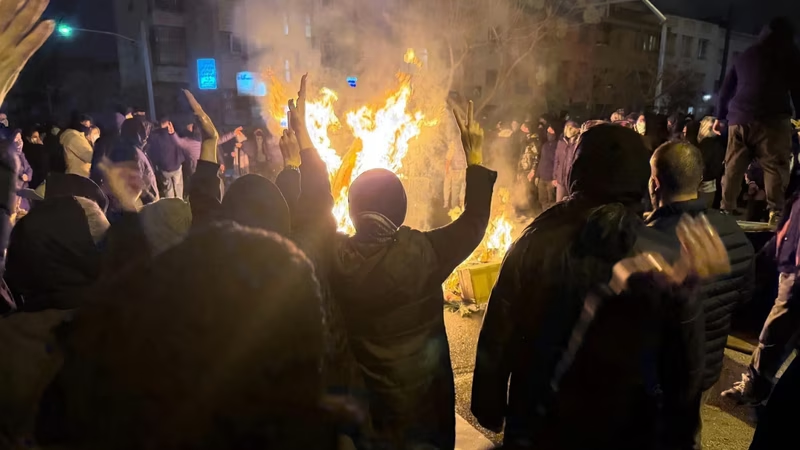
Heart-wrenching pleas are pouring in from families across Jammu and Kashmir as the Iran unrest intensifies, leaving over 10,000 Indian citizens—including hundreds of young students—stranded in a rapidly deteriorating security environment. With Iran shutting down its internet, closing its airspace, and imposing severe movement restrictions, terrified parents are begging the Indian government to launch an emergency evacuation before it’s too late .
The situation escalated after widespread protests erupted across Iran, prompting authorities to cut off digital communication and restrict civilian air travel. The Indian Embassy in Tehran has issued an urgent advisory: “All Indian nationals are advised to leave Iran by any available means of transport immediately” . But for many students, especially those from economically modest backgrounds in Kashmir who traveled to Iran for affordable medical and engineering education, “any available means” is easier said than done.
Table of Contents
- The Human Crisis: Stranded Students in a Lockdown
- Why Are So Many Indians in Iran?
- Kashmiri Parents Unite in Desperation
- Indian Government’s Response So Far
- Precedents and Possibilities for Evacuation
- What Families Can Do Right Now
- Conclusion
- Sources
The Human Crisis: Stranded Students in a Lockdown
Imagine being thousands of miles from home, with no internet, no flights, and growing uncertainty about your safety. That’s the reality for Indian students in cities like Tehran, Mashhad, and Qom. Reports confirm that Iran has effectively closed its airspace to civilian traffic amid the unrest, making commercial departures nearly impossible .
Students are unable to contact their families due to the nationwide internet shutdown. Those who manage brief calls describe scenes of fear: streets patrolled by security forces, universities closed, and local markets shuttered. For parents back in Srinagar, Baramulla, and Anantnag, the silence is unbearable.
Why Are So Many Indians in Iran?
Iran has long been a destination for Indian students seeking quality yet affordable higher education, particularly in fields like medicine and engineering. Tuition fees are significantly lower than in Western countries or even private Indian colleges, and many Iranian universities are recognized by the Medical Council of India (MCI) .
A large number of these students come from Jammu and Kashmir, where access to top-tier domestic institutions remains limited and competitive. For many families, sending a child to Iran represented a hard-earned opportunity for upward mobility—a dream now overshadowed by crisis.
Kashmiri Parents Unite in Desperation
In a coordinated effort, parents’ associations from across Kashmir have drafted a formal letter to the Ministry of External Affairs (MEA), urging immediate action. The letter highlights that over 10,000 Indian nationals are at risk and stresses the urgency of a state-led evacuation akin to Operation Rahat (Yemen, 2015) or Operation Ganga (Ukraine, 2022) .
“Our children went to study, not to face war-like conditions,” said one parent in a statement shared with local media. “We’ve invested our life savings. Now we just want them back alive.” Their appeal isn’t just emotional—it’s logistical. Many students lack the funds to book last-minute tickets on the rare flights still operating out of neighboring countries like Turkey or Armenia.
Indian Government’s Response So Far
The Indian Embassy in Tehran has activated its 24/7 helpline and is providing consular assistance to registered citizens. In its latest advisory, it explicitly states: “Given the volatile situation, all Indian nationals are urged to depart immediately using any available land, sea, or air route” .
However, critics argue this places the burden entirely on individuals who may not have the resources or information to navigate complex border crossings. As of now, there’s no official announcement of a dedicated evacuation mission, though MEA sources indicate they are “monitoring the situation closely” and are in “constant touch” with Iranian authorities .
Precedents and Possibilities for Evacuation
India has a strong track record of evacuating citizens from conflict zones:
- Operation Ganga (2022): Rescued over 25,000 Indians from Ukraine during the Russian invasion.
- Operation Rahat (2015): Evacuated more than 4,600 people from Yemen.
- Operation Safe Homecoming (2011): Brought back 17,000+ citizens from Libya.
Given this history, families are asking: why not now? While Iran’s airspace closure presents a unique challenge, alternatives exist—such as coordinating with friendly nations for overflight permissions or organizing bus convoys to Turkey or Pakistan. The key is political will and rapid mobilization.
What Families Can Do Right Now
While waiting for government action, families are advised to:
- Ensure their children are registered with the Indian Embassy in Tehran via the MADAD portal .
- Attempt contact through satellite phones or messaging apps that may still work intermittently (e.g., WhatsApp via Wi-Fi if available).
- Join regional WhatsApp groups organized by other affected parents to share real-time updates.
- Monitor official channels: MEA website, Embassy social media, and [INTERNAL_LINK:india-evacuation-operations] for historical context.
Conclusion
The Iran unrest has turned a pursuit of education into a fight for safety for thousands of Indian students. The appeals from Kashmiri parents are not just cries for help—they’re a test of India’s commitment to its citizens abroad, regardless of their state or economic background. As time runs out and options dwindle, the window for a safe, orderly evacuation is narrowing. The world has seen India rise to such challenges before. Now, with over 10,000 lives in limbo, the call for action has never been more urgent.
Sources
- Times of India. “Iran unrest: Kashmiri parents seek help to bring children back; write to Centre.” https://timesofindia.indiatimes.com/india/iran-unrest-kashmiri-parents-seek-help-to-bring-children-back-write-to-centre/articleshow/126539172.cms
- Embassy of India, Tehran. “Advisory for Indian Nationals in Iran.” https://www.indianembassyiran.gov.in/
- Reuters. “Iran shuts airspace amid nationwide protests and internet blackout.” https://www.reuters.com/world/middle-east/iran-closes-airspace-amid-escalating-unrest-2026-01-14/
- Ministry of External Affairs, Government of India. “MEA Spokesperson Statement on Situation in Iran.” https://www.mea.gov.in/
- Medical Council of India. “List of Recognized Foreign Medical Universities.” https://www.nmc.org.in/information-desk/foreign-medical-graduates/
- MADAD Portal – Ministry of External Affairs. https://madad.gov.in/