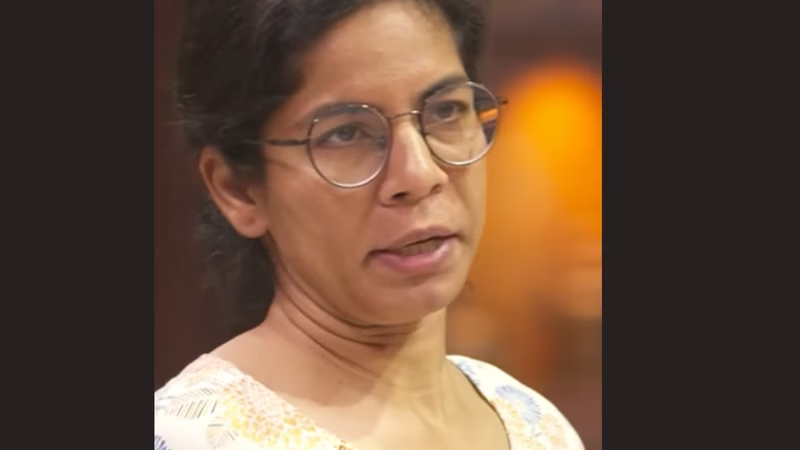
From Tremors to Tasting Menus: The Unstoppable Rise of Manisha Sharma
In a world where reality TV often thrives on drama and conflict, Manisha Sharma MasterChef stands out—not for fiery arguments or kitchen tantrums, but for quiet strength, unwavering focus, and a story that has moved viewers to tears. Hailing from Udaipur, this young chef isn’t just competing for a title; she’s redefining what’s possible in the face of a life-altering diagnosis: secondary Parkinson’s disease at the age of 14 .
While most teenagers worry about exams and friendships, Manisha was learning to steady her hands, manage involuntary tremors, and navigate a condition typically associated with the elderly. But rather than let it define her, she found an unexpected ally—cooking. What began as a therapeutic escape has blossomed into a national platform, turning her into a symbol of hope, resilience, and the healing power of passion.
Table of Contents
- Who Is Manisha Sharma?
- A Rare Diagnosis at 14: Understanding Secondary Parkinson’s
- How Cooking Became Her Lifeline and Therapy
- Manisha Sharma MasterChef: Calm, Confident, and Captivating
- Public and Medical Community’s Response
- What Her Story Teaches Us About Resilience
- Conclusion: More Than a Contestant—A Beacon
- Sources
Who Is Manisha Sharma?
Manisha Sharma is a 20-year-old culinary enthusiast from Udaipur, Rajasthan, whose journey to the MasterChef India kitchen began long before the cameras rolled. Raised in a supportive family, she discovered her love for food while helping her grandmother prepare traditional Rajasthani dishes. But her path took a dramatic turn when, at just 14, she started experiencing unexplained tremors, muscle rigidity, and fatigue.
After months of tests, doctors delivered a shocking diagnosis: secondary Parkinsonism—a rare form of Parkinson’s triggered not by neurodegeneration (as in typical Parkinson’s) but by factors like brain injury, toxins, or certain medications . For a young girl with dreams of becoming a chef, the news was devastating.
A Rare Diagnosis at 14: Understanding Secondary Parkinson’s
Primary Parkinson’s disease affects about 1% of people over 60, but onset before age 21—called juvenile Parkinsonism—is extremely rare, accounting for less than 5–10% of all cases . Secondary Parkinsonism, which mimics Parkinson’s symptoms but has a different root cause, is even more uncommon in adolescents.
Symptoms include:
- Tremors in hands, arms, or legs
- Slowed movement (bradykinesia)
- Muscle stiffness
- Balance and coordination issues
For someone aspiring to be a chef—where precision, speed, and fine motor control are essential—these symptoms posed a seemingly insurmountable challenge.
How Cooking Became Her Lifeline and Therapy
Instead of retreating, Manisha leaned into her passion. “Cooking gave me control,” she shared in a recent interview. “When my body wouldn’t listen, my mind could still create something beautiful on a plate.”
She began using cooking as a form of occupational therapy:
- Fine motor practice: Chopping, stirring, and plating helped improve hand-eye coordination.
- Routine and structure: Meal prep provided daily rhythm, crucial for managing neurological symptoms.
- Emotional outlet: Creating dishes became a way to express joy, grief, and hope without words.
Her family converted their kitchen into a safe space—non-slip mats, ergonomic tools, and extra lighting—so she could cook independently and safely.
Manisha Sharma MasterChef: Calm, Confident, and Captivating
On MasterChef India, Manisha doesn’t mention her condition unless asked. Yet, her presence speaks volumes. While others rush and panic, she moves with deliberate grace. Her dishes—often rooted in Rajasthani flavors with modern twists—reflect her philosophy: “Food should comfort, not complicate.”
Judges have praised her for “culinary maturity beyond her years” and “emotional intelligence on the plate.” One standout moment came when she recreated her grandmother’s dal-baati-churma, dedicating it to “the woman who taught me that love is the secret ingredient.”
Her performance has sparked conversations about disability representation in media and the untapped potential of neurodiverse individuals in high-pressure creative fields.
Public and Medical Community’s Response
Manisha’s story has gone viral on social media, with hashtags like #ManishaSharmaStrong and #CookingWithCourage trending nationwide. Neurologists and therapists have also lauded her approach.
“Her use of cooking as active therapy is textbook-perfect,” says Dr. Anjali Mehta, a neurologist at AIIMS. “Engaging in meaningful, goal-directed activities can significantly slow functional decline in movement disorders” .
Organizations like the Parkinson’s Disease Society of India have reached out to feature her in awareness campaigns, hoping to inspire other young patients.
What Her Story Teaches Us About Resilience
Manisha’s journey offers profound lessons:
- Passion is medicine: Purpose-driven activity can be as therapeutic as any pill.
- Disability ≠ inability: With adaptation and support, barriers can become bridges.
- Quiet strength matters: You don’t need to shout to be heard—sometimes, a perfectly plated dish speaks loudest.
For parents of children with chronic illnesses, her story is a beacon: nurture their interests, not just their diagnoses.
Conclusion: More Than a Contestant—A Beacon
The Manisha Sharma MasterChef phenomenon is about far more than winning a trophy. It’s about proving that limitations are often external—and that the human spirit, when fueled by love and purpose, can transform even the most daunting challenges into sources of beauty. Whether she lifts the MasterChef crown or not, Manisha has already won something greater: the hearts of a nation and the admiration of everyone who believes in second chances.
Sources
- Times of India: Original Article
- National Institute of Neurological Disorders and Stroke (NINDS): Parkinson’s Disease Information
- Parkinson’s Foundation: Juvenile & Young-Onset Parkinson’s
- AIIMS Neurology Department: Expert Commentary on Movement Disorders