Is a Handwritten Letter the Ultimate Act of Rebellion in the Age of DMs?
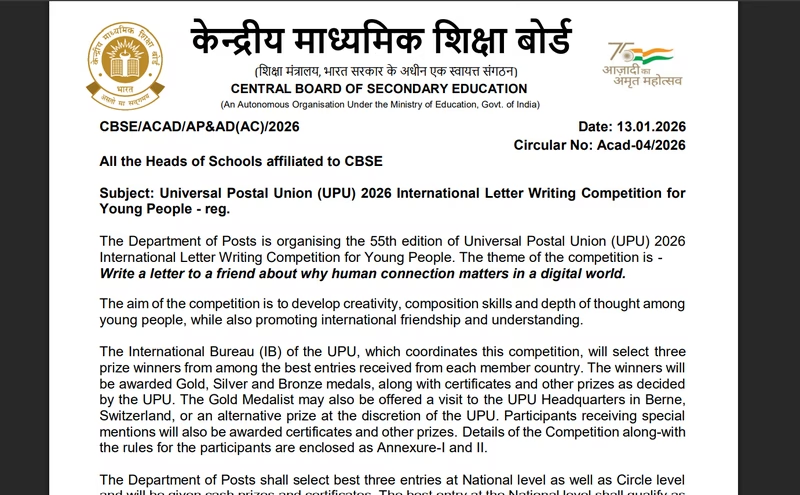
In a world dominated by tweets, reels, and disappearing messages, the Central Board of Secondary Education (CBSE) is making a bold move: it’s asking students to pick up a pen and write a letter. Not an email. Not a WhatsApp note. A real, heartfelt, handwritten letter for the UPU 2026 letter writing competition .
Organized globally by the Universal Postal Union (UPU) and locally by India’s Department of Posts, this prestigious contest—now in its 55th year—challenges young minds to reflect on a timely and poignant theme: “Why does human connection matter in a digital world?” It’s more than a writing exercise; it’s a call to rediscover empathy, depth, and authenticity in an era of fleeting online interactions.
Table of Contents
- What Is the UPU Letter Writing Competition?
- Decoding the 2026 Theme: Human Connection vs. Digital Noise
- UPU 2026 letter writing competition: Who Can Enter & Key Rules
- Step-by-Step Guide to Participate via CBSE
- Judging Criteria and Prizes: From School to Global Stage
- 5 Expert Tips to Craft a Winning Letter
- Why This Competition Matters More Than Ever
- Conclusion: Your Pen, Your Power
- Sources
What Is the UPU Letter Writing Competition?
Launched in 1972, the UPU International Letter Writing Competition is one of the world’s longest-running youth contests. Open to children under 16 in over 190 countries, it aims to promote literacy, creative expression, and cross-cultural understanding through the timeless art of letter writing .
Each year, a new theme is announced by the UPU in Bern, Switzerland. National postal operators—like India’s Department of Posts—coordinate entries at the country level. The best national entry is then sent to UPU headquarters for international judging. Past Indian winners have seen their letters published globally and even received by heads of state.
Decoding the 2026 Theme: Human Connection vs. Digital Noise
The 2026 prompt—“Why does human connection matter in a digital world?”—couldn’t be more relevant. Students are growing up in a paradox: hyper-connected online, yet often lonely offline. The competition invites them to explore questions like:
- Can a video call replace a hug from a grandparent?
- Does a ‘like’ carry the same weight as a handwritten birthday note?
- How do we preserve genuine relationships when algorithms curate our social circles?
This isn’t about rejecting technology—it’s about reclaiming intentionality in how we relate to one another.
UPU 2026 letter writing competition: Who Can Enter & Key Rules
Here’s what CBSE-affiliated schools and students need to know:
- Eligibility: Students up to Class 10 (born on or after January 1, 2010).
- Word Limit: Maximum 800 words in English or Hindi.
- Format: Must be written as a personal letter (with date, address, salutation, body, and closing).
- Originality: Plagiarism leads to immediate disqualification.
- Submission: Through school only—individual entries are not accepted.
Schools must conduct internal screening and submit their top entry to CBSE by the deadline (expected in March 2026; confirm via official circular) .
Step-by-Step Guide to Participate via CBSE
- Check with your school: Ensure your institution is registered with CBSE for the contest.
- Write your letter: Focus on personal stories, emotions, and original insights.
- Get it reviewed: Ask your English teacher for feedback on structure and language.
- School selection: Your school will hold internal judging to pick its best entry.
- National submission: The school forwards the winning letter to CBSE/Department of Posts.
For inspiration, read past winning letters on the [INTERNAL_LINK:best-upu-letter-examples] page.
Judging Criteria and Prizes: From School to Global Stage
Letters are judged on:
- Originality of ideas
- Clarity and coherence
- Emotional impact
- Adherence to letter format
- Language proficiency
Prizes:
- National Level: Certificates, medals, and potential feature in DoP publications.
- International Level: The global winner receives a medal, certificate, and a trip to UPU headquarters in Switzerland. Their letter is translated into multiple languages and shared worldwide .
5 Expert Tips to Craft a Winning Letter
- Start with a story: “Last Diwali, my Nani wrote me a letter…” is more powerful than abstract theory.
- Be vulnerable: Share a moment of loneliness or connection that feels real.
- Use sensory details: Describe the smell of old paper, the sound of tearing an envelope.
- Address a real person: Write to a friend, family member, or even your future self.
- Edit ruthlessly: Cut fluff. Every sentence should serve emotion or insight.
Why This Competition Matters More Than Ever
In an age where AI writes essays and bots generate content, the UPU contest reaffirms a fundamental truth: human voices matter. Writing by hand slows us down, deepens reflection, and builds neural pathways that typing cannot replicate . For educators, it’s a tool to nurture emotional intelligence alongside literacy.
Moreover, as UNESCO notes, letter writing preserves linguistic diversity and cultural heritage—a mission more urgent than ever in a homogenized digital landscape .
Conclusion: Your Pen, Your Power
The UPU 2026 letter writing competition is more than a contest—it’s an invitation to pause, reflect, and connect. In 800 words, a student can challenge the status quo, heal a relationship, or inspire a nation. So, grab a sheet of paper. Find a quiet corner. And remind the world that in the race for attention, sometimes the slowest medium carries the loudest message.
Sources
- Times of India: Original Article
- Universal Postal Union (UPU): Official Competition Page
- Department of Posts, India: National Coordinator
- UNESCO on Literacy: Literacy and Cultural Expression