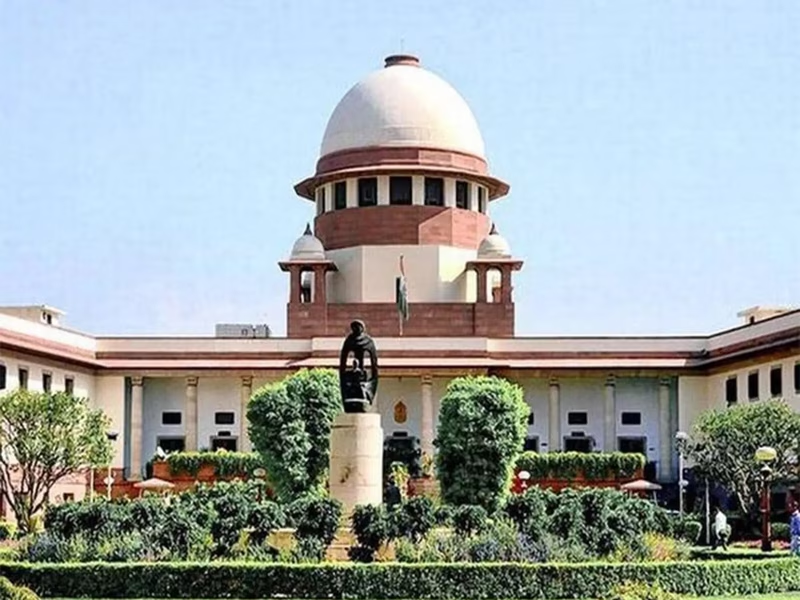
Supreme Court Takes a Hard Line on ED vs Mamata Banerjee Standoff
In a dramatic escalation of the ongoing political-legal battle in West Bengal, the Supreme Court of India has taken a firm stance on the ED vs Mamata Banerjee controversy. The apex court, visibly disturbed by events at the Calcutta High Court, has labeled the Enforcement Directorate’s (ED) allegations against the Chief Minister as “serious” and has ordered an urgent hearing of the agency’s plea .
The core of the dispute revolves around the ED’s investigation into alleged coal pilferage and money laundering, which led to raids on the Indian Political Action Committee (I-PAC), a key strategic partner of the Trinamool Congress (TMC). The ED claims that its statutory powers were obstructed by none other than the state’s top executive, setting a dangerous precedent for the rule of law.
Table of Contents
- What Are the Core Allegations?
- The Calcutta High Court Drama
- Supreme Court’s Strong Response
- The Wider Political Fallout
- What Happens Next?
- Conclusion: A Test for Federal Balance
- Sources
What Are the Core Allegations?
The Enforcement Directorate’s case is built on a series of explosive claims. Appearing before the Supreme Court bench of Justices Prashant Kumar Mishra and Vipul Pancholi, Solicitor General Tushar Mehta, representing the ED, argued that this was not an isolated incident. He stated that historically, “whenever statutory authorities exercised statutory power, [Mamata] Banerjee barged in and interfered” .
The specific trigger for the current legal battle was the ED’s search operation at the offices of I-PAC. The agency alleges that during this lawful process, they faced significant obstruction from state authorities acting on the CM’s directives. The ED has gone a step further, seeking a CBI probe into 17 separate offences against Mamata Banerjee, including evidence tampering and issuing threats to its officers .
The Calcutta High Court Drama
The immediate catalyst for the Supreme Court’s intervention was the handling of the matter at the Calcutta High Court. The TMC had filed a petition challenging the legality of the ED’s raids on I-PAC. However, in a surprising turn, the High Court disposed of the TMC’s plea without a detailed hearing on the merits of the case .
This disposal left the ED in a precarious position, as it felt its operational autonomy and the integrity of its investigation were under direct threat from the highest office in the state. The agency perceived the Calcutta HC’s actions as part of a broader pattern of political interference designed to shield the ruling party from scrutiny .
ED vs Mamata Banerjee: A ‘Serious’ Matter for the Apex Court
Faced with these developments, the Supreme Court did not mince words. The bench explicitly stated it was “disturbed by what happened in the Calcutta High Court,” signaling its deep unease with the potential erosion of investigative independence . By calling the ED’s allegations “serious,” the Court has effectively elevated the case from a routine administrative dispute to a matter of constitutional importance concerning the separation of powers.
This strong language from the SC is a clear message to all state governments: interference with central agencies conducting lawful investigations will be met with the highest level of judicial scrutiny. It underscores the principle that no one, not even a Chief Minister, is above the law.
The Wider Political Fallout
This legal tussle is unfolding against a backdrop of intense political rivalry between the TMC and the BJP. The I-PAC, as a strategic consultancy, has been instrumental in the TMC’s electoral successes, making it a high-value target for the opposition. The ED’s investigation is widely seen as part of a larger political strategy by the central government.
For Mamata Banerjee, the stakes are incredibly high. A finding of obstruction could severely damage her image as a champion of federalism and states’ rights—a key plank of her national political platform. Conversely, if she can successfully portray the ED’s actions as politically motivated harassment, it could galvanize her support base in West Bengal and beyond.
What Happens Next?
The Supreme Court has scheduled a detailed hearing of the ED’s plea, which means the legal battle is far from over. Key questions that the Court will likely address include:
- Did the actions of the West Bengal government constitute unlawful interference in a central agency’s investigation?
- What is the appropriate balance between a state government’s authority and the operational freedom of central investigative bodies?
- Is there sufficient prima facie evidence to warrant a CBI probe into the Chief Minister’s conduct?
The outcome of this case will have far-reaching implications, not just for West Bengal but for the entire federal structure of India. It will set a critical precedent for how similar conflicts are resolved in the future.
Conclusion: A Test for Federal Balance
The ED vs Mamata Banerjee case is more than a political slugfest; it is a fundamental test of India’s democratic institutions. The Supreme Court’s decision to take the allegations seriously is a crucial step in upholding the rule of law. As the hearings progress, the nation will be watching closely to see whether the judiciary can effectively mediate between the competing claims of state autonomy and central investigative authority. For now, the ball is firmly in the Supreme Court’s court.
Sources
- Times of India: Original Article
- Web Search Results: , , , ,
- Supreme Court of India: https://main.sci.gov.in/