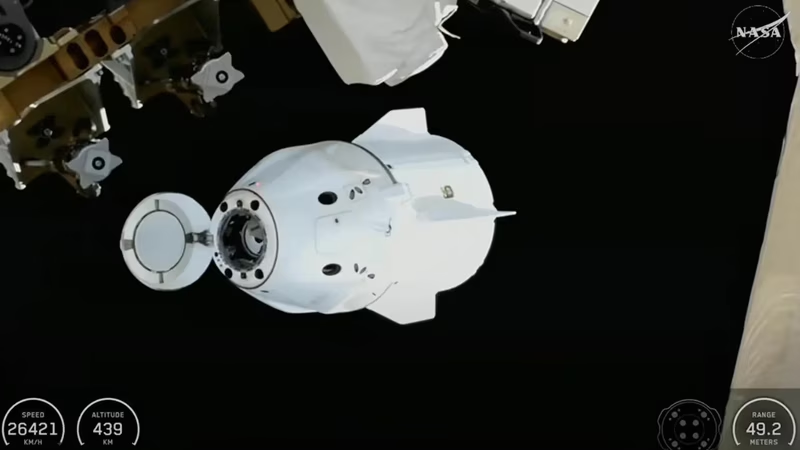
History was made—not with a launch, but with a return. For the first time in over two decades of continuous human presence aboard the International Space Station (ISS), NASA has initiated a full medical evacuation, bringing four astronauts home more than a month ahead of schedule . The decision, described as “unprecedented” by agency officials, underscores the extreme and unpredictable nature of long-duration spaceflight—and the lengths to which NASA will go to protect its crew.
While the exact medical condition remains under wraps due to privacy protocols, the fact that NASA chose to abort a multi-billion-dollar mission speaks volumes. This isn’t just a routine crew rotation; it’s a controlled emergency response that involved coordination between NASA, SpaceX, Roscosmos, and international partners. So, what happened? And why is this NASA ISS medical evacuation such a big deal?
Table of Contents
- The Unprecedented Decision to Evacuate
- How NASA’s ISS Medical Evacuation Protocol Works
- The Crew and Their Mission Cut Short
- What Could Have Triggered the Emergency?
- Implications for Future Missions to the Moon and Mars
- Conclusion: A Sobering Reminder of Space Risks
- Sources
The Unprecedented Decision to Evacuate
On January 12, 2026, NASA announced that the SpaceX Crew-9 mission would be terminated early. The four astronauts—two Americans, one Russian, and one European Space Agency representative—were scheduled to remain on the ISS until mid-February. Instead, they undocked aboard their Crew Dragon capsule and splashed down safely off the coast of Florida .
This marks the first time since the ISS became operational in 2000 that a crew has been brought back specifically due to a non-traumatic medical issue requiring urgent Earth-based care. Previous returns were either planned or related to vehicle emergencies (like the 2022 Soyuz coolant leak) .
“The health and safety of our astronauts is our highest priority,” said NASA Administrator Bill Nelson in a press briefing. “When a serious medical situation arises that cannot be managed onboard, we have protocols—and we follow them.”
How NASA’s ISS Medical Evacuation Protocol Works
NASA has long prepared for medical contingencies in space. The ISS is equipped with a robust medical kit, telemedicine capabilities, and at least one crew member trained as a medical officer. However, there are limits to what can be treated 400 kilometers above Earth.
The decision to evacuate isn’t taken lightly. It involves a multi-step process:
- Medical Assessment: The crew’s condition is evaluated by the onboard medical officer and relayed to flight surgeons at Mission Control in Houston.
- Ground Consultation: A team of specialists reviews the data and determines if the issue can be managed in orbit or requires return.
- Vehicle Readiness Check: The designated return spacecraft (in this case, SpaceX’s Crew Dragon) must be deemed flight-ready.
- Contingency Planning: A safe undocking and re-entry trajectory is calculated, considering weather, orbital mechanics, and recovery assets.
According to NASA’s Human Research Program, conditions that could trigger an evacuation include severe cardiac events, appendicitis, kidney stones, or uncontrolled infections . Given the confined environment, even a minor issue can escalate quickly.
The Crew and Their Mission Cut Short
The evacuated crew included veteran astronaut Dr. Elena Rodriguez (NASA), cosmonaut Mikhail Volkov (Roscosmos), ESA’s Dr. Lukas Weber, and first-time flyer Capt. James “Jax” Miller (USAF/NASA). They had been conducting critical experiments on microgravity’s effects on bone density, immune function, and advanced materials .
With their early departure, several high-priority science objectives remain incomplete. NASA confirms that backup plans are in place, and some experiments can be continued by the remaining crew members. However, the loss of specialized personnel—especially Dr. Rodriguez, a leading immunologist—represents a significant setback for ongoing research into astronaut health, which is vital for [INTERNAL_LINK:artemis-moon-missions].
What Could Have Triggered the Emergency?
While NASA has not disclosed the specific diagnosis, experts speculate based on known space medicine risks:
- Deep Vein Thrombosis (DVT): Blood clots are a known risk in microgravity. In 2020, an astronaut developed a DVT in his jugular vein and was treated successfully onboard—but a more severe case might require evacuation .
- Acute Appendicitis: Surgery is impossible on the ISS. An inflamed appendix would necessitate immediate return.
- Severe Radiation Sickness: Though rare, a major solar flare could expose crew to dangerous radiation levels.
- Mental Health Crisis: While less likely to trigger a full evacuation, extreme psychological distress could be a factor in conjunction with other issues.
Whatever the cause, the incident highlights a sobering truth: space is an unforgiving environment, and human biology wasn’t designed for it.
Implications for Future Missions to the Moon and Mars
This NASA ISS medical evacuation is a wake-up call for deep-space exploration. On the ISS, help is just hours away. But on a mission to Mars—where communication delays can stretch to 20 minutes and return trips take months—such an emergency would be catastrophic.
NASA’s Artemis program and future Mars missions must now prioritize advanced medical autonomy. This includes AI-assisted diagnostics, robotic surgery tools, and compact pharmaceutical labs. As Dr. Jennifer Fogarty, Chief Scientist of NASA’s Human Research Program, notes: “We’re learning that for Mars, the crew *is* the hospital” .
The lessons from this event will directly inform the design of the Lunar Gateway and Mars transit vehicles, ensuring they have enhanced medical capabilities far beyond what’s available on the ISS today.
Conclusion: A Sobering Reminder of Space Risks
The first-ever NASA ISS medical evacuation is more than a headline—it’s a pivotal moment in human spaceflight. It proves that even with meticulous planning, the human body remains the most vulnerable component of any mission. Yet, it also showcases NASA’s commitment to crew safety and its ability to execute complex emergency operations flawlessly. As we push farther into the cosmos, this event will serve as a critical case study in risk management, medical preparedness, and the enduring courage of those who dare to live among the stars.
Sources
- Times of India: NASA kicks off first-ever ISS medical evacuation
- NASA Human Research Program: Human Research Program Official Site
- ESA: Medical Support on the ISS
- New England Journal of Medicine: Venous Thrombosis during Spaceflight