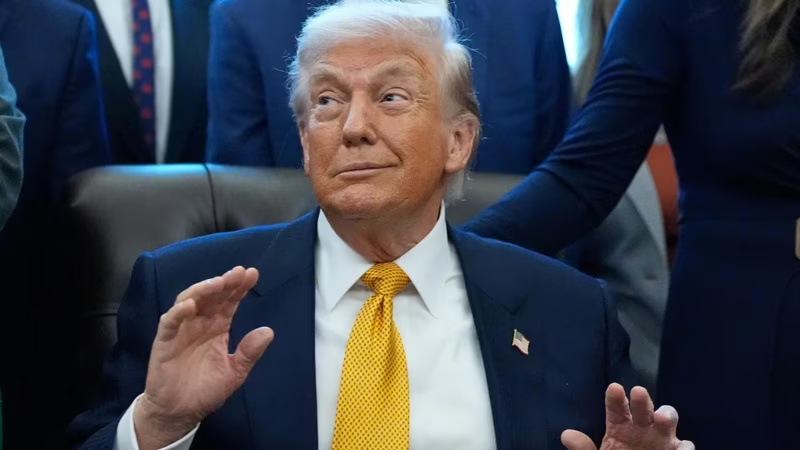
It’s back. The idea that once drew global ridicule—and serious concern—is resurfacing with renewed vigor. Former President Donald Trump has again floated the notion of the United States acquiring Greenland, this time framing it not as a real estate deal but as a critical national security imperative. In a recent statement, Trump declared, “Something will work out,” suggesting that American control over the world’s largest island isn’t just desirable—it’s necessary .
This isn’t the first time Trump has expressed interest in Greenland. Back in 2019, his reported inquiry about purchasing the autonomous Danish territory sparked a diplomatic firestorm, with Denmark’s Prime Minister calling the idea “absurd.” Now, as he campaigns for a potential second term, Trump is reframing the conversation around defense, climate, and great-power competition—particularly with China and Russia. But what’s really at stake? And why does Trump Greenland keep coming up?
Table of Contents
- Why Trump Wants Greenland: A Strategic Primer
- The Trump Greenland Saga: A Brief History
- Greenland’s Geopolitical Value in the Arctic Race
- Denmark’s Firm Stance on Sovereignty
- Public and Expert Reactions to Trump’s Latest Comments
- Conclusion: Is Greenland the Next Frontier of U.S. Power?
- Sources
Why Trump Wants Greenland: A Strategic Primer
At first glance, Greenland—a sparsely populated island of ice, fjords, and indigenous Inuit communities—might seem like an odd obsession for a U.S. president. But beneath its frozen surface lies immense strategic value:
- Military Positioning: The U.S. already operates the Thule Air Base in northern Greenland, a key site for missile warning and space surveillance. Full control could expand U.S. defense capabilities in the High North.
- Arctic Resources: Greenland is believed to hold vast reserves of rare earth minerals, oil, and natural gas—resources critical for green tech and national defense .
- Countering China & Russia: Both nations have shown growing interest in the Arctic. China calls itself a “near-Arctic state” and has invested in Greenlandic infrastructure. Russia has militarized its Arctic coastline. Trump argues the U.S. can’t afford to fall behind .
“We need Greenland for national security,” Trump recently stated, echoing concerns shared by some defense analysts—even if his proposed solution (buying it) remains highly unconventional .
The Trump Greenland Saga: A Brief History
The Trump Greenland narrative began in August 2019, when reports surfaced that he had repeatedly asked aides about the feasibility of purchasing the island. He saw it as a “large real estate deal” and was reportedly frustrated when told it wasn’t for sale .
The backlash was swift. Denmark, which handles Greenland’s foreign and defense policy, called the idea “completely ridiculous.” The then-Prime Minister, Mette Frederiksen, canceled Trump’s planned state visit. Trump retaliated by saying Denmark was “not treating the U.S. properly” .
Now, five years later, Trump is reviving the idea—but with a more sober, security-focused justification. This shift reflects a broader trend in U.S. foreign policy: the Arctic is no longer a frozen frontier but a new arena of global competition.
Greenland’s Geopolitical Value in the Arctic Race
Climate change is rapidly transforming the Arctic. Melting ice is opening new shipping lanes and making resource extraction feasible. As a result, the region has become a focal point for strategic rivalry.
The U.S. Department of Defense’s 2024 Arctic Strategy explicitly identifies Greenland as vital to American interests. It notes that “secure access to Greenland enhances our ability to project power and monitor threats” . While the report stops short of advocating acquisition, it underscores the island’s irreplaceable role.
Meanwhile, China’s attempts to buy a former naval base in Greenland were blocked by Copenhagen in 2018 over security concerns—a clear signal that great-power competition has reached the Arctic . Trump’s comments may be blunt, but they tap into a real and growing anxiety within U.S. security circles.
Denmark’s Firm Stance on Sovereignty
Despite Greenland’s push for greater autonomy—and even eventual independence—Denmark remains unequivocal: Greenland is not for sale. Danish officials stress that any change in sovereignty must come from the Greenlandic people themselves, through democratic processes, not foreign purchase offers .
Greenland’s government has also made its position clear. While open to deeper cooperation with the U.S., especially on defense and climate, leaders reject any notion of becoming a U.S. territory. “We are not a commodity,” said one Greenlandic minister in 2019 .
This stance is backed by international law. The United Nations Charter upholds the territorial integrity of states, making forced or transactional annexation diplomatically untenable in the modern era.
Public and Expert Reactions to Trump’s Latest Comments
Reactions to Trump’s renewed interest have been mixed. Supporters see it as bold, forward-thinking leadership. Critics call it neo-colonialist fantasy.
Foreign policy experts are divided. Some, like Dr. Rebecca Pincus of the Wilson Center, acknowledge Greenland’s strategic importance but argue that “partnership, not possession, is the path forward” . Others worry that such rhetoric damages U.S. credibility with NATO allies like Denmark at a time when unity against Russian aggression is crucial.
On social media, the topic has reignited debate, with hashtags like #NotForSale trending among Greenlandic users—a powerful reminder that the people most affected have a voice in this story.
Conclusion: Is Greenland the Next Frontier of U.S. Power?
The Trump Greenland fixation may sound outlandish, but it points to a deeper truth: the Arctic is becoming central to 21st-century geopolitics. While purchasing Greenland remains legally and politically impossible, the U.S. is likely to double down on its existing partnership—expanding the Thule Air Base, investing in infrastructure, and countering Chinese influence through diplomacy and aid.
Trump’s blunt language may be controversial, but his underlying concern isn’t unfounded. The question isn’t whether Greenland matters—it’s how the U.S. can engage with it ethically, respectfully, and effectively. For more on U.S. Arctic strategy, see our deep dive on [INTERNAL_LINK:us-arctic-policy-explained].
Sources
- Times of India: Greenland dispute: Donald Trump says ‘something will work out’, cites ‘need’ for ‘national security’
- U.S. Department of Defense: 2024 Department of Defense Arctic Strategy
- Council on Foreign Relations: Why Greenland Matters for U.S. Foreign Policy
- Wilson Center: The Arctic: Great Power Competition