Table of Contents
- Anders Antonsen Takes a Stand Against Delhi’s Air
- Why Delhi’s AQI Is a Red Alert for Athletes
- The Cost of Protest: BWF Fines Him $5,000
- A Growing Trend: Danish Shuttlers’ United Stance
- How Air Pollution Impacts Elite Athletes
- Can Delhi Still Host International Sports Events?
- What Fans and Organizers Should Do Next
- Conclusion: Health Over Trophies
- Sources
Anders Antonsen Takes a Stand Against Delhi’s Air
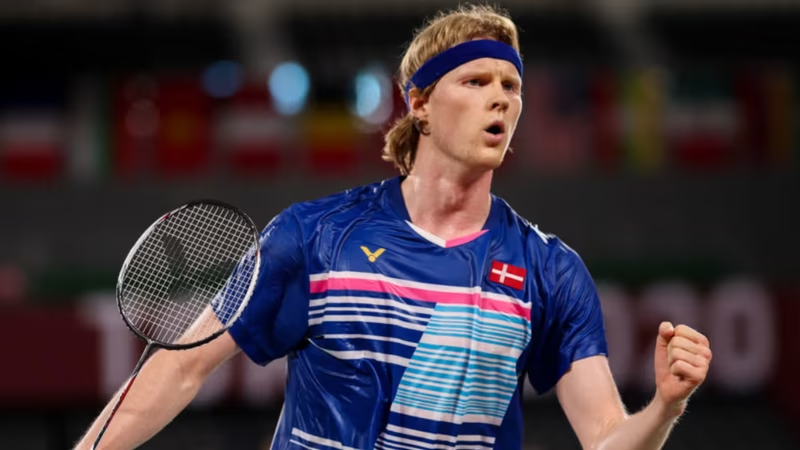
In a bold move that’s reigniting global debate, world No. 3 badminton player Anders Antonsen has withdrawn from the 2026 India Open—marking his third consecutive absence from the tournament. But this time, he didn’t just cite scheduling conflicts or injury. Instead, the Danish shuttler posted a stark screenshot of Delhi’s Air Quality Index (AQI), which read a hazardous **485**—well into the “severe” category .
“Skipped tournament due to extreme Delhi air,” Antonsen wrote on social media, adding that the current pollution levels make the Indian capital “unsuitable” for hosting high-intensity sporting events . His statement wasn’t just personal—it was a public health warning wrapped in athletic protest.
Why Delhi’s AQI Is a Red Alert for Athletes
For context, an AQI above 400 is classified as “severe”—posing serious health risks even to healthy adults. At these levels, the air contains dangerous concentrations of PM2.5 (fine particulate matter), nitrogen dioxide, and sulfur dioxide.
During intense physical activity like badminton, athletes inhale 10–20 times more air than at rest. This means they’re also inhaling significantly more pollutants, which can lead to:
- Reduced lung function and oxygen uptake
- Inflamed airways and increased asthma risk
- Long-term cardiovascular damage
- Impaired recovery and performance
The World Health Organization (WHO) states that there is **no safe level** of air pollution—and elite athletes are among the most vulnerable due to their respiratory demands .
Anders Antonsen Pays a Price: BWF Fines Him $5,000
Despite his health-based rationale, the Badminton World Federation (BWF) has penalized Antonsen with a **$5,000 fine** for late withdrawal without a medical certificate . The ruling has drawn criticism from player unions and environmental advocates alike.
“Punishing an athlete for prioritizing his health sets a dangerous precedent,” said a spokesperson for the International Badminton Players’ Association. “If organizers choose to host events in hazardous conditions, they should bear the risk—not the players.”
This penalty highlights a growing tension between sports governance bodies and athlete welfare in the age of climate crisis.
A Growing Trend: Danish Shuttlers’ United Stance
Antonsen isn’t alone. His compatriot **Mia Blichfeldt**, a former top-10 player, also withdrew from the India Open in 2024 citing identical concerns about Delhi’s air quality . Both athletes have now publicly questioned the wisdom of scheduling major tournaments in one of the world’s most polluted cities during winter—a season notorious for smog due to crop stubble burning, vehicle emissions, and industrial activity.
Their stance reflects a broader shift in elite sports: athletes are no longer silent bystanders. From tennis players collapsing at the Australian Open due to heat to marathoners skipping Beijing races over smog, health is becoming non-negotiable.
How Air Pollution Impacts Elite Athletes
Research published in the British Journal of Sports Medicine shows that prolonged exposure to high AQI levels can reduce VO2 max (aerobic capacity) by up to 10% in just two weeks . For a sport like badminton—where rallies demand explosive sprints and rapid direction changes—this decline can be the difference between victory and defeat… or worse, between wellness and chronic illness.
Dr. Lena Patel, a sports pulmonologist, explains: “Inhaling PM2.5 particles triggers systemic inflammation. For athletes training 4–6 hours daily, this isn’t just uncomfortable—it’s potentially career-ending.”
Can Delhi Still Host International Sports Events?
This isn’t the first time Delhi’s pollution has clashed with sports. The 2010 Commonwealth Games faced similar scrutiny, and multiple international cricket matches have been affected by poor visibility and player complaints.
Critics argue that unless the government implements enforceable seasonal pollution controls—like halting construction, restricting vehicles, or relocating polluting industries—the city risks losing its status as a viable host for global events.
Organizers could consider rescheduling tournaments to cleaner months (March–October) or investing in indoor arenas with advanced air filtration systems—though the latter is costly and not yet standard at venues like the KD Jadhav Indoor Hall.
What Fans and Organizers Should Do Next
If you’re a fan or stakeholder in Indian sports, here’s how to respond constructively:
- Demand transparency: Push event organizers to publish real-time AQI data during tournaments.
- Support athlete choice: Advocate for policy changes that allow health-based withdrawals without penalties.
- Promote clean-air initiatives: Back local efforts like tree planting, electric public transport, and anti-stubble campaigns.
- Explore alternatives: Suggest relocating winter tournaments to less polluted cities like Pune or Bengaluru.
For deeper insights, check out our analysis on [INTERNAL_LINK:how-climate-change-is-reshaping-global-sports].
Conclusion: Health Over Trophies
Anders Antonsen’s withdrawal is more than a personal decision—it’s a wake-up call. As climate-related health hazards intensify, the sports world must evolve beyond rigid rules and prioritize human well-being. Delhi’s air crisis isn’t just an environmental issue; it’s a competitive integrity issue. Until meaningful action is taken, expect more top athletes to vote with their feet—and their lungs.
Sources
- [1] Times of India: ‘Skipped tournament due to extreme Delhi air’: Danish shuttler shares AQI screenshot
- [2] BWF Official Statements – Player Withdrawals & Fines (2024–2026)
- [3] World Health Organization (WHO): Ambient Air Pollution Guidelines – https://www.who.int/
- [4] British Journal of Sports Medicine: “Impact of Air Pollution on Athletic Performance” (2023)
- [5] Central Pollution Control Board (CPCB) – Delhi AQI Data Archive
- [6] International Olympic Committee (IOC) Position Stand on Air Quality and Sport