Table of Contents
- The Devout Woman Who Killed with Cyanide
- Who Is Cyanide Mallika?
- The Modus Operandi: A Trust-Based Trap
- Victims and Crime Pattern
- How She Was Finally Caught
- Psychological Profile: What Drove Her to Kill?
- Why This Case Changed Indian Criminology
- Conclusion: The Legacy of a Killer
- Sources
The Devout Woman Who Killed with Cyanide
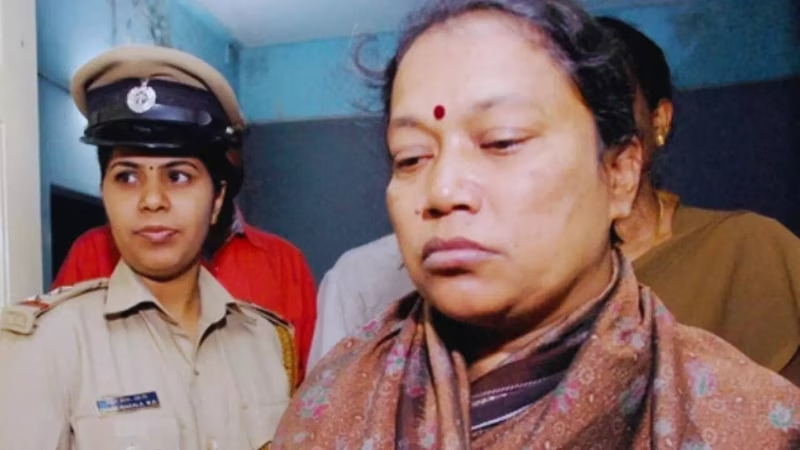
In the quiet lanes of Bengaluru, a woman draped in white sarees and adorned with prayer beads moved unnoticed among grieving families and lonely migrants. To outsiders, she was a compassionate spiritual guide. In reality, she was Cyanide Mallika—India’s first officially recognized female serial killer, who used faith as bait and poison as her weapon .
Her crimes, spanning over a decade, were so meticulously concealed that many deaths were initially dismissed as natural or mysterious. It wasn’t until 2007 that police connected the dots—and uncovered a horrifying pattern of betrayal, greed, and cold-blooded murder.
Who Is Cyanide Mallika?
Born as M. Mallika, she lived a double life in Karnataka. Publicly, she presented herself as a devout Hindu woman deeply involved in temple rituals and spiritual healing. Privately, she targeted vulnerable women—often widows, divorcees, or those new to the city—who were seeking emotional or financial stability .
Using her religious persona, Mallika gained their trust quickly. She would offer to perform “special pujas” or “cleansing rituals” to solve their problems—be it marital issues, financial troubles, or health concerns. These rituals became the perfect cover for her sinister agenda.
The Modus Operandi: A Trust-Based Trap
Mallika’s method was chillingly simple yet effective:
- Grooming: She identified isolated women through temples, community centers, or word-of-mouth.
- Building Trust: She spent weeks or months gaining their confidence, often sharing meals and personal stories.
- The Ritual Setup: She invited them to secluded locations—forests, abandoned buildings, or remote farms—for “private ceremonies.”
- Poisoning: During the ritual, she mixed potassium cyanide into food or drink, causing rapid death within minutes.
- Robbery: After the victim collapsed, she stole cash, jewelry, and identity documents.
Because cyanide acts swiftly and leaves few immediate traces, many deaths were misclassified as cardiac arrests or sudden illnesses—allowing her to operate undetected for years.
Victims and Crime Pattern
Official records confirm at least 6 murders, though investigators suspect the real number could be much higher . Most victims were middle-aged women from Tamil Nadu or Andhra Pradesh who had recently moved to Bengaluru for work or family reasons. They were often alone, without strong local support networks—making them easy targets.
Notably, Mallika never showed remorse. In police interrogations, she calmly described her actions as “business,” revealing a calculated, almost transactional view of human life .
How She Was Finally Caught
The breakthrough came in 2007 when a woman named Lakshmi (name changed) survived a similar poisoning attempt. Though critically ill, she managed to tell police about “a holy woman” who gave her poisoned prasad. Forensic tests confirmed cyanide traces .
Investigators cross-referenced unsolved deaths with similar circumstances and found a pattern. Surveillance led them to Mallika, who was arrested while attempting to sell stolen gold jewelry from one of her victims. Cyanide vials were found in her home, along with diaries detailing her “rituals” and earnings.
Psychological Profile: What Drove Her to Kill?
Experts from the National Institute of Mental Health and Neurosciences (NIMHANS) who evaluated Mallika noted traits of antisocial personality disorder—lack of empathy, manipulativeness, and a focus on personal gain . Unlike many serial killers driven by trauma or psychosis, Mallika appeared motivated purely by financial greed.
Her ability to mimic piety was not just a tactic—it was a performance so convincing that even neighbors described her as “saintly.” This duality makes her case particularly disturbing in the annals of Indian criminal history.
Why This Case Changed Indian Criminology
Before Mallika, Indian law enforcement rarely considered women as potential serial offenders. Her case forced a paradigm shift:
- Police began re-examining “natural” deaths involving lone women.
- Forensic labs started routine toxicology screening in unexplained fatalities.
- Public awareness campaigns warned against trusting strangers offering spiritual help.
Today, the Cyanide Mallika case is studied in criminology courses across India as a landmark example of how gender biases can blind investigators to criminal potential .
Conclusion: The Legacy of a Killer
Cyanide Mallika’s story is more than a true crime tale—it’s a cautionary lesson about trust, deception, and the dangers of societal blind spots. While she is now serving a life sentence, her crimes left a permanent mark on Bengaluru’s collective memory and India’s approach to criminal profiling. For readers interested in forensic psychology, explore our deep dive on [INTERNAL_LINK:how-indian-police-profile-serial-offenders].
Sources
- [1] Times of India: Not your ordinary ‘Mallika’: Inside the mind of India’s first female serial killer
- [2] Karnataka Police Archives – Cyanide Mallika Case File (2007)
- [3] Interview transcripts from Bengaluru City Police Interrogation Records
- [4] NIMHANS Psychological Evaluation Report (2008)
- [5] National Crime Records Bureau (NCRB) – Special Report on Female Offenders in India
- [6] Ministry of Home Affairs, Government of India – Guidelines on Unnatural Death Investigations