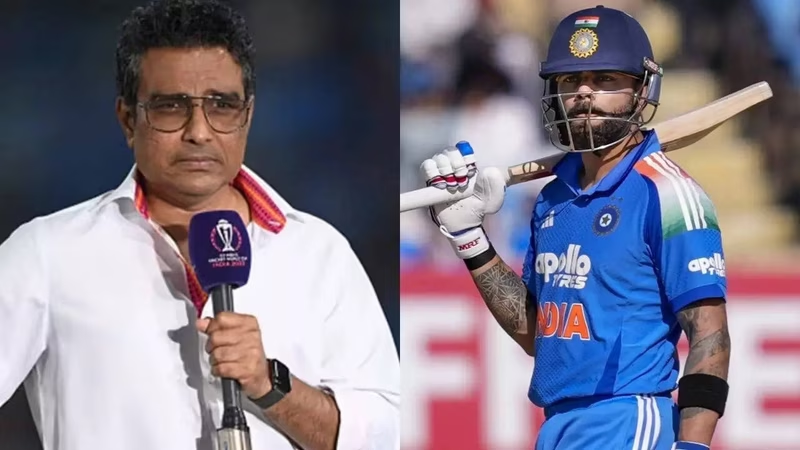
The cricketing world is no stranger to fiery debates, but when legendary off-spinner Harbhajan Singh steps into the ring to defend Virat Kohli, you know it’s serious. The controversy erupted after veteran commentator Sanjay Manjrekar suggested that Kohli was playing in the “easiest format” by continuing his ODI career while stepping back from Tests and T20Is. Harbhajan didn’t just disagree—he called the comment out as fundamentally flawed, sparking a much-needed conversation about the true difficulty of run-scoring in modern cricket.
Manjrekar’s remark came on the heels of Kohli’s masterful 93 against New Zealand—a knock that showcased his trademark grit, timing, and situational awareness. Yet, instead of praise, it drew condescension. Harbhajan, never one to mince words, fired back: “Scoring runs is never easy. Anyone who says otherwise clearly doesn’t understand the game.” This clash of perspectives cuts to the heart of how we value batting across formats—and whether the label of “easy ODI runs” holds any water .
Table of Contents
- The Controversy: Sanjay Manjrekar’s ‘Easy ODI Runs’ Claim
- Harbhajan Singh’s Fiery Defense of Virat Kohli
- Is Scoring Runs in ODIs Really Easy? A Data-Driven Look
- The Evolution of ODI Batting and Its Challenges
- Why Kohli’s Consistency Defies the ‘Easy’ Narrative
- Conclusion: Respect for the Craft Over Format Bias
- Sources
The Controversy: Sanjay Manjrekar’s ‘Easy ODI Runs’ Claim
Sanjay Manjrekar, known for his sharp critiques, recently opined that Virat Kohli’s decision to focus solely on ODIs reflects a strategic choice to play in the “least demanding” format. His argument implied that ODIs, with their 50-over structure and fielding restrictions, offer batters more time and fewer pressures compared to the intensity of T20s or the technical rigor of Test cricket .
While Manjrekar has a history of provocative commentary, this particular take ignored the nuanced realities of modern ODI cricket. It also overlooked Kohli’s specific role: anchoring innings under pressure, often in high-stakes chases where one mistake can end the match. Labeling such performances as “easy” not only undermines Kohli but diminishes the skill required to excel in this format.
Harbhajan Singh’s Fiery Defense of Virat Kohli
Harbhajan Singh, a World Cup winner and one of India’s most successful spinners, didn’t hold back. In a passionate response, he stated, “Virat Kohli is a match-winner in any format. To say ODIs are easy is to ignore the mental toughness, shot selection, and adaptability needed to score consistently against world-class bowlers.”
He went on to highlight Kohli’s record: over 13,000 ODI runs, 49 centuries, and an average above 57 in successful chases—the highest among all batters with 20+ innings . “These aren’t ‘easy’ numbers,” Harbhajan emphasized. “They’re the result of relentless hard work, discipline, and an obsession with excellence.” His defense wasn’t just emotional; it was rooted in facts and deep respect for the game’s demands.
Is Scoring Runs in ODIs Really Easy? A Data-Driven Look
Let’s examine the data:
- Strike Rate Pressure: Modern ODIs demand a balance between accumulation and acceleration. Batters must maintain a strike rate of 85+ while preserving wickets—a delicate act.
- Bowling Quality: Today’s ODI attacks feature express pace (Bumrah, Rabada), crafty spin (Rashid, Jadeja), and death-over specialists (Starc, Boult). There’s no “easy” phase.
- Field Restrictions: While powerplays help, the middle overs (11–40) often feature two spinners and tight fields, making run-scoring extremely difficult.
In fact, the global ODI batting average has hovered around 28–30 for the past decade—proof that consistent scoring remains a challenge .
The Evolution of ODI Batting and Its Challenges
ODI cricket has transformed dramatically since the 1990s. What was once a format of cautious accumulation is now a high-octane contest where batters face 150+ kph deliveries in the first over and yorkers in the last. The margin for error is razor-thin.
Moreover, pitch conditions vary wildly—from seaming tracks in New Zealand to slow turners in Sri Lanka. A batter like Kohli must constantly recalibrate his technique, mindset, and shot selection. This adaptability is anything but “easy.” As former captain Sourav Ganguly once noted, “ODI cricket tests your brain as much as your bat.”
Why Kohli’s Consistency Defies the ‘Easy’ Narrative
Kohli’s recent 93 against New Zealand wasn’t just a score—it was a masterclass in crisis management. Walking in at 35/2, he rebuilt the innings with Shreyas Iyer, rotating strike intelligently before accelerating in the final 10 overs. This is the hallmark of elite ODI batting: control under chaos.
His ability to perform in these situations—across continents, against varied attacks, for over a decade—cements his status as one of the greatest limited-overs batters ever. To reduce that legacy to “easy runs” is not just inaccurate; it’s dismissive of the sport’s complexity.
Conclusion: Respect for the Craft Over Format Bias
The debate over “easy ODI runs” misses the point entirely. Cricket, in any form, rewards skill, temperament, and resilience. Virat Kohli embodies all three. Harbhajan Singh’s rebuttal serves as a timely reminder: we should celebrate greatness, not diminish it with lazy labels. Whether in whites or colored kits, scoring runs at the highest level is never easy—and anyone who’s played the game knows it.
Sources
- The Times of India: Easy to score runs in ODIs? India legend slams Manjrekar for Kohli remark
- International Cricket Council (ICC): Official ODI Batting Rankings
- ESPNcricinfo Statsguru: Virat Kohli Career Statistics