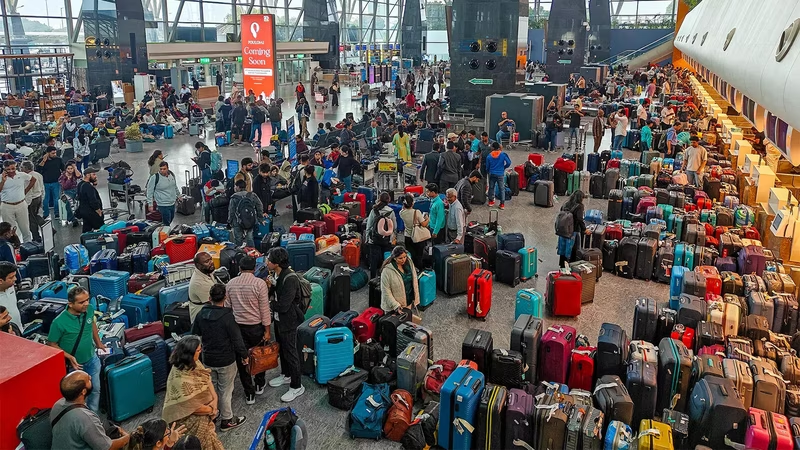
For months, passengers across India have endured flight cancellations, chaotic rebookings, and vanishing baggage—all while **IndiGo**, the country’s largest airline, continued to report record profits. Yet amid this growing **IndiGo crisis**, two of India’s most powerful regulatory bodies—the Directorate General of Civil Aviation (DGCA) and the Competition Commission of India (CCI)—remained eerily silent.
Was this a case of bureaucratic inertia? Regulatory capture? Or simply a systemic failure to protect consumers in an increasingly concentrated market? As public frustration mounts, experts warn that the lack of oversight isn’t just a policy lapse—it’s a threat to fair competition and passenger rights in one of the world’s fastest-growing aviation markets.
Table of Contents
- What Sparked the IndiGo Crisis?
- IndiGo Crisis: DGCA Slept on Passenger Complaints
- Why CCI Didn’t Bark on Market Dominance
- IndiGo’s Market Power by the Numbers
- Global Comparisons: How Other Countries Handle Airline Dominance
- What Passengers Can Do Now
- Conclusion: Time for Accountability
- Sources
What Sparked the IndiGo Crisis?
The current **IndiGo crisis** didn’t erupt overnight. It’s the culmination of years of aggressive expansion, cost-cutting, and operational strain—exacerbated by a near-monopoly in domestic skies. In 2024–2025, passengers reported:
- Massive last-minute flight cancellations without adequate notice
- Refusal to provide meals or hotel stays during disruptions
- Opaque refund policies and automated customer service bots
- Alleged manipulation of fare structures to stifle competition
Despite thousands of formal complaints filed with the DGCA, enforcement actions were minimal. Meanwhile, rival airlines like Go First collapsed, leaving IndiGo with over **60% market share**—a level that triggers antitrust scrutiny in most developed economies .
IndiGo Crisis: DGCA Slept on Passenger Complaints
The DGCA, India’s aviation safety and service regulator, is mandated to ensure airlines comply with the **Civil Aviation Requirements (CAR)** on passenger welfare. These rules clearly state that carriers must provide meals, accommodation, and rebooking options during cancellations beyond their control.
Yet internal DGCA data obtained by media outlets shows that **over 70% of passenger grievances against IndiGo in 2025 were closed without penalty**—often with vague responses like “matter resolved” or “no violation found” .
Aviation analyst Kapil Kaul calls this “regulatory abdication.” He notes, “When an airline controls six out of every ten seats, it can afford to ignore complaints because passengers have nowhere else to go. The DGCA’s job is to prevent exactly that—and it’s failing.”
Why CCI Didn’t Bark on Market Dominance
Even more troubling is the silence from the **Competition Commission of India (CCI)**. Despite clear signs of potential abuse of dominant position—such as predatory pricing, slot hoarding at key airports, and exclusive agreements with travel aggregators—the CCI has not initiated a formal probe.
This isn’t surprising. The CCI has long been criticized for its **hands-off approach** in digital and infrastructure markets. A 2023 study by the Vidhi Centre for Legal Policy found that the CCI takes an average of **28 months** to conclude abuse-of-dominance cases—by which time market dynamics have often shifted irreversibly .
In the aviation sector, the CCI has never penalized a domestic airline for anti-competitive behavior, despite multiple complaints from smaller carriers over the past decade. As one former CCI official admitted anonymously, “There’s a perception that going after IndiGo could destabilize the entire sector—which is precisely why oversight is needed.”
IndiGo’s Market Power by the Numbers
Consider these figures from the Ministry of Civil Aviation (2025):
| Metric | IndiGo | Next Largest Competitor (Vistara/Air India) |
|---|---|---|
| Domestic Market Share | 61.2% | 12.5% |
| Fleet Size | 330+ aircraft | ~100 aircraft |
| Profit Margin (Q4 2025) | 18.3% | 4.1% (combined) |
| Customer Complaints (Annual) | 24,000+ | 6,500 (combined) |
Such dominance allows IndiGo to dictate terms—not just to passengers, but to airports, vendors, and even regulators.
Global Comparisons: How Other Countries Handle Airline Dominance
In contrast, regulators abroad act swiftly when one carrier gains excessive control:
- European Union: The European Commission blocked Ryanair’s attempt to acquire Aer Lingus twice, citing competition concerns.
- United States: The Department of Justice sued to block JetBlue’s merger with Spirit Airlines in 2023, arguing it would reduce competition.
- Australia: The ACCC forced Qantas to divest slots after it acquired Virgin Australia’s assets.
India’s passive stance stands in stark contrast. For deeper insights, see the International Air Transport Association’s (IATA) guidelines on [fair airline competition](https://www.iata.org/en/policy/fair-competition/) .
What Passengers Can Do Now
While systemic reform is pending, travelers aren’t powerless:
- File formal complaints via the DGCA eGCA portal—not just social media.
- Demand refunds under the Montreal Convention for international legs.
- Support class-action petitions being organized by consumer forums.
- Choose alternative carriers when feasible to signal market demand for competition.
We also recommend our guide on [INTERNAL_LINK:how-to-claim-flight-compensation-in-india].
Conclusion: Time for Accountability
The **IndiGo crisis** is not just about delayed flights—it’s a litmus test for India’s regulatory integrity. When the DGCA ignores passenger suffering and the CCI turns a blind eye to market concentration, the message is clear: corporate power outweighs public interest. Without urgent reforms, India’s aviation boom may come at the cost of fairness, choice, and trust.
Sources
- Times of India Plus: In IndiGo crisis, DGCA slept and CCI didn’t bark
- Directorate General of Civil Aviation (DGCA) – Official Portal
- Vidhi Centre for Legal Policy: Competition Law Enforcement in India (2023)
- International Air Transport Association (IATA): Fair Competition Policy
- Competition Commission of India – Annual Report 2024–25