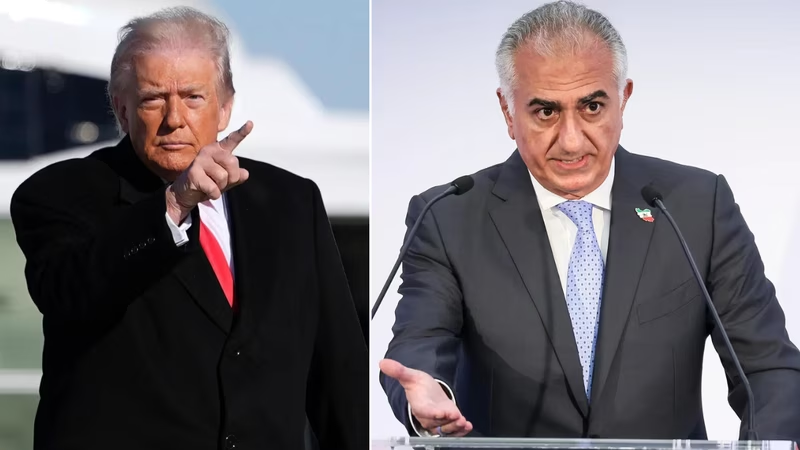
In a world where geopolitical chess moves are often cloaked in silence, a single offhand comment from Donald Trump has ignited a firestorm of speculation: **Is Reza Pahlavi the future of Iran?**
During a recent interview, the former U.S. president referred to the exiled crown prince as a “nice person”—a seemingly casual remark that carries immense weight given the context of escalating anti-regime protests in Iran and the search for a unifying opposition figure. While Trump stopped short of endorsing Pahlavi as a leader, the mere acknowledgment has thrust the 63-year-old royal back into the global spotlight and reignited debate over whether the Pahlavi dynasty could make a historic comeback.
Table of Contents
- Who Is Reza Pahlavi? The Exiled Crown Prince
- Reza Pahlavi and Trump’s Comment: What It Really Means
- Is There Real Support for Pahlavi Inside Iran?
- The Monarchy vs. Republic Debate in Iranian Opposition
- What Would a Pahlavi Restoration Actually Look Like?
- Conclusion: Symbol or Statesman?
- Sources
Who Is Reza Pahlavi? The Exiled Crown Prince
Born in 1960, Reza Pahlavi is the eldest son of Mohammad Reza Pahlavi, the last Shah of Iran, who was overthrown during the 1979 Islamic Revolution. The family fled into exile, and Reza has lived primarily in the United States ever since.
Unlike many royal heirs content with a life of quiet privilege, Pahlavi has spent decades positioning himself as a voice for democratic change in Iran. He holds a degree in political science from the University of Southern California and has consistently advocated for a secular, democratic Iran—**not necessarily a restored monarchy**. In fact, he has repeatedly stated that the form of government should be decided by the Iranian people through a free and fair referendum .
His message resonates with a segment of the Iranian diaspora and younger Iranians disillusioned with both the current regime and fragmented opposition groups. His social media presence—particularly on platforms like Instagram and X (formerly Twitter)—has grown significantly during recent protest waves, including the “Woman, Life, Freedom” movement that erupted after Mahsa Amini’s death in 2022.
Reza Pahlavi and Trump’s Comment: What It Really Means
When asked about potential leadership alternatives in Iran, Trump responded: “I think he’s a nice person. I’ve heard good things.” He added, however, that he was “not sure” if Pahlavi was the right choice—a classic Trumpian mix of praise and ambiguity .
Why does this matter? Because Trump’s words carry outsized influence in conservative and nationalist circles, both in the U.S. and among Iranian expatriates. His administration (2017–2021) took a hardline stance against Tehran, withdrawing from the Iran nuclear deal and imposing crippling sanctions. Any signal of support for an alternative figure—even a tentative one—is interpreted as strategic messaging.
It’s worth noting that the U.S. government, under both Democratic and Republican administrations, has officially maintained a policy of non-interference in Iran’s internal governance. Yet, unofficial channels often explore relationships with credible opposition figures. Pahlavi has met with U.S. lawmakers, think tanks, and State Department officials over the years, building legitimacy as a potential bridge between Washington and a post-regime Iran .
Is There Real Support for Pahlavi Inside Iran?
This is the million-dollar question. While Pahlavi enjoys vocal backing from parts of the diaspora, gauging sentiment inside Iran is difficult due to state surveillance and repression.
However, several indicators suggest growing curiosity—if not outright support:
- Social Media Trends: Hashtags like #RezaPahlavi and #ReferendumNow have trended during major protests.
- Symbolic Gestures: Protesters have been seen waving pre-revolutionary Iranian flags—the tricolor with the Lion and Sun emblem associated with the Pahlavi era.
- Grassroots Polls: Unofficial online surveys by diaspora groups show Pahlavi as a top choice for transitional leadership, though these lack scientific rigor .
Still, critics argue that nostalgia for the Pahlavi era overlooks its authoritarianism, inequality, and suppression of dissent—factors that contributed to the 1979 revolution in the first place. For more on this complex legacy, see our analysis on [INTERNAL_LINK:the-rise-and-fall-of-the-pahlavi-dynasty].
The Monarchy vs. Republic Debate in Iranian Opposition
The Iranian opposition is far from unified. It includes secular republicans, leftists, feminists, ethnic minorities, and monarchists. Many fear that elevating Pahlavi could fracture the movement.
Pahlavi himself has tried to navigate this carefully. In a 2023 speech at the National Press Club in Washington, D.C., he said: “I am not here to reclaim a throne. I am here to serve as a catalyst for unity and a free vote.” He has endorsed a transitional council model that would include diverse voices before any national referendum .
Yet skepticism remains. Can a figure tied to a deposed monarchy truly represent a new, inclusive Iran? Or is he a convenient symbol for Western powers seeking a familiar face to replace the ayatollahs?
What Would a Pahlavi Restoration Actually Look Like?
Let’s be clear: a full return to monarchy is highly unlikely. Even Pahlavi doesn’t advocate for it. More plausible scenarios include:
- Transitional Figurehead: Pahlavi serves as a unifying interim leader during a democratic transition, similar to Spain’s King Juan Carlos after Franco.
- Constitutional Monarch: If a referendum favors monarchy, he becomes a ceremonial head of state with no executive power—like the British king.
- Political Advocate: He remains a prominent civilian voice, perhaps leading a political party or civil society coalition.
Any path forward would require massive internal upheaval, international coordination, and—most importantly—the will of the Iranian people.
Conclusion: Symbol or Statesman?
Trump’s description of **Reza Pahlavi** as a “nice person” may seem trivial, but in the high-stakes theater of geopolitics, even small signals can ripple outward. Whether Pahlavi becomes Iran’s future leader or remains a respected exile depends not on foreign endorsements, but on the courage of ordinary Iranians demanding change. For now, he stands as both a symbol of a bygone era and a potential bridge to a freer tomorrow.
Sources
- Times of India: Is Reza Pahlavi the future? Trump calls ex-crown prince ‘nice person’
- BBC News: Who is Reza Pahlavi and what does he want for Iran?
- Council on Foreign Relations: Iran’s Opposition Movement – Challenges and Opportunities
- IranPoll.com – Independent Public Opinion Research on Iran
- Official Website of Reza Pahlavi – Statements and Vision