The world watched in stunned silence as U.S. forces executed a high-stakes military operation in Venezuela on January 3, 2026, resulting in the capture of President Nicolás Maduro . But while the international community grapples with the geopolitical fallout, a crucial question is being asked at home: Do Americans support this bold move?
The answer, according to a wave of new polls, is a resounding no. A clear majority of U.S. citizens believe their country has gone too far, expressing strong disapproval of the US intervention in Venezuela and a broader desire for a more restrained foreign policy.
Table of Contents
- The Polling Data: A Nation Divided, But Leaning Against Intervention
- Why Americans Disapprove of US Intervention in Venezuela
- The Partisan Split on Foreign Policy
- What This Means for Trump’s Foreign Policy Agenda
- Conclusion
- Sources
The Polling Data: A Nation Divided, But Leaning Against Intervention
The numbers paint a complex but telling picture. While some see potential benefits—like halting the flow of illegal drugs, which 50% of respondents believe the intervention will achieve —the overall sentiment is deeply negative.
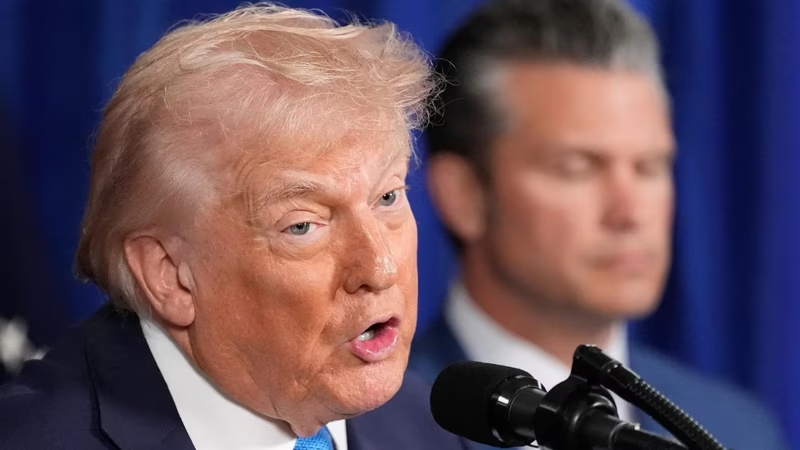
A striking 57% of Americans disapprove of how President Trump is handling the situation in Venezuela . This disapproval cuts across many demographics, though it is not uniform. For instance, a Quinnipiac poll from December found that nearly 6 in 10 registered voters were opposed to U.S. military intervention in the country . The sentiment is even stronger among Black Americans, with 57% opposing the action .
Furthermore, the idea of a prolonged U.S. presence is overwhelmingly rejected. Only 15% of Americans believe the U.S. should administer Venezuela for the next few years, and a mere 24% support the notion of taking Venezuela’s oil . These figures underscore a critical point: Americans may accept a swift, decisive action in theory, but they have no appetite for another open-ended, nation-building mission.
Why Americans Disapprove of US Intervention in Venezuela
The public’s skepticism stems from several key concerns:
- War-Weariness: After decades of involvement in Iraq, Afghanistan, and other conflicts, the American public is exhausted by foreign entanglements. There’s a strong desire to focus on domestic issues like the economy, healthcare, and infrastructure.
- Distrust in Outcomes: Many doubt that military force can create a stable, democratic Venezuela. History has shown that regime change often leads to power vacuums and prolonged instability, not the promised peace and prosperity.
- Legality and Morality: Questions about the legal justification for the operation under international law, and the moral implications of one sovereign nation forcibly removing the leader of another, weigh heavily on the public conscience .
This isn’t just about Venezuela; it’s a referendum on America’s role in the world. As one poll succinctly put it, most Americans want a “less-active” role in world affairs .
The Partisan Split on Foreign Policy
While opposition is the majority view, it’s not evenly distributed. Unsurprisingly, there’s a sharp partisan divide. Republican voters are significantly more likely to support the President’s actions than their Democratic counterparts . However, even within the GOP, there are factions—particularly among more traditional conservatives—who are wary of expansive military adventures that don’t directly threaten U.S. soil.
This internal tension within the Republican party mirrors a larger national debate between an “America First” isolationist stance and a more traditional neoconservative belief in assertive global leadership. The Venezuela operation has become the latest flashpoint in this ongoing ideological battle.
What This Means for Trump’s Foreign Policy Agenda
This public backlash presents a significant political challenge for the administration. A foreign policy initiative that lacks broad public support is difficult to sustain, especially if it leads to unforeseen consequences like casualties, a refugee crisis, or a wider regional conflict.
The White House now faces a critical choice. It can double down, framing the operation as a necessary act of strength against a hostile regime, or it can pivot towards a more diplomatic and multilateral approach to stabilize Venezuela post-Maduro. Given the polling data, the latter path may be more politically sustainable.
For now, the message from Main Street to Washington is clear: the era of unchecked American military intervention may be coming to an end. The public’s demand for a more restrained and thoughtful foreign policy is a powerful force that cannot be ignored.
Conclusion
The US intervention in Venezuela has ignited a fierce domestic debate that goes far beyond the borders of Caracas. The polling data reveals a public that is deeply skeptical of military solutions, weary of foreign wars, and eager for their government to prioritize problems at home. While the operation may have achieved its immediate tactical objective, its long-term strategic success hinges on whether it can win over a reluctant American populace. With a majority believing the US has “gone too far,” the path forward is fraught with political peril.
Sources
- Times of India: Gone too far? What Americans think of US op in Venezuela – a ‘less-active’ role in world
- Web Search Results: Americans not on board with Trump’s military interventions
- Web Search Results: 2026 United States intervention in Venezuela
- Web Search Results: Quinnipiac poll on Venezuela intervention
- Web Search Results: AP News: What Americans think about Trump’s military intervention
- Council on Foreign Relations: CFR on U.S. Public Opinion and Foreign Policy