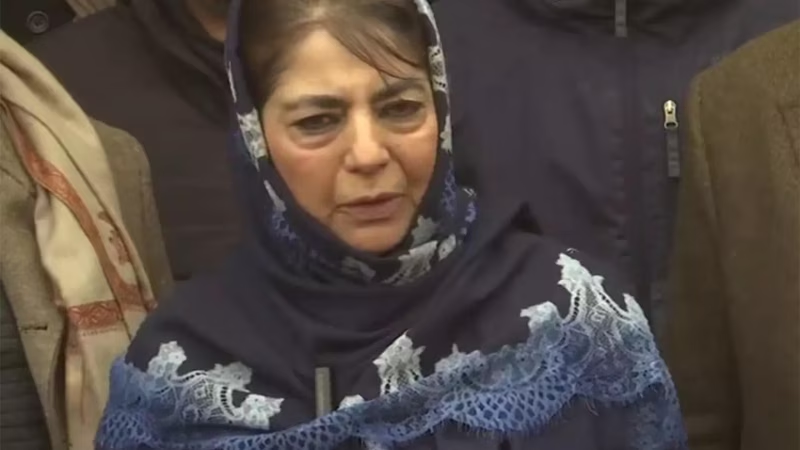
In a statement that has reignited tensions around faith, security, and equality, former Jammu and Kashmir Chief Minister Mehbooba Mufti declared: “If religious places are to be profiled, then start with temples.”
The remark—made during a public address in Srinagar—comes amid growing concerns over alleged selective surveillance of mosques and Islamic institutions under the guise of counter-terrorism. Mufti’s comments challenge the narrative that only certain communities pose security risks, calling instead for uniform scrutiny across all places of worship.
But her words have drawn sharp reactions: some hail them as a necessary call for equity; others accuse her of politicizing national security. So, what’s really behind this controversy—and does it reflect a deeper pattern of religious profiling in India?
Table of Contents
- What Did Mehbooba Mufti Say—and Why?
- The Context Behind Religious Profiling Claims
- Are Temples Really Exempt from Surveillance?
- Legal and Constitutional Perspectives
- Public and Political Reactions
- Historical Precedents of Religious Targeting
- Conclusion: Equity or Escalation?
- Sources
What Did Mehbooba Mufti Say—and Why?
Speaking at a gathering focused on civil liberties in J&K, Mufti questioned why security agencies appear to focus disproportionately on mosques, madrasas, and Sufi shrines—particularly in Muslim-majority regions—while large Hindu temples hosting millions annually receive minimal scrutiny.
“When every imam is treated like a suspect, but no one questions who funds grand temple renovations or manages their finances, there’s a double standard,” she said . Her core argument: if the state claims it’s profiling religious sites to prevent radicalization or terror funding, the policy must apply universally—not selectively.
The Context Behind Religious Profiling Claims
Mufty’s comments didn’t emerge in a vacuum. Over the past decade, reports from human rights groups—including Amnesty International and the Commonwealth Human Rights Initiative—have documented cases where Muslim communities faced heightened surveillance, arbitrary detentions, and stigmatization under anti-terror laws like UAPA .
Meanwhile, several high-profile Hindu temples—such as those in Ayodhya, Tirupati, and Puri—operate vast financial empires with limited transparency. The Tirumala Tirupati Devasthanams (TTD), for instance, collects over ₹3,000 crore annually in donations, yet its audit mechanisms remain largely opaque .
Critics argue that if financial oversight is justified for one faith, it must be for all.
Are Temples Really Exempt from Surveillance?
Technically, no. Many major temples are under state government control (e.g., Tamil Nadu Hindu Religious and Charitable Endowments Department) and undergo audits. However, these are administrative—not security-related.
In contrast, mosques in sensitive areas often face routine police visits, drone monitoring, and intelligence reports on sermons. A 2023 RTI reply revealed that Delhi Police maintains “mosque registers” tracking Friday congregations—a practice not extended to gurdwaras, churches, or temples .
This asymmetry fuels perceptions of bias, even if unintentional.
Legal and Constitutional Perspectives
Article 14 of the Indian Constitution guarantees equality before the law. Article 15 prohibits discrimination on grounds of religion. Any state action that singles out one community for scrutiny—without objective, evidence-based criteria—risks violating these principles.
The Supreme Court has repeatedly emphasized that “suspicion cannot be the basis of state action” (Safdar Hashmi Memorial Trust v. Union of India, 2021). Yet, in practice, security policies often rely on communal stereotypes rather than individualized threat assessments.
Public and Political Reactions
Reactions to Mufti’s statement have been polarized:
- Bharatiya Janata Party (BJP): Condemned her remarks as “divisive” and accused her of undermining national security.
- Congress and Left parties: Called for a “rational debate” on equitable security protocols.
- Civil society groups: Supported her call for non-discriminatory policing.
- Social media: #TempleProfiling trended, with users sharing data on temple finances vs. mosque funding.
Notably, even some Hindu priests have echoed Mufti’s sentiment, arguing that true secularism means equal accountability—not blanket suspicion of any one group.
Historical Precedents of Religious Targeting
This isn’t the first time such concerns have surfaced. After the 2008 Malegaon blasts, Muslim youth were rounded up based on flimsy evidence—only for courts to later exonerate them. Conversely, investigations into the 2007 Samjhauta Express blast (targeting Pakistanis) faced delays and alleged political interference .
These cases reveal a troubling pattern: security responses often mirror societal prejudices rather than forensic logic.
Conclusion: Equity or Escalation?
Mehbooba Mufti’s demand to include temples in any religious profiling in India isn’t about targeting Hindus—it’s about demanding consistency. In a democracy, security measures must be blind to faith and based solely on verifiable risk.
Ignoring this principle doesn’t just alienate minorities—it erodes public trust in the very institutions meant to protect us all. As India navigates rising communal tensions, the path forward lies not in selective scrutiny, but in universal accountability.
Sources
- Times of India: If religious places are to be profiled, then start with temples: Mehbooba Mufti
- Amnesty International: Misuse of UAPA in India
- Tirumala Tirupati Devasthanams Annual Reports
- The Hindu: Delhi Police Maintains Register of Mosques
- Supreme Court Judgment on Safdar Hashmi Memorial Trust Case
- Internal: Secularism vs. Security: Can India Balance Both?