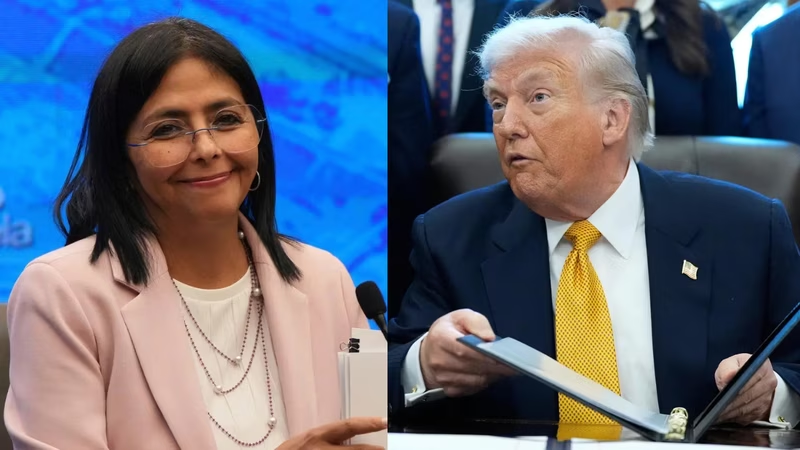
In a development that has sent shockwaves through diplomatic circles, former U.S. President Donald Trump has held a lengthy phone call with Venezuela’s interim leader, Delcy Rodríguez—marking the first known direct contact between the two since the dramatic ousting of longtime dictator Nicolás Maduro.
Described by Trump as a “great conversation,” the call underscores a potential recalibration of U.S. engagement with one of Latin America’s most volatile nations. But who is Delcy Rodríguez? Why is Trump reaching out now? And what does this mean for the future of Venezuela—and American influence in the region?
Table of Contents
- Who Is Delcy Rodríguez—and Why Is She ‘Interim Leader’?
- The Trump Venezuela Call: What We Know
- Why Now? The Timing of Trump’s Diplomatic Reach
- Maduro’s Ouster: What Really Happened?
- Geopolitical Stakes: US, Russia, and China in Venezuela
- Implications for Biden’s Foreign Policy
- Conclusion: A New Chapter or Political Theater?
- Sources
Who Is Delcy Rodríguez—and Why Is She ‘Interim Leader’?
Until recently, Delcy Rodríguez was best known as Maduro’s loyal vice president—a key architect of his authoritarian regime and a sanctioned figure by the U.S. Treasury for human rights abuses and corruption .
But following Maduro’s sudden removal from power in late 2025—reportedly due to a military-backed political transition amid economic collapse and mass protests—Rodríguez emerged as the head of a transitional government. Her appointment as “interim leader” has been recognized by several regional powers, including Brazil and Colombia, though not yet formally endorsed by the United Nations.
Her pivot from hardline Chavista to transitional figure has raised eyebrows. Critics call it a rebranding exercise; supporters argue it’s a necessary step toward stability.
The Trump Venezuela Call: What We Know
According to a statement released by Trump’s office, the call lasted over 45 minutes and covered “energy security, democratic restoration, and regional cooperation.” Trump praised Rodríguez for her “courageous leadership” and expressed support for “free and fair elections” in Venezuela.
Notably, the call was not coordinated with the Biden administration—a break from diplomatic protocol that has drawn criticism from State Department officials. A senior official told Reuters: “Private citizens should not be conducting parallel foreign policy” .
Still, Trump’s team insists the outreach is “consistent with America’s long-term interests” and aims to “prevent further Russian or Chinese entrenchment” in the Western Hemisphere.
Why Now? The Timing of Trump’s Diplomatic Reach
Several factors explain the timing:
- 2026 U.S. Election Campaign: Trump is positioning himself as a global statesman ahead of a potential presidential run.
- Venezuela’s Oil Reserves: With global energy markets unstable, Venezuela’s 300 billion barrels of oil remain a strategic prize.
- Power Vacuum: With Maduro gone, the U.S. sees a narrow window to shape Venezuela’s future before rival powers step in.
Moreover, Trump’s previous “maximum pressure” campaign against Maduro failed to dislodge him. Now, engaging Rodríguez—even controversially—may be seen as a pragmatic reset.
Maduro’s Ouster: What Really Happened?
While details remain murky, reports suggest Maduro was forced out in December 2025 after a coalition of military generals, opposition leaders, and civil society groups united against his rule. Hyperinflation had rendered the bolívar nearly worthless, and blackouts crippled major cities.
Unlike past coup attempts, this transition avoided bloodshed. Rodríguez, leveraging her institutional knowledge and ties to both the military and civilian sectors, brokered a fragile consensus to lead a 12-month transitional council tasked with organizing elections.
Whether this leads to democracy—or another authoritarian cycle—remains uncertain.
Geopolitical Stakes: US, Russia, and China in Venezuela
Venezuela sits at the heart of a new Cold War-style rivalry. Russia maintains a military presence near Caracas, while China holds over $20 billion in oil-backed loans .
Trump’s call appears aimed at countering both. By offering conditional support to Rodríguez—potentially including sanctions relief—the U.S. hopes to pull Venezuela back into its sphere of influence.
But it’s a risky gamble. If Rodríguez is seen as a U.S. puppet, she could lose domestic legitimacy overnight.
Implications for Biden’s Foreign Policy
The call puts the Biden administration in a bind. On one hand, it aligns with U.S. goals of stabilizing Venezuela. On the other, it undermines official channels and could complicate negotiations.
State Department spokespersons have remained noncommittal, stating only that “we are aware of the report and are monitoring developments.” But behind closed doors, tensions are reportedly high.
This episode also highlights a broader challenge: how to manage influential ex-presidents in an era of personalized diplomacy.
Conclusion: A New Chapter or Political Theater?
The Trump Venezuela call is more than gossip—it’s a signal. Whether it heralds genuine progress or is merely Trump’s latest headline-grabbing maneuver remains to be seen. But one thing is clear: Venezuela’s fate is once again a global flashpoint, and America’s role in it is being contested not just in Washington, but on the world stage.
As elections loom in both Venezuela and the U.S., expect more high-stakes moves—and more controversy.