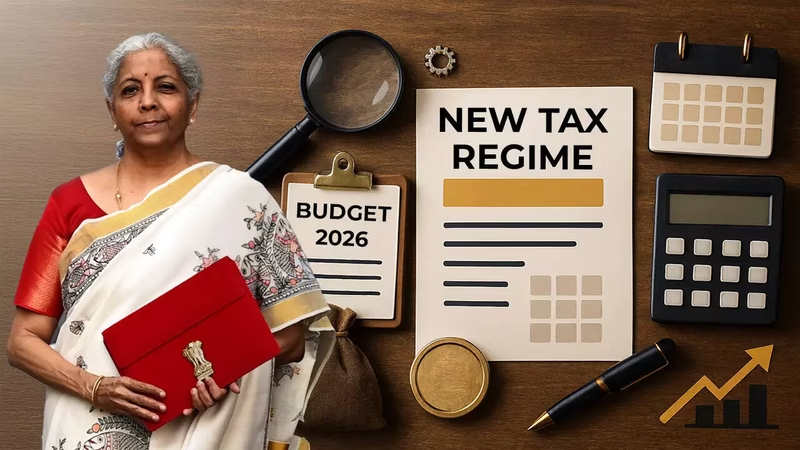
Every year, the Union Budget sends a ripple through the personal finances of every Indian earner. But in 2026, the spotlight is laser-focused on one critical question: will the government finally make the new income tax regime truly irresistible? Introduced as a simpler, lower-rate alternative, this regime has been slowly gaining traction. Yet, many taxpayers—especially those with home loans, health insurance, or significant investments—still find the old regime more beneficial due to its array of deductions.
With Finance Minister Nirmala Sitharaman set to present her eighth budget, there’s a strong consensus among experts that a major overhaul of the new regime is not just likely, but necessary. The goal? To fulfill the government’s long-stated ambition of making this streamlined system the default and preferred choice for the vast majority of taxpayers. So, what specific changes can we expect, and how will they impact your wallet?
Table of Contents
- Why the New Income Tax Regime Needs a Boost
- Top Budget 2026 Expectations for the New Regime
- Old vs. New Regime: Which is Better for You in FY 2025-26?
- Expert Opinions: What Tax Professionals Are Predicting
- How to Prepare for Budget 2026 Tax Changes
- Conclusion: Will 2026 Be the Tipping Point?
- Sources
Why the new income tax regime Needs a Boost
The new regime was launched with a promise: lower tax rates in exchange for giving up most popular deductions under sections like 80C (for PPF, ELSS, life insurance), 80D (health insurance), and HRA (House Rent Allowance). On paper, it’s elegant. In practice, for a large segment of the middle class with financial commitments, it often results in a higher tax outgo.
The government’s own data shows a growing adoption, but a significant portion of taxpayers—particularly those in the ₹7-15 lakh bracket—still opt for the old system. To achieve its vision of a simplified, low-compliance tax system, the government must bridge this gap by making the new regime financially superior for almost everyone.
Top Budget 2026 Expectations for the New Regime
Tax experts and industry bodies have been vocal about their recommendations. Here are the most widely anticipated changes:
- Raising the Basic Exemption Limit: The most common expectation is an increase in the zero-tax slab from ₹3 lakh to ₹5 lakh. This would provide immediate relief to a massive number of entry-level and mid-level salaried employees .
- Reintroducing a Key Deduction: There’s a strong push to allow at least one major deduction within the new regime, with the standard deduction of ₹50,000 (currently available only in the old regime) being the prime candidate. This single change could sway millions of taxpayers .
- Slab Rate Rationalization: Experts suggest minor tweaks to the existing slab rates, such as reducing the 20% rate to 15% for income between ₹6-9 lakh, to create a smoother progression and make the math more appealing.
- Making it the Default Option: The government may officially declare the new regime as the default, requiring taxpayers to actively opt-out if they wish to use the old one. This nudge could significantly accelerate its adoption.
Old vs. New Regime: Which is Better for You in FY 2025-26?
Until the Budget is announced, you still need to plan for the current financial year (FY 2025-26). The choice depends entirely on your individual financial profile:
- Choose the NEW Regime if: You are a young professional with minimal investments, no home loan, and few eligible deductions. The lower rates will likely save you money.
- Choose the OLD Regime if: You have significant deductions from home loan interest (Section 24), health insurance premiums (80D), investments in PPF/ELSS (80C), or are paying substantial rent (HRA). These can drastically reduce your taxable income.
Always run the numbers for both scenarios before finalizing your investment strategy for the year.
Expert Opinions: What Tax Professionals Are Predicting
Leading voices in the tax community are optimistic about significant changes. A survey by a major financial publication found that over 80% of chartered accountants believe the basic exemption limit will be raised .
“The government has a golden opportunity in Budget 2026 to deliver a major personal finance boost,” says a senior partner at a top-tier CA firm. “By raising the exemption limit to ₹5 lakh and allowing the standard deduction, they can make the new regime a win-win for both taxpayers and the administration.”
This sentiment is echoed by industry associations like FICCI and CII, who have formally submitted these recommendations to the Finance Ministry.
How to Prepare for Budget 2026 Tax Changes
While you wait for the big announcement, here’s how to stay ahead:
- Don’t Stop Your Current Investments: Continue with your 80C and 80D investments for FY 2025-26. You can always choose the better regime while filing your return.
- Model Different Scenarios: Use online tax calculators to see how your tax liability would change under various proposed structures (e.g., a ₹5 lakh exemption limit).
- Stay Flexible: Avoid locking into long-term, illiquid investments solely for tax savings until the new rules are clear.
Conclusion: Will 2026 Be the Tipping Point?
Budget 2026 feels like a pivotal moment for India’s personal taxation system. The government has laid the groundwork for a simpler, more efficient tax regime. Now, it has the chance to put its money where its mouth is. By making the new income tax regime genuinely more lucrative through a higher exemption limit and a key deduction, Finance Minister Nirmala Sitharaman can deliver a powerful message of trust and relief to the Indian middle class. For a comprehensive guide on maximizing your tax savings regardless of the regime, check out our detailed resource on [INTERNAL_LINK:ultimate-guide-to-section-80c-deductions].