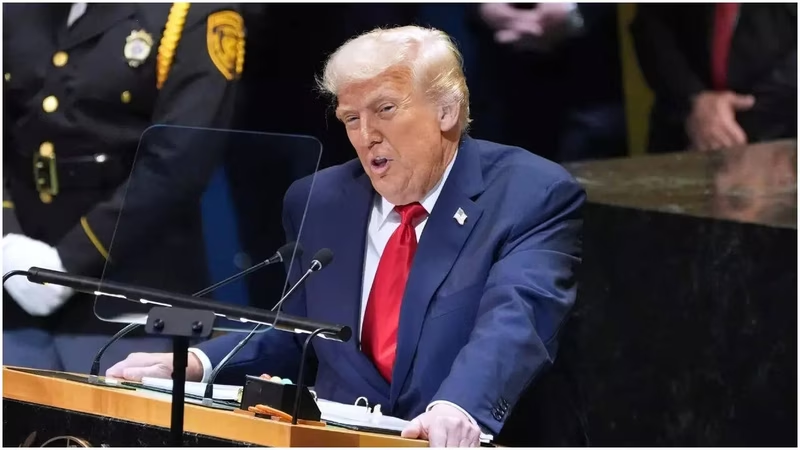
In a development that has sent shockwaves through diplomatic and defense circles, former President Donald Trump was reportedly presented with a highly sensitive dossier containing the exact locations of 50 Iranian military targets . This intelligence package, delivered by a prominent Washington advocacy group, is far more than just a list—it’s a potential blueprint for a devastating military campaign that could reshape the entire Middle East.
The dossier’s most alarming detail is its specificity. It doesn’t just name cities or regions; it provides the precise GPS coordinates for some of Iran’s most fortified and strategically vital sites, including the nerve center of its most powerful military force: the Islamic Revolutionary Guard Corps (IRGC). This level of detail suggests a serious, premeditated planning effort, moving the conversation from hypothetical threats to concrete options on a war room table .
Table of Contents
- The Dossier: A Blueprint for Strike Options
- Key Iran Military Targets Identified
- The Source: Washington Advocacy and Its Agenda
- Why the IRGC Tharallah Headquarters is Critical
- Potential Consequences of a US Strike on Iran
- Conclusion: A Region on the Brink
- Sources
The Dossier: A Blueprint for Strike Options
This isn’t your typical policy memo. According to reports, the document provided to the Trump administration was a meticulously compiled intelligence file designed to give decision-makers a clear menu of military options . By identifying 50 distinct targets, the dossier effectively outlines a graduated response strategy—from limited, surgical strikes on specific facilities to a broader campaign aimed at degrading Iran’s entire military infrastructure.
The timing and nature of this delivery are crucial. It comes amid a backdrop of heightened tensions between Washington and Tehran, including attacks on shipping lanes, proxy conflicts across the region, and Iran’s advancing nuclear program. Providing such a list to a president known for his “maximum pressure” approach is widely seen as an attempt to influence U.S. policy towards a more aggressive, military-led solution.
Key Iran military targets Identified
While the full list remains classified, several high-value targets have been confirmed in public reports. These installations represent the core of Iran’s defensive and offensive capabilities:
- IRGC’s Tharallah Headquarters (Tehran): The central command for the IRGC’s operations within the capital and a key node in its nationwide security network .
- Major Missile Bases: Facilities housing Iran’s vast arsenal of short and medium-range ballistic missiles, which can reach U.S. allies like Israel and Saudi Arabia.
- Nuclear Research Sites: Though often under IAEA safeguards, certain military-linked research centers are believed to be part of Iran’s nuclear weapons development efforts.
- Naval Bases in the Strait of Hormuz: Strategic ports from which the IRGC Navy can launch fast-attack craft to disrupt one of the world’s most critical oil chokepoints.
- Regional Proxy Command Centers: Bases used to coordinate and supply allied militias in Iraq, Syria, Lebanon (Hezbollah), and Yemen (Houthis) .
The inclusion of the IRGC’s main command is particularly significant, as it would be a direct decapitation strike against the heart of Iran’s power structure.
The Source: Washington Advocacy and Its Agenda
The dossier was delivered by a “prominent advocacy group” based in Washington, D.C. While the specific organization hasn’t been officially named in all reports, such groups are often aligned with hardline foreign policy stances and have strong ties to pro-Israel or neoconservative think tanks . Their goal is typically to push U.S. policy towards a more confrontational posture with adversarial regimes like Iran’s.
By providing what appears to be actionable intelligence, these groups aim to lower the perceived risk and complexity of a military strike, making it seem like a clean, manageable option. However, critics argue that this kind of lobbying dangerously oversimplifies the immense complexities and catastrophic risks of a war with a nation as large and strategically positioned as Iran.
Why the IRGC Tharallah Headquarters is Critical
The Tharallah base in Tehran is not just another military building. It is the operational brain of the IRGC’s internal security apparatus. The unit stationed there, also called Tharallah, is directly responsible for protecting the Supreme Leader and maintaining order in the capital—a role that became brutally evident during the crackdowns on domestic protests .
Striking this headquarters would be an unprecedented act of aggression. It would signal a direct attack on the very institution that safeguards Iran’s theocratic regime. Such a move would almost certainly provoke a massive and immediate retaliation, potentially dragging the entire region into a full-scale conflict. It represents the ultimate “red line” target.
Potential Consequences of a US Strike on Iran
A military strike based on this dossier would unleash a cascade of consequences, both immediate and long-term:
- Regional Escalation: Iran would likely retaliate through its network of proxies, launching missile and drone attacks on U.S. bases in Iraq and Syria, and on Israeli and Gulf state targets.
- Global Oil Shock: The Strait of Hormuz could be blockaded or mined, causing a massive spike in global oil prices and triggering a worldwide economic crisis.
- Humanitarian Crisis: A sustained conflict would displace millions and create a new refugee wave across the Middle East.
- Acceleration of Iran’s Nuclear Program: In response to an attack, Iran would almost certainly abandon any remaining constraints on its nuclear program, racing towards a bomb.
The potential for a single strike to spiral into a regional war makes this dossier not just a list of targets, but a potential trigger for a global crisis.
Conclusion: A Region on the Brink
The existence of this dossier detailing Iran military targets is a stark reminder of how close the world can come to the edge of a major conflict. While possessing such a list is a standard part of military planning, its public revelation and delivery to a former president known for his hawkish views adds a dangerous layer of political volatility. The path forward requires immense diplomatic skill and restraint. The alternative—a war sparked by a list of 50 coordinates—could have consequences that echo for generations. For a deeper look at the history of US-Iran tensions, see our analysis on [INTERNAL_LINK:history-of-us-iran-relations].