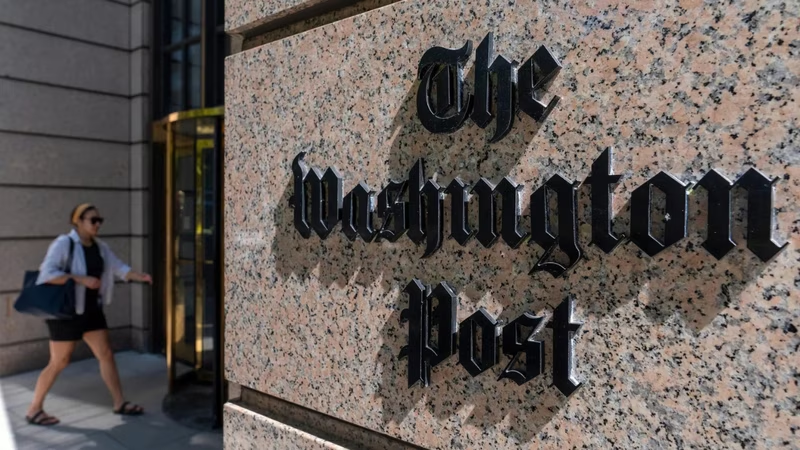
In a quiet Virginia neighborhood, an event unfolded that has now become a flashpoint in a critical national conversation. Federal agents from the FBI arrived at the home of Washington Post reporter Hannah Natanson, armed with a search warrant, and seized her phone and even her Garmin watch . This isn’t just a story about a single raid; it’s a stark reminder of the fragile line between national security and the fundamental democratic pillar of press freedom.
Natanson, who covers the federal workforce and the Trump administration’s impact on government, was told she is not a subject of the investigation . So why was her home raided? The answer points to a much larger, and more troubling, issue: the government’s aggressive pursuit of whistleblowers and leakers, often at the expense of the journalists who report their revelations.
Table of Contents
- Who is Hannah Natanson?
- The FBI Raid: What Happened?
- Why This Raid Threatens Press Freedom
- Legal Protections for Journalists: Are They Enough?
- Historical Context: Government vs. The Press
- Conclusion: A Chilling Effect on Journalism
- Sources
Who is Hannah Natanson?
Hannah Natanson is a respected reporter for The Washington Post, known for her in-depth coverage of the federal government and its inner workings. Her reporting often focuses on how political administrations, particularly the Trump administration, reshape the machinery of government and its effects on public services . She is not an activist or a partisan commentator; she is a journalist doing her job—gathering information and holding power to account. This context is crucial because it underscores that the target of the FBI’s action was a mainstream journalist from one of the nation’s most prominent newspapers, not a fringe blogger or an overtly political actor.
The FBI Raid: What Happened?
On a recent Wednesday, FBI agents arrived at Natanson’s home with a court-authorized search warrant . They proceeded to search her devices and confiscated her personal phone and a Garmin smartwatch—a device that can store a wealth of personal data, including location history and communications . The Washington Post has confirmed that its reporter is not under investigation. Instead, the raid appears to be part of a broader probe into a government contractor accused of illegally retaining classified information . The clear implication is that the FBI believes one of Natanson’s confidential sources may be connected to this leak, and they are attempting to uncover that source by examining her personal communications.
Why This Raid Threatens Press Freedom
This incident strikes at the very heart of press freedom. For journalism to function as a watchdog, reporters must be able to guarantee confidentiality to their sources. Without that promise, whistleblowers with vital information about government misconduct or wrongdoing will remain silent, fearing exposure and retribution. When the government raids a journalist’s home to find a source, it sends a chilling message: talking to the press can lead to your identity being exposed by federal agents.
Legal experts and press freedom organizations have long argued that such tactics violate the spirit, if not the letter, of the First Amendment. As David McCraw, a top lawyer for The New York Times, has noted in similar cases, these actions can violate both the First Amendment and the Privacy Protection Act of 1980, which was designed to shield journalists from exactly this kind of search and seizure .
Legal Protections for Journalists: Are They Enough?
The United States Constitution’s First Amendment explicitly protects freedom of the press . However, this protection is not absolute, especially when it collides with national security concerns. The legal landscape is complex and often favors the government in leak investigations.
Key legal frameworks include:
- The First Amendment: Guarantees freedom of speech and of the press, but its application in leak cases is frequently tested in court.
- The Privacy Protection Act of 1980: This law was passed in direct response to police raids on newsrooms. It generally prohibits government officials from searching or seizing a journalist’s work product or documentary materials unless the journalist is suspected of a crime .
- Department of Justice Guidelines: The DOJ has internal guidelines that are supposed to make it a last resort to subpoena a journalist’s records, requiring high-level approval. However, these are just guidelines, not laws, and their enforcement can be inconsistent.
The raid on Natanson’s home, where she was explicitly told she was not a suspect, raises serious questions about whether these protections are being honored in practice.
Historical Context: Government vs. The Press
This is far from the first time the U.S. government has clashed with the press over confidential sources. The most famous example is the New York Times’ publication of the Pentagon Papers in 1971, a secret history of the Vietnam War. The Nixon administration tried to block publication, leading to a landmark Supreme Court victory for the press.
More recently, the Obama administration was criticized for its aggressive prosecution of leakers, using the Espionage Act more times than all previous administrations combined. The Trump administration continued this trend, and the current situation with Natanson suggests a persistent pattern. Each of these incidents chips away at the trust between sources and journalists, making it harder for the public to learn what its government is doing in its name.
Conclusion: A Chilling Effect on Journalism
The FBI’s raid on Hannah Natanson’s home is a stark warning sign for the health of American democracy. While the government has a legitimate interest in protecting classified information, its methods must not come at the cost of a free and independent press. The seizure of a journalist’s personal devices to hunt for a source is a tactic that creates a profound chilling effect. It discourages potential whistleblowers and makes the essential work of investigative journalism exponentially more difficult. In a time of increasing government secrecy, robust press freedom is not a luxury—it’s a necessity. The public deserves to know what its government is doing, and that knowledge often flows through the courageous work of journalists and their confidential sources.
For more on the legal battles surrounding journalistic privilege, see our deep dive on [INTERNAL_LINK:first-amendment-legal-battles].