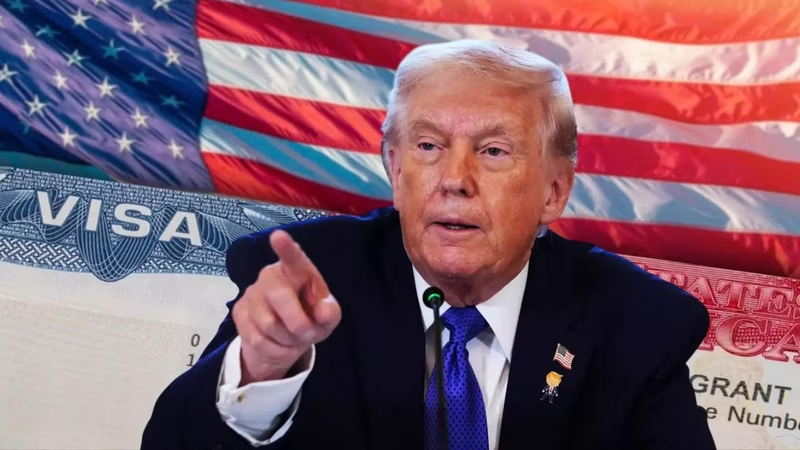
Imagine saving for years, selling assets, and meticulously preparing documents for your American dream—only to have the door slammed shut without warning. That’s the harsh reality for citizens of 75 countries who are now caught in the crosshairs of a sudden and sweeping US visa freeze.
The US State Department has announced an indefinite suspension of routine visa processing for these nations, citing a need to “reassess and strengthen screening procedures.” At the heart of this policy shift is the controversial “public charge” provision, a rule that allows the US government to deny entry to applicants it deems likely to rely on public welfare benefits .
While framed as a measure to protect American taxpayers, the move has ignited a firestorm of criticism, with many seeing it as a thinly veiled attempt to restrict immigration from lower-income and politically sensitive countries under the guise of administrative review.
Table of Contents
- What Is the US Visa Freeze and Who Is Affected?
- The Public Charge Rule: A Contentious History
- Why These 75 Countries? The Strategic Targeting
- Real-World Impact: Families and Dreams on Hold
- Legal Challenges and Global Backlash
- What Applicants Can Do: Next Steps
- Conclusion: A Policy of Exclusion in Disguise?
- Sources
What Is the US Visa Freeze and Who Is Affected?
The State Department’s directive halts the processing of most non-immigrant and immigrant visas for nationals of the 75 listed countries. This includes common visa types like tourist (B1/B2), student (F-1), and work visas (H-1B, L-1). While emergency and diplomatic visas may still be processed, the vast majority of applications are now in limbo.
The list of affected nations is telling. It includes geopolitical rivals like Iran and Russia, fragile states like Afghanistan and Syria, and even key US allies and popular tourist destinations like Thailand and Egypt . This broad scope suggests the policy is less about specific security threats and more about implementing a blanket, risk-averse approach to immigration from the Global South.
The Public Charge Rule: A Contentious History
The “public charge” concept dates back to the 19th century but was dramatically expanded under the previous US administration. The rule allows consular officers to deny a visa if they believe the applicant is likely to receive certain public benefits—like food stamps (SNAP), housing assistance, or Medicaid—for more than 12 months in total within any 36-month period .
Critics argue the rule is inherently discriminatory, as it effectively creates a wealth test for immigration. It penalizes applicants for being poor or from countries with weaker social safety nets, regardless of their skills, education, or potential contributions to American society. The current “reassessment” appears to be a move to codify and enforce this rule even more stringently.
Why These 75 Countries? The Strategic Targeting
The selection of these specific nations isn’t random. It aligns with a broader trend in US immigration policy that prioritizes “merit-based” migration while discouraging what it views as “low-skilled” or “burdensome” immigration. Many of the affected countries have high rates of visa denials under the public charge rule due to lower average incomes and higher perceived reliance on potential future benefits.
This move can be seen as a bureaucratic workaround to achieve a political goal: reducing overall immigration numbers without passing new, overtly restrictive legislation through Congress. By freezing processing under the banner of a “security review,” the administration can achieve a de facto ban.
Real-World Impact: Families and Dreams on Hold
The human cost of this US visa freeze is immense and immediate:
- Separated Families: Spouses, children, and parents are now unable to reunite, with no clear timeline for when processing might resume.
- Stalled Careers & Education: Students accepted into US universities and professionals with job offers are left in professional purgatory, their plans shattered.
- Financial Ruin: Many applicants have already spent thousands of dollars on application fees, medical exams, and travel preparations, all for nothing.
For those seeking guidance, our resource on [INTERNAL_LINK:navigating-us-visa-changes] offers practical advice during this uncertain time.
Legal Challenges and Global Backlash
Immigration advocates and civil rights groups are already preparing legal challenges, arguing that the freeze is arbitrary, capricious, and violates due process. They contend that a blanket suspension for entire countries, without individualized assessment, is a gross overreach of executive power.
Globally, the move has been met with dismay and anger, particularly from the governments of affected allied nations like Thailand, who see it as a betrayal of long-standing partnerships. The policy risks damaging America’s reputation as a welcoming nation and a land of opportunity.
What Applicants Can Do: Next Steps
If you are from one of the affected countries, here are some immediate steps to consider:
- Do Not Submit New Applications: Until the freeze is lifted, new applications will not be processed.
- Monitor Official Channels: Keep a close eye on the website of the US Embassy or Consulate in your country for any updates.
- Seek Legal Counsel: Consult with a qualified US immigration attorney to understand your specific situation and explore potential options, such as humanitarian parole in extreme cases.
- Document Everything: Keep records of all communications, payments, and plans related to your visa application.
For official and up-to-date information on US visa policies, always refer to the primary source: the US Department of State’s Bureau of Consular Affairs.
Conclusion: A Policy of Exclusion in Disguise?
The indefinite US visa freeze for 75 countries, justified by a reassessment of the public charge rule, represents a significant hardening of America’s immigration stance. While sold as a necessary security and fiscal measure, its broad and indiscriminate nature suggests a deeper agenda of exclusion. For thousands of hopeful applicants around the world, the American dream has been put on hold—not because of who they are, but because of where they come from and how much money they have. This policy doesn’t just screen applicants; it builds a new, invisible wall around the United States.
Sources
- Times of India. (2026). US freezes visas for 75 countries: Iran, Russia, Thailand among affected nations – key details. Retrieved from https://timesofindia.indiatimes.com/business/international-business/us-freezes-visas-for-75-countries-iran-russia-thailand-among-affected-nations-key-details/articleshow/126529838.cms
- US Citizenship and Immigration Services (USCIS). (2026). The Public Charge Ground of Inadmissibility.
- US Department of State. (2026). Announcement on Visa Processing Suspension for Designated Countries.
- American Immigration Lawyers Association (AILA). (2026). Statement on the Indefinite Visa Freeze.