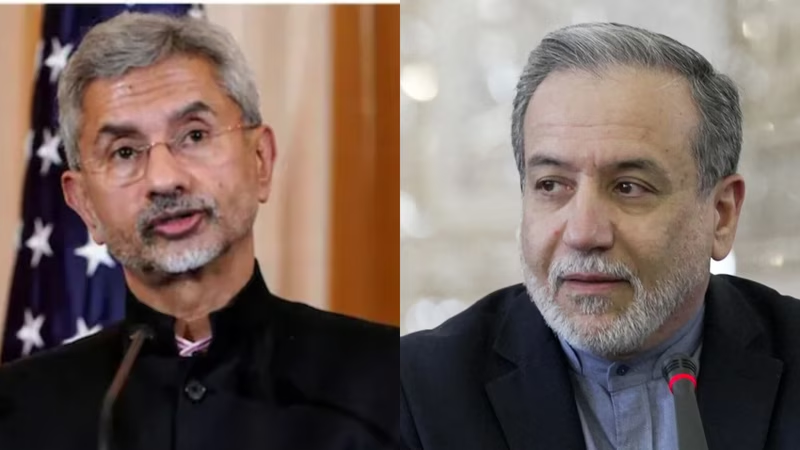
The phone rang in New Delhi at a critical hour. On the other end was Hossein Amir-Abdollahian, Iran’s Foreign Minister (now succeeded by Abbas Araghchi, as referenced in recent reports). The topic? An “evolving situation” in the Middle East—a diplomatic euphemism for a region rapidly spiraling toward chaos.
This wasn’t just a routine check-in. It was a vital piece of India’s real-time crisis management strategy. As rockets fly and alliances shift in West Asia, India finds itself walking a razor-thin line. Its interests are massive: over 8 million citizens living in the Gulf, nearly 70% of its oil imports flowing from the region, and a long-standing commitment to strategic autonomy. The recent conversation between External Affairs Minister Dr. S. Jaishankar and Iran’s top diplomat is a masterclass in navigating this complex landscape without taking sides .
Table of Contents
- Why the Middle East Matters So Much to India
- The Trigger: What Is the “Evolving Situation”?
- India-Iran Relations: A Complex and Critical Partnership
- Jaishankar’s Diplomatic Playbook: Principles Over Polarization
- The Three Pillars of India’s Middle East Strategy
- Conclusion: Navigating the Storm with Calculated Caution
- Sources
Why the Middle East Matters So Much to India
For India, the Middle East isn’t a distant geopolitical chessboard; it’s an economic and human lifeline. The stakes are incredibly high:
- Energy Security: India is the world’s third-largest oil importer, and the Persian Gulf supplies the lion’s share of its crude. Any major disruption sends shockwaves through the Indian economy, fueling inflation and widening the current account deficit.
- Diaspora Welfare: Over 8 million Indians live and work across the Gulf Cooperation Council (GCC) countries. Their safety, well-being, and ability to send home over $50 billion in annual remittances are paramount national concerns.
- Trade & Investment: The region is a crucial market for Indian goods and services, from pharmaceuticals to IT. India is also investing heavily in regional infrastructure, like the Chabahar Port in Iran, to secure alternative trade routes.
The Trigger: What Is the “Evolving Situation”?
While the official statement from the Ministry of External Affairs was characteristically brief, the “evolving situation” almost certainly refers to the escalating cycle of retaliation between Israel and Iran-backed groups, which has now drawn in state actors directly. Following a series of attacks and counter-attacks, the risk of a full-blown regional war has never been higher .
For India, this presents an immediate and direct threat. Its citizens are caught in the crossfire, and its commercial shipping lanes through the Strait of Hormuz—the world’s most important oil chokepoint—are under potential threat. Jaishankar’s call was a proactive move to de-escalate, gather intelligence, and ensure channels of communication remain open with all key players, including Tehran.
India-Iran Relations: A Complex and Critical Partnership
The India Iran relations dynamic is one of the most intricate in India’s foreign policy portfolio. On one hand, Iran is a historic civilizational partner and a key to India’s connectivity ambitions in Central Asia via the International North-South Transport Corridor (INSTC). The Chabahar Port project is the crown jewel of this partnership, offering India a strategic foothold that bypasses Pakistan .
On the other hand, India must balance this relationship with its growing strategic ties with the United States and its partnerships with Arab Gulf states like the UAE and Saudi Arabia, who view Iran with deep suspicion. This tightrope walk requires immense diplomatic skill, which is precisely what Jaishankar’s call demonstrates.
Jaishankar’s Diplomatic Playbook: Principles Over Polarization
India’s official stance, as articulated by Jaishankar, is consistent and clear: it calls for “restraint” from all parties and emphasizes the need to protect civilian lives. This is not neutrality for its own sake; it’s a principled position rooted in India’s core interests.
By refusing to be drawn into the binary “us vs. them” narrative that often dominates Western discourse on the Middle East, India preserves its ability to engage with all sides. This is the essence of its “multi-alignment” strategy. It allows India to be a potential voice for peace and a channel for dialogue when others have slammed their doors shut.
The Three Pillars of India’s Middle East Strategy
India’s approach to this crisis can be understood through three key pillars:
- Protecting Citizens: The primary and non-negotiable objective. India’s embassies are on high alert, ready to execute contingency plans for evacuation if necessary. For more on this, see our coverage on [INTERNAL_LINK:indian-diaspora-crisis-management].
- Securing Energy Flows: Working diplomatically to ensure that global energy markets remain stable and that India’s supply lines are not severed.
- Maintaining Strategic Autonomy: Engaging with all stakeholders—Iran, Israel, the GCC states, and global powers—on its own terms, based on its national interest, not dictated by any alliance system.
For a broader perspective on international crisis response, the United Nations provides frameworks and updates on global conflicts.
Conclusion: Navigating the Storm with Calculated Caution
Dr. S. Jaishankar’s phone call to his Iranian counterpart is far more than a diplomatic formality. It is a critical maneuver in India’s high-stakes effort to shield its national interests from a raging regional storm. In a world increasingly defined by bloc politics, India’s commitment to an independent, pragmatic, and principle-based foreign policy—especially in managing its delicate India Iran relations—is not just a strategic choice, but a necessity for its economic and human security. The coming weeks will be a true test of this carefully calibrated balancing act.
Sources
- Ministry of External Affairs, Government of India. (2026). Official Statement on EAM’s Conversation with Iranian FM.
- Times of India. (2026). ‘Discussed evolving situation’: Jaishankar speaks to Iran FM Araghchi; tensions mount in Middle East. Retrieved from https://timesofindia.indiatimes.com/india/discussed-evolving-situation-iran-fm-araghchi-dials-eam-jaishankar-tensions-mount-in-middle-east/articleshow/126529985.cms
- Observer Research Foundation. (2025). India’s West Asia Policy in an Age of Turmoil.
- International Crisis Group. (2026). The Escalating Conflict in the Middle East: A Regional Flashpoint.