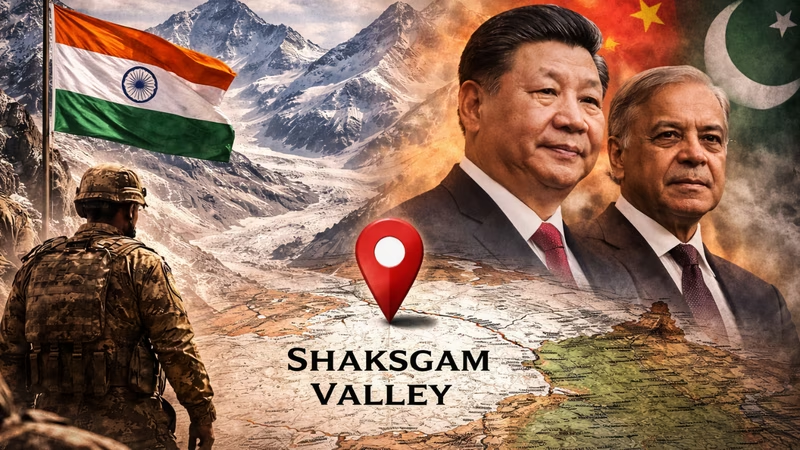
When you think of the India-China border standoff, your mind likely jumps to the icy heights of Galwan or the desolate plains of Depsang. But there’s another, often overlooked, piece of contested territory that’s just as strategically vital—and it’s suddenly back in the spotlight: the Shaksgam Valley.
China’s recent reassertion of its claim over this remote valley has drawn a sharp rebuke from New Delhi. And for good reason. This isn’t just a dusty historical footnote; it’s a live wire in the already tense geopolitical landscape of South Asia, deeply entangled with the China-Pakistan Economic Corridor (CPEC) and India’s core national security interests.
Table of Contents
- Where is Shaksgam Valley and Why Does It Matter?
- The Historical Root of the Shaksgam Valley Dispute
- China’s Fresh Claim and the CPEC Connection
- India’s Firm Stance on Sovereignty
- The Strategic Stakes for India
- Conclusion: A Silent but Critical Frontier
- Sources
Where is Shaksgam Valley and Why Does It Matter?
Tucked away in the far northern reaches of the Kashmir region, the Shaksgam Valley is a high-altitude, glaciated tract of land nestled between the Karakoram range to the north and the main Himalayan range to the south. It lies just north of the Siachen Glacier, the world’s highest battlefield, and acts as a crucial corridor connecting the Chinese-held Aksai Chin region with Pakistan-occupied Gilgit-Baltistan.
Its strategic value is immense. Control over Shaksgam provides a direct land link between China’s Xinjiang province and Pakistan, making it a linchpin for the western arm of China’s ambitious Belt and Road Initiative (BRI), specifically the China-Pakistan Economic Corridor (CPEC). For India, this is a red line, as CPEC passes through territory it claims as its own.
The Historical Root of the Shaksgam Valley Dispute
The crux of the Shaksgam Valley dispute dates back to a controversial agreement signed in 1963 between China and Pakistan. In the midst of their own war with India, Pakistan ceded approximately 5,180 square kilometers of the Shaksgam Valley to China. From India’s perspective, this was an illegal act.
New Delhi has always maintained that since Jammu and Kashmir is an integral part of India, Pakistan had no legal right to transfer any portion of it to a third party. Therefore, the 1963 Sino-Pakistani Boundary Agreement is considered “illegal and invalid” by the Indian government . This position has been consistently upheld for over six decades.
China’s Fresh Claim and the CPEC Connection
China’s recent statements are not just a reiteration of old claims; they are directly tied to its ongoing infrastructure development in the region. Beijing has been actively building roads and other facilities in the Shaksgam Valley, which it frames as necessary for the smooth operation and security of the CPEC route.
This construction activity is viewed by Indian security analysts as a significant escalation. It’s not merely about economic development; it’s about cementing China’s physical control over the area and creating a permanent military and logistical presence on India’s doorstep. This move effectively extends China’s strategic depth into a region that India considers its sovereign territory, creating a two-front pressure point alongside the Line of Actual Control (LAC) in Ladakh .
India’s Firm Stance on Sovereignty
In response to China’s renewed assertions, the Indian Ministry of External Affairs has issued a strong statement, reiterating its long-standing position. The official line is clear and uncompromising:
“The Shaksgam Valley is an integral part of the Union Territory of Ladakh. The so-called China-Pakistan boundary agreement of 1963 is illegal and invalid. We reject any attempt by China to legitimize its occupation of this Indian territory.”
This diplomatic language masks a deep-seated strategic concern. India sees China’s actions as part of a broader pattern of using infrastructure projects to assert territorial claims—a tactic also observed along the LAC.
The Strategic Stakes for India
The implications of the Shaksgam Valley dispute for India are multi-layered and severe:
- Military Vulnerability: A fortified Chinese presence in Shaksgam creates a direct threat to India’s hold on the Siachen Glacier and could potentially outflank Indian positions in eastern Ladakh.
- Diplomatic Isolation: It reinforces the China-Pakistan axis, presenting a united front against India on multiple international platforms.
- Economic Challenge: By legitimizing CPEC through its control of Shaksgam, China strengthens a project that bypasses India and seeks to reshape regional trade dynamics in its favor.
- Precedent Setting: Allowing China’s claim to go unchallenged could set a dangerous precedent for other disputed territories along the vast Himalayan frontier.
For a deeper understanding of the complex geography of this region, resources from the Library of Congress offer valuable historical maps and analyses of South Asian borders.
Conclusion: A Silent but Critical Frontier
The Shaksgam Valley may be remote and sparsely populated, but its strategic significance is anything but silent. China’s fresh claim is a stark reminder that the India-China border dispute is not a single, static line but a complex, multi-dimensional chessboard. While the world’s attention is often captured by the more visible standoffs, the battle for influence and control in places like Shaksgam is just as critical to the future security and sovereignty of India. Ignoring this forgotten flashpoint could prove to be a costly mistake.
Sources
- Times of India. (2026). Shaksgam Valley: India bristles over China’s fresh claim – dispute explained. Retrieved from https://timesofindia.indiatimes.com/india/shaksgam-valley-india-bristles-over-chinas-fresh-claim-dispute-explained/articleshow/126523897.cms
- Ministry of External Affairs, Government of India. (2026). Official Statement on Shaksgam Valley.
- International Institute for Strategic Studies (IISS). (2025). The Strategic Implications of CPEC for South Asia.
- Library of Congress. (2024). Country Studies: India and China Border Disputes.