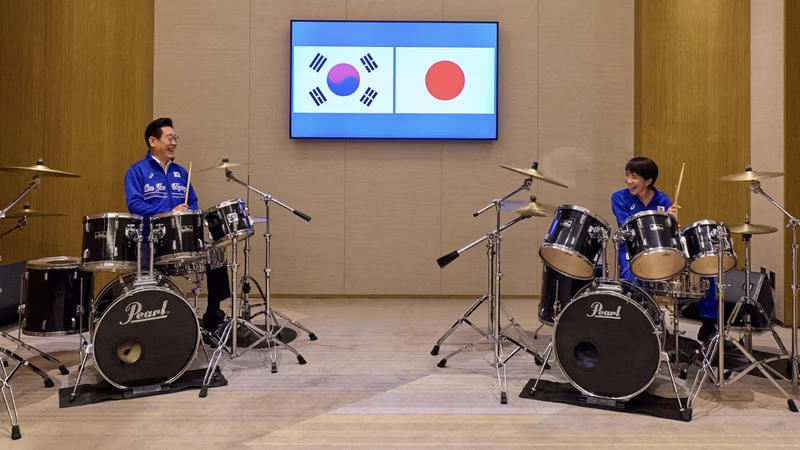
Forget stiff handshakes and carefully worded joint statements. The future of Japan South Korea diplomacy might just be written in the beat of a drum and the catchy chorus of a K-pop anthem.
In a scene that seemed ripped from a feel-good movie rather than the tense world of geopolitics, Japanese Prime Minister Sanae Takaichi and South Korean President Lee Jae Myung recently put on a show in Nara that has the entire region talking. Following their formal summit, the two leaders didn’t head straight to their motorcades. Instead, they picked up drumsticks and launched into an impromptu performance of BTS’s global smash hit, ‘Dynamite,’ and the track ‘Golden’ from the animated series ‘K-pop Demon Hunters’ .
This wasn’t just a quirky photo op; it was a masterclass in modern statecraft—a deliberate, symbolic act designed to signal a powerful message of reconciliation and a shared desire to move forward.
Table of Contents
- From Historic Tensions to a Shared Beat
- The Nara Summit: What Was on the Agenda?
- ‘Dynamite’ Diplomacy: Decoding the Symbolism
- Why K-Pop is the New Language of Diplomacy
- Public Reaction and the Road Ahead
- Conclusion: A Rhythm of Hope for Japan and South Korea
- Sources
From Historic Tensions to a Shared Beat
The relationship between Japan and South Korea has long been a complex tapestry woven with threads of deep cultural exchange, painful historical grievances, and critical economic interdependence. Issues stemming from World War II have repeatedly cast a long shadow over bilateral cooperation, often stalling progress on vital regional security matters.
Against this backdrop, the image of their leaders laughing and drumming together is nothing short of revolutionary. It represents a conscious effort to step out of the shadow of the past and build a new, more positive narrative for the future. As President Lee Jae Myung poetically noted after their performance, they had “shared harmony atop our individual rhythms” . This simple statement perfectly encapsulates the goal: not to erase their differences, but to find a way to coexist and collaborate despite them.
The Nara Summit: What Was on the Agenda?
The drum session was the colorful finale to a substantive summit held in the historic city of Nara. While the world focused on the viral video, the leaders were tackling serious issues behind closed doors. Key agenda items likely included:
- Trilateral Security Cooperation: Strengthening coordination with the United States to address shared concerns about regional stability, particularly regarding North Korea’s nuclear program and China’s growing assertiveness.
- Economic and Technological Partnership: Discussing ways to deepen collaboration in critical sectors like semiconductors, clean energy, and supply chain resilience.
- People-to-People Exchanges: Rebuilding trust at the grassroots level through increased tourism, academic exchanges, and cultural programs—a space where K-pop has already played a massive role.
The decision to hold the summit in Nara, a city famed for its ancient temples and as a symbol of Japan’s early cultural connections with the Korean peninsula, was itself a subtle but powerful diplomatic signal .
‘Dynamite’ Diplomacy: Decoding the Symbolism
Choosing BTS’s ‘Dynamite’ was no accident. The song is a global phenomenon, a symbol of Korean soft power that has transcended language and cultural barriers. For Prime Minister Takaichi to enthusiastically participate in playing a song by a Korean group is a significant gesture of respect and acceptance.
Furthermore, the act of drumming is inherently collaborative. It requires listening, timing, and a shared sense of rhythm. It’s a physical manifestation of the very cooperation they are trying to foster. Reportedly, President Lee Jae Myung had mentioned his desire to play the drums, and Prime Minister Takaichi arranged the surprise session as a goodwill gesture . This personal touch adds a layer of authenticity that traditional diplomacy often lacks.
Why K-Pop is the New Language of Diplomacy
This event is a prime example of what experts call “soft power” or “cultural diplomacy.” In an era where public opinion heavily influences foreign policy, governments are increasingly leveraging popular culture to shape perceptions and build bridges.
K-pop, with its massive global fanbase (the “ARMY”), is one of South Korea’s most potent diplomatic assets. By embracing it, Japan is signaling its willingness to engage with modern Korean identity on its own terms. This form of Japan South Korea diplomacy bypasses political rhetoric and speaks directly to the hearts of citizens, especially the younger generation who will shape the future of both nations.
For more on how culture shapes international relations, you can explore resources from the U.S. Department of State’s Bureau of Educational and Cultural Affairs.
Public Reaction and the Road Ahead
The video of the drum battle has gone massively viral across social media platforms in both countries and globally. The reaction has been overwhelmingly positive, with many citizens expressing hope that this marks a genuine turning point.
However, experts caution that while the symbolism is powerful, the real test lies in sustained action. Can this moment of “K-pop diplomacy” translate into concrete policy changes and a lasting improvement in public sentiment? The road ahead will require consistent effort to address the underlying historical and political challenges that have plagued the relationship for decades.
Conclusion: A Rhythm of Hope for Japan and South Korea
The drum session in Nara was far more than a charming oddity. It was a bold, creative, and deeply human attempt to reset a critical relationship. By using the universal language of music—and specifically the global language of K-pop—Prime Minister Takaichi and President Lee Jae Myung have offered a vision of a future where Japan and South Korea can move in harmony. The success of this new chapter in Japan South Korea diplomacy will depend on whether they can maintain this rhythm long after the cameras have stopped rolling.
Sources
- Times of India. (2026). ‘Dynamite’ diplomacy: Japan’s Takaichi, South Korea’s Lee Jae Myung in K-pop drum battle— watch. Retrieved from https://timesofindia.indiatimes.com/world/rest-of-world/dynamite-diplomacy-japans-takaichi-south-koreas-lee-jae-myung-in-k-pop-drum-battle-watch/articleshow/126529480.cms
- Associated Press. (2026). In Nara, Lee and Takaichi turn shared rhythm into diplomacy.
- Reuters. (2026). Japanese and South Korean leaders bang out surprise K-pop tune.
- BBC News. (2026). Video. Prime Minister Takaichi and President Lee share a musical moment.