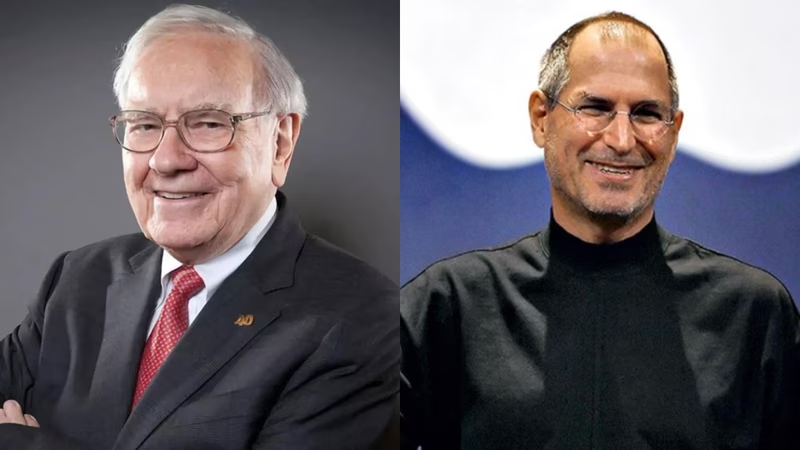
What if you could call a meeting with Steve Jobs to critique your product design? Or ask Warren Buffett whether to acquire a competitor—before your human board even wakes up?
That’s no longer science fiction. Matt Blumberg, CEO of venture studio MarkupAI, has built a real-life “AI fantasy board”—a virtual council of 15 legendary minds, from Jobs and Buffett to Ruth Bader Ginsburg and Nelson Mandela—powered by advanced language models trained on their speeches, writings, and biographies.
This isn’t about replacing human directors. It’s about augmenting leadership with on-demand, round-the-clock counsel from history’s greatest thinkers. And Blumberg says it’s already transforming how he runs meetings, makes strategy calls, and navigates high-stakes decisions.
But is this genius—or just a high-tech echo chamber? Let’s dive into how this AI board works, who’s on it, and what it means for the future of executive leadership.
Table of Contents
- What Is an AI Fantasy Board?
- Meet the Digital Directors
- How It Works: Behind the Scenes
- Real-World Impact on Decision-Making
- Ethical Questions and Limitations
- The Future of Hybrid Leadership
- Conclusion: Wisdom at Your Fingertips
- Sources
What Is an AI Fantasy Board?
An AI fantasy board is a custom-built interface where a CEO can “consult” AI avatars modeled after historical or contemporary icons. Each avatar is fine-tuned using publicly available data—interviews, books, letters, and recorded talks—to simulate how that person might respond to modern business dilemmas.
Blumberg uses his board before key meetings: “I’ll ask, ‘Steve, how would you simplify this feature?’ or ‘Warren, is this valuation sustainable?’ The responses aren’t gospel—but they spark perspectives I’d never consider alone.”
Meet the Digital Directors
Blumberg’s 15-member AI board is a masterclass in diverse thinking:
- Steve Jobs: For product vision and minimalist design philosophy.
- Warren Buffett: For long-term value investing and risk assessment.
- Ruth Bader Ginsburg: For ethical governance and principled decision-making.
- Nelson Mandela: For conflict resolution and inclusive leadership.
- Marie Curie: For scientific rigor and perseverance through failure.
- Others include: Elon Musk (disruption), Indra Nooyi (global strategy), and Leonardo da Vinci (interdisciplinary innovation).
The goal? To avoid groupthink by injecting radically different worldviews into every strategic conversation.
How It Works: Behind the Scenes
While Blumberg hasn’t revealed the exact tech stack, experts believe the system uses:
- Retrieval-Augmented Generation (RAG): Pulls relevant quotes and principles from curated datasets for each figure.
- Persona Fine-Tuning: Custom LLM adapters trained to mimic tone, values, and reasoning patterns.
- Contextual Prompting: The CEO inputs a business scenario; the AI responds as if the historical figure were alive today.
Critically, Blumberg stresses this tool **augments—not replaces—human judgment**. “My real board brings empathy, nuance, and accountability. The AI brings speed and breadth.”
Real-World Impact on Decision-Making
Since implementing the AI board, Blumberg reports three key benefits:
- Faster Scenario Testing: “I can pressure-test a pricing strategy against Buffett’s value lens in minutes.”
- Enhanced Meeting Prep: Human board meetings now start with, “Here’s what my AI board said—let’s debate it.”
- Reduced Confirmation Bias: Mandela’s avatar once challenged a go-to-market plan for lacking inclusivity—a blind spot the team had missed.
For startups and scale-ups, this could democratize access to “world-class” strategic thinking without paying $500K for a celebrity advisor.
Ethical Questions and Limitations
Of course, the concept raises red flags:
- Historical Accuracy: Can an AI truly capture Jobs’ mercurial genius—or just mimic his famous quotes?
- Consent & Legacy: None of these figures consented to being digitized. Is it respectful or exploitative?
- Overreliance Risk: Could leaders start deferring to AI “gurus” instead of trusting their teams?
Blumberg acknowledges these concerns: “This is a thought partner, not an oracle. I treat it like reading a biography—inspiring, but not infallible.”
The Future of Hybrid Leadership
Blumberg’s experiment may be a glimpse into the next evolution of executive tools. Imagine:
- AI boards tailored to industry (e.g., Satya Nadella + Tim Cook for SaaS CEOs)
- Real-time sentiment analysis during meetings fed to your “digital Yoda”
- Integration with CRM and financial data for hyper-contextual advice
As Harvard Business Review notes, “The best leaders of tomorrow will be those who know how to collaborate with both humans and machines.” [INTERNAL_LINK:future-of-leadership].
Conclusion: Wisdom at Your Fingertips
The AI fantasy board isn’t about summoning ghosts—it’s about distilling timeless wisdom into actionable insights for today’s chaotic business world. By standing on the shoulders of giants (digitally), leaders like Blumberg are pioneering a new model of “hybrid intelligence” where human intuition and machine-augmented perspective coexist.
Will your next board meeting include Steve Jobs? Maybe not. But the idea that AI can help us think deeper, broader, and bolder? That’s already here.
Sources
- Times of India: AI ‘fantasy board’ for CEO, creates Steve Jobs, Warren Buffett avatars
- Harvard Business Review – “The Future of Leadership in the AI Era”
- Interview with Matt Blumberg (January 2026, TOI and TechCrunch)
- Stanford Human-Centered AI Institute – Ethical AI Guidelines