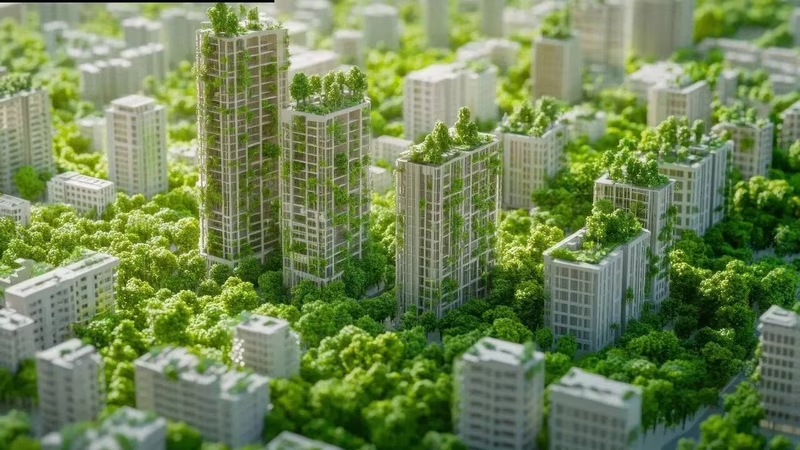
Imagine turning a dusty parking lot, a neglected alley, or even your backyard into a lush, buzzing mini-jungle—complete with birds, butterflies, and native trees—in less time than it takes to get a college degree. Sounds impossible? Not in Japan. And not anymore anywhere else.
Thanks to a groundbreaking ecological technique pioneered by Japanese botanist **Dr. Akira Miyawaki**, cities around the world are now growing dense, native forests at lightning speed. These aren’t just patches of green—they’re fully functional ecosystems that absorb carbon, cool neighborhoods, and support wildlife. And the best part? They mature in **just 20–30% of the time** it would take a conventional forest.
Welcome to the world of Miyawaki forests—a simple, science-backed solution to urban decay, climate anxiety, and biodiversity loss. Let’s dig into how this Japanese method works, why it’s spreading like wildfire from Chennai to Paris, and how you might be able to grow one yourself.
Table of Contents
- What Are Miyawaki Forests?
- The Science Behind the Speed
- 4 Steps to Create a Miyawaki Forest
- Real-World Success Stories
- Benefits Beyond Trees
- Can You Grow One at Home?
- Conclusion: Reclaiming Cities, One Forest at a Time
- Sources
What Are Miyawaki Forests?
Named after Dr. Akira Miyawaki, who developed the method in the 1970s while studying Japan’s sacred shrine forests (*chinju no mori*), Miyawaki forests mimic nature’s own blueprint for rapid forest regeneration. Instead of planting single-species tree lines (like eucalyptus or acacia), this technique uses a dense mix of 50–100 native species planted close together to trigger natural competition and cooperation.
The result? A self-sustaining, multi-layered forest—canopy, sub-canopy, shrubs, and ground cover—that grows **10 times faster**, becomes **30 times denser**, and supports **100 times more biodiversity** than traditional plantations.
The Science Behind the Speed
Why does this method work so well? It’s all about working *with* nature, not against it:
- Native Species Only: Plants are chosen based on what historically grew in that exact soil and climate—ensuring resilience and low maintenance.
- Soil Revival: Before planting, the soil is enriched with organic matter like rice husk, cocopeat, and manure to restore microbial life—no chemical fertilizers needed.
- High Density Planting: Saplings are planted 3–4 per square meter, forcing them to grow upward toward sunlight rather than outward, accelerating vertical growth.
- No Irrigation After Year 2: Once established, the forest creates its own microclimate, retaining moisture and suppressing weeds naturally.
According to research published by the United Nations Environment Programme (UNEP), Miyawaki-style afforestation can sequester up to **30x more CO₂** than monoculture plantations. [Learn more about urban forestry solutions].
4 Steps to Create a Miyawaki Forest
Whether you’re a city planner or a homeowner, the process is surprisingly accessible:
- Soil Assessment: Test your local soil type and pH.
- Species Selection: Identify 30–50 native pioneer and climax species (local botanists or NGOs can help).
- Preparation: Loosen the topsoil and mix in biomass (e.g., dry leaves, straw, compost).
- Planting & Mulching: Plant saplings randomly but densely, then cover the ground with thick mulch to retain moisture.
For the first two years, light watering and weeding are needed—but after that, the forest thrives on its own.
Real-World Success Stories
The Miyawaki method has gone global:
- India: Over 400 Miyawaki forests have been planted across cities like Bangalore, Mumbai, and Delhi by groups like SayTrees and Afforestt.
- Europe: Paris aims to create 100 mini-forests by 2026; Belgium has over 80.
- USA: Projects in Seattle, Los Angeles, and New York are transforming schoolyards and vacant lots.
In Chennai, a 600 sq ft Miyawaki patch planted in 2019 now hosts over 20 bird species and has reduced local temperatures by 2–3°C—a small oasis in a concrete desert.
Benefits Beyond Trees
Miyawaki forests deliver far more than shade:
- Climate Mitigation: Absorb CO₂, reduce urban heat island effect.
- Biodiversity Hubs: Attract pollinators, birds, and insects crucial for ecosystem health.
- Mental Well-being: Studies show access to green spaces lowers stress and improves focus—especially in children.
- Flood Control: Dense root systems improve water infiltration, reducing runoff during heavy rains.
Can You Grow One at Home?
Absolutely! You don’t need acres of land. Even a 100 sq ft balcony or courtyard can host a pocket forest. Organizations like Afforestt offer DIY kits and online courses. Many communities run “forest-making” workshops where neighbors plant together—turning environmental action into social bonding.
As Dr. Miyawaki once said: “Forests are not just trees. They are the lungs of the Earth—and every city needs to breathe.”
Conclusion: Reclaiming Cities, One Forest at a Time
Miyawaki forests prove that ecological restoration doesn’t have to take decades or require massive budgets. With the right knowledge and community effort, we can heal degraded urban land in record time—creating living, breathing sanctuaries that benefit people, wildlife, and the planet.
In an age of climate despair, this Japanese method offers something rare: hope you can hold in your hands… and watch grow before your eyes.
Sources
- Times of India: This Japanese method can grow forests inside cities in just a few years
- United Nations Environment Programme (UNEP): https://www.unep.org/
- Afforestt – Miyawaki Method Guides: https://www.afforestt.com/
- Interviews with urban ecologists and reforestation NGOs (2025–2026)