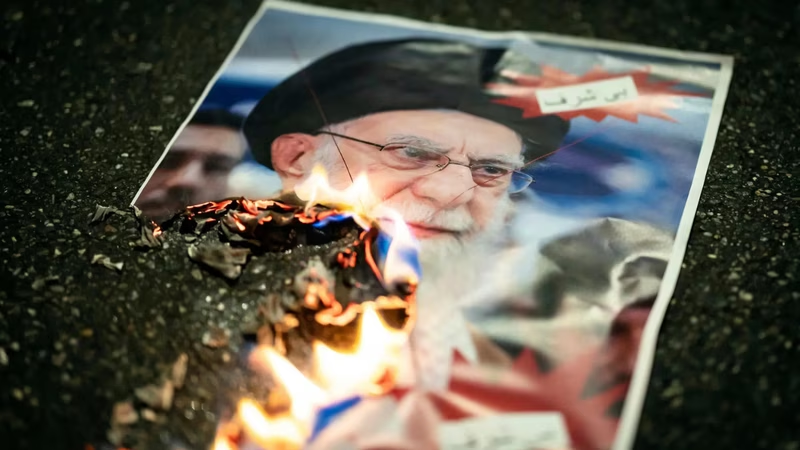
The powder keg that is the Middle East is once again on the verge of a major explosion. In a dramatic escalation of an already volatile situation, the United States has begun repositioning its military personnel from critical regional bases—a move widely interpreted as a defensive posture against a rising tide of threats from Iran.
This isn’t just routine troop rotation. This is a calculated, high-stakes maneuver in response to Tehran’s explicit warning: any US military strike will be met with immediate attacks on American bases across the region. The situation has become so precarious that non-essential personnel have been advised to depart Qatar’s strategically vital Al Udeid Air Base—the nerve center for US Central Command operations in the Middle East .
What’s driving this sudden shift? And how close are we to a full-blown regional conflict? Let’s break down the complex web of events fueling this Middle East crisis.
Table of Contents
- What Is Happening on the Ground?
- The Trigger: Iran Protests and US Threats
- Why Al Udeid Air Base Matters
- Historical Context: A Long-Standing Rivalry
- Global Implications of the Middle East Crisis
- Conclusion: Navigating a Dangerous New Phase
- Sources
What Is Happening on the Ground?
The US Department of Defense has confirmed a “posture change” for its forces stationed across the Middle East. While officials are careful to frame this as a precautionary measure, the reality is more alarming. Non-essential military staff and civilian contractors have been instructed to leave several forward operating locations, with the most significant directive concerning Qatar’s Al Udeid Air Base .
This base is not just another installation; it’s the largest US military facility in the region, housing the Combined Air Operations Center (CAOC) that coordinates all coalition air missions from Syria to Afghanistan. A partial evacuation signals a serious concern about its vulnerability.
The Trigger: Iran Protests and US Threats
The current Middle East crisis stems from a confluence of internal Iranian turmoil and external pressure. A recent government crackdown on domestic protests has drawn sharp international condemnation. In response, the US administration has reportedly floated the idea of targeted military action to deter further human rights abuses—a threat that Tehran has taken extremely seriously.
Iran’s Islamic Revolutionary Guard Corps (IRGC) wasted no time in issuing a chilling counter-warning: “If America dares to strike our soil, our missiles will rain down on their bases from Baghdad to Doha.” This direct threat to US assets in allied nations like Iraq and Qatar has forced Washington’s hand, leading to the current defensive repositioning.
Why Al Udeid Air Base Matters
Understanding the gravity of the situation requires appreciating the strategic importance of Al Udeid:
- Operational Hub: It serves as the primary launchpad for US airpower in the region, including surveillance, drone, and fighter jet operations.
- Logistical Lifeline: The base is a critical logistics and supply node for all US military activities east of Egypt.
- Political Symbol: Its presence in Qatar, a US ally, is a cornerstone of American influence in the Gulf. Any threat to it is a direct challenge to that influence.
An attack on Al Udeid would not just be a military setback; it would be a geopolitical earthquake, potentially dragging multiple nations into a wider conflict.
Historical Context: A Long-Standing Rivalry
This isn’t the first time the US and Iran have stood on the brink. The animosity dates back to the 1979 Iranian Revolution and the subsequent hostage crisis. Over the decades, the rivalry has played out through proxy wars in Lebanon, Iraq, Syria, and Yemen.
The 2020 assassination of IRGC commander Qasem Soleimani by a US drone strike brought the two nations to the edge of open war. While a full-scale conflict was averted then, the underlying tensions never truly subsided. The current standoff over the US military withdrawal Middle East is the latest, and perhaps most dangerous, chapter in this decades-long saga.
Global Implications of the Middle East Crisis
The fallout from this escalating crisis extends far beyond the region’s borders:
- Oil Markets: Any disruption to shipping lanes in the Strait of Hormuz could send global oil prices soaring, triggering a worldwide economic shock.
- Alliance Stability: US allies in the Gulf, particularly Saudi Arabia and the UAE, are watching nervously. Their own security doctrines are deeply intertwined with the American military presence.
- Global Security: A wider conflict could empower extremist groups and create a massive refugee crisis, destabilizing Europe and Asia.
The world is holding its breath, hoping that cooler heads will prevail. For a deeper analysis of global energy security in such scenarios, see the International Energy Agency’s reports at [INTERNAL_LINK:global-energy-security].
Conclusion: Navigating a Dangerous New Phase
The current Middle East crisis represents a perilous inflection point. The US decision to reposition its forces is a clear signal that the threat from Iran is being treated with the utmost seriousness. Meanwhile, Tehran’s aggressive rhetoric shows it is prepared to defend its sovereignty at any cost.
While both sides may be engaging in a high-stakes game of brinkmanship, the risk of a miscalculation is terrifyingly real. The evacuation of personnel from Al Udeid is not just a logistical detail; it’s a flashing red warning light for the entire international community. The path forward requires intense diplomacy, clear communication, and a shared desire to avoid a catastrophic war that no one truly wants—but everyone must now prepare for.
Sources
- Times of India: Middle East on boil: US asks military personnel to depart bases; Iran issues warning
- US Department of Defense Official Statements
- International Energy Agency (IEA): https://www.iea.org/
- Reuters and Associated Press reporting on regional developments