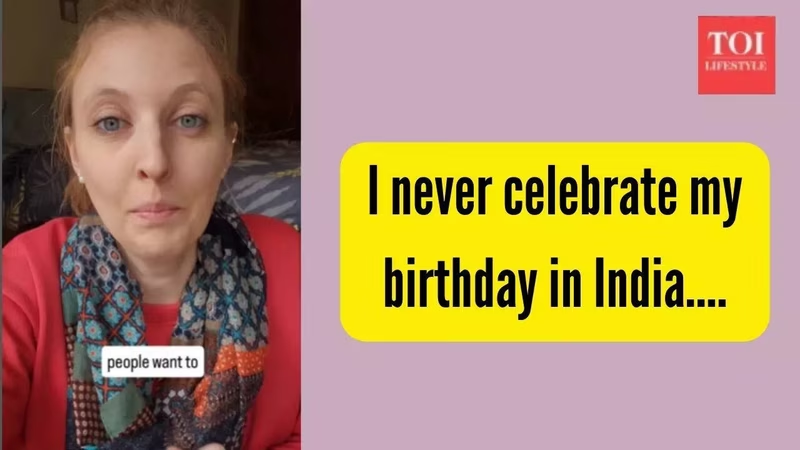
Imagine falling so deeply in love with a country that you pack up your life and move there permanently—only to quietly stop celebrating one of your most personal milestones: your birthday. That’s exactly what happened to Kristen Fischer, an American travel writer who’s called India home for the past four years.
Despite her profound affection for Indian culture, food, and people, Kristen has made a conscious decision: she no longer marks her birthday while living in India. And it’s not because she’s unhappy—far from it. It’s because the way birthdays are perceived and celebrated here clashes so starkly with her own emotional expectations that the day has “lost its appeal” entirely .
This isn’t just a quirky personal habit—it’s a window into the subtle, often overlooked challenges of cross-cultural living. For expats and digital nomads considering a long-term stay in India, Kristen’s story offers valuable insight into how even joyful rituals can become sources of quiet dissonance.
Table of Contents
- Who Is Kristen Fischer—and Why She Loves India
- The Birthday in India Dilemma: Cultural Misalignment
- How Indians and Americans View Birthdays Differently
- The Emotional Toll of Unmet Expectations
- What Expats Can Learn From This Experience
- Embracing India on Your Own Terms
- Sources
Who Is Kristen Fischer—and Why She Loves India
Kristen and her husband first arrived in India as tourists. But something about the chaos, color, and warmth of everyday life captivated them. Within months, they’d decided to stay—not just for a year, but indefinitely. Today, they run a travel blog chronicling their adventures across Rajasthan, Kerala, and beyond .
She speaks fondly of chai breaks with neighbors, Diwali celebrations, and the generosity of strangers. So her aversion to celebrating her birthday in India isn’t born of resentment—it’s a nuanced response to a specific cultural gap.
The Birthday in India Dilemma: Cultural Misalignment
In the U.S., birthdays are intensely personal, often centered on the individual: surprise parties, heartfelt messages, gifts chosen with care, and a full day of being “the star.” In many parts of India—especially outside cosmopolitan circles—birthdays are more low-key, communal, or even overlooked unless it’s a milestone (like a 1st or 60th).
Kristen found that despite her close friendships here, the emotional weight she associates with her birthday simply doesn’t translate. As she put it: “No one forgets your birthday back home. Here, it’s easy to go unnoticed—and that silence hurts more than I expected” .
How Indians and Americans View Birthdays Differently
The contrast goes deeper than party size:
- Individualism vs. Collectivism: Western birthdays celebrate the self; Indian celebrations often emphasize family duty or religious rituals (like fasting or temple visits).
- Gift Culture: In the U.S., personalized gifts are common. In India, cash or sweets may be given—but not always on the exact day.
- Public Acknowledgment: Social media “happy birthday” posts flood American feeds. In India, such public displays are less universal, especially among older generations.
For someone raised in a culture where your birthday = your day, the absence of fanfare can feel like invisibility—not humility.
The Emotional Toll of Unmet Expectations
Psychologists note that expats often experience “cultural grief”—a mourning for small, familiar comforts lost in translation . A birthday might seem trivial, but it’s tied to identity, memory, and belonging.
Kristen isn’t asking India to change. Instead, she’s adapted by either traveling abroad for her birthday or keeping it private. “I’ve learned to protect my joy,” she says. “If celebrating here makes me sad, I won’t do it. Loving a country doesn’t mean forcing yourself into its rhythms when they wound you.”
What Expats Can Learn From This Experience
Her story offers practical wisdom for anyone living abroad:
- Identify Your Non-Negotiables: What rituals anchor your sense of self? Protect them.
- Communicate Gently: If your birthday matters, tell close friends—but don’t expect them to perform Western norms.
- Create Hybrid Traditions: Blend cultures! Have an Indian-style lunch with cake afterward.
- Give Yourself Grace: It’s okay to skip a celebration if it brings more stress than joy [[INTERNAL_LINK:expat-mental-health-india]].
Embracing India on Your Own Terms
Kristen’s choice isn’t rejection—it’s self-awareness. She still calls India home. She still lights diyas during Karva Chauth and dances at weddings. But she’s also honest about where the fit isn’t perfect. And that honesty, paradoxically, is what allows her to stay.
As more global citizens consider relocating to India—a country both enchanting and complex—stories like hers remind us that true cultural integration isn’t about erasing your roots. It’s about weaving them into a new tapestry, even if some threads remain separate.
Sources
- Times of India: I never celebrate my birthday in India: US woman shares culture shock
- Interview excerpts and quotes from Kristen Fischer’s blog and social media
- American Psychological Association (APA): Cultural Adjustment and Expat Mental Health