Table of Contents
- Musk Drops a Bombshell on Medical Education
- AI in Healthcare: Where We Stand Today
- Can AI Really Outperform Human Doctors?
- What This Means for Future Medical Students
- Ethical and Practical Challenges of AI-Driven Medicine
- Experts Push Back: Is Musk Overstating the Case?
- Conclusion: Augmentation, Not Replacement
- Sources
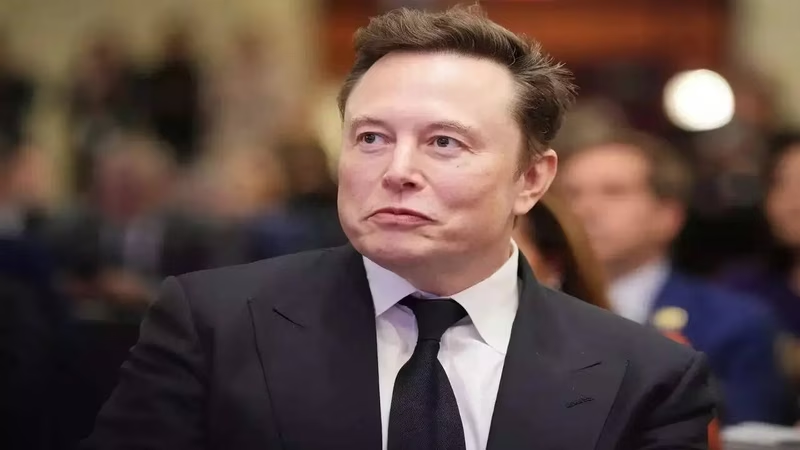
“Going to medical school might be a waste of time.” That’s the stark warning from none other than Elon Musk, who recently claimed that artificial intelligence is advancing so rapidly it could soon render traditional medical training obsolete. Speaking at a tech forum, Musk argued that future AI systems will not only match but exceed human doctors in diagnostic accuracy, treatment planning, and even bedside manner—thanks to vast data processing and emotional simulation capabilities . His comments have sent shockwaves through the medical and tech communities, reigniting a fierce debate about the role of AI in healthcare and whether the noble profession of medicine is facing an existential disruption.
Musk Drops a Bombshell on Medical Education
Musk’s assertion isn’t entirely new—he’s long been vocal about AI’s potential to surpass human cognition—but applying it directly to medical education is particularly jarring. Medical school typically requires over a decade of grueling study, residency, and specialization, costing students hundreds of thousands of dollars. If AI can deliver superior outcomes with zero fatigue, bias, or ego, Musk asks, why subject humans to such a costly and time-intensive path?
He envisions a future where an AI “doctor” accessible via smartphone could analyze symptoms, cross-reference millions of case studies in seconds, recommend personalized treatments, and even monitor patient adherence—all without the risk of human error, which the WHO estimates contributes to 2.6 million deaths annually worldwide .
AI in Healthcare: Where We Stand Today
While Musk’s vision sounds futuristic, the foundation is already being laid. AI in healthcare is no longer theoretical—it’s operational:
- Diagnosis: Google’s DeepMind can detect over 50 eye diseases with 94% accuracy—matching top ophthalmologists.
- Radiology: AI tools like Aidoc and Zebra Medical analyze CT scans and MRIs faster and often more accurately than radiologists.
- Drug Discovery: Companies like Insilico Medicine use AI to cut drug development time from years to months.
- Administrative Tasks: AI handles scheduling, billing, and documentation, freeing up 30% of clinicians’ time .
[INTERNAL_LINK:ai-healthcare-applications] shows these tools are already saving lives—but they’re assistants, not replacements.
Can AI Really Outperform Human Doctors?
Proponents argue yes—especially in data-heavy specialties like pathology, radiology, and genomics. AI doesn’t get tired, doesn’t overlook subtle patterns, and learns continuously. A 2025 Stanford study found an AI model outperformed 87% of dermatologists in identifying malignant skin lesions .
But critics highlight critical gaps. AI lacks true empathy, contextual understanding, and ethical judgment. Can an algorithm comfort a grieving family? Navigate cultural sensitivities? Make a judgment call when data is incomplete? These “human” elements remain irreplaceable in holistic care.
What This Means for Future Medical Students
Musk’s warning should be a wake-up call—not a death knell—for aspiring physicians. The future likely belongs to “augmented doctors”: clinicians who leverage AI as a super-tool while focusing on communication, ethics, and complex decision-making.
Medical curricula are already evolving. Top schools like Harvard and Johns Hopkins now teach AI literacy, data interpretation, and human-AI collaboration. As Dr. Eric Topol, author of *Deep Medicine*, states: “The best doctor of the future won’t compete with AI—they’ll command it” .
Ethical and Practical Challenges of AI-Driven Medicine
Even if AI becomes technically superior, major hurdles remain:
- Bias in Data: AI trained on non-diverse datasets can misdiagnose women or minorities.
- Accountability: Who’s liable if an AI prescribes a fatal dose—the developer, hospital, or algorithm?
- Privacy: Health data is the most sensitive; breaches could be catastrophic.
- Access Inequality: Will only the wealthy benefit from AI doctors, widening health disparities?
These aren’t technical bugs—they’re societal questions requiring regulation, transparency, and public trust.
Experts Push Back: Is Musk Overstating the Case?
Many leading physicians disagree with Musk’s absolutism. “Medicine is science, but healing is an art,” says Dr. Atul Gawande. “No algorithm can replicate the therapeutic alliance between patient and doctor” .
The World Medical Association emphasizes that AI should support—not supplant—clinical judgment. And while AI excels at pattern recognition, it struggles with rare diseases, ambiguous presentations, and psychosocial factors that define real-world medicine.
Conclusion: Augmentation, Not Replacement
Elon Musk’s warning about medical school may be hyperbolic, but it’s not baseless. The rise of AI in healthcare is inevitable and accelerating. However, the future isn’t a world without doctors—it’s a world where doctors wield AI to achieve unprecedented precision, efficiency, and compassion. Rather than making medical education pointless, AI may redefine it, elevating the physician’s role from information processor to empathetic healer and strategic decision-maker. The stethoscope isn’t disappearing—it’s getting smarter.
Sources
- Times of India: Musk warns medical school could be pointless: AI may outperform human doctors
- World Health Organization (WHO): Patient Safety and Medical Errors Report
- Nature Medicine: AI in Clinical Practice: 2025 Review
- Stanford University AI in Dermatology Study (2025)
- Dr. Eric Topol, *Deep Medicine: How Artificial Intelligence Can Make Healthcare Human Again* (2019)
- Dr. Atul Gawande, Public Statements on AI and Medicine (NEJM, 2025)