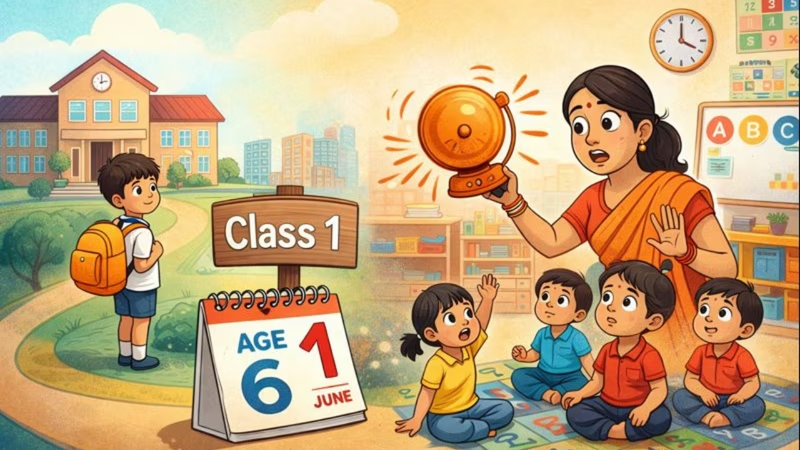
Starting school just got a little later in Goa—and possibly across India. The state has officially raised the minimum age for Class 1 admission to six years through the newly introduced Goa School Education Bill, 2026. On the surface, it’s a simple administrative tweak. But beneath it lies a seismic shift in how India views early learning—one that aligns with the National Education Policy (NEP) 2020 but exposes a glaring gap: the unprepared state of pre-school education nationwide.
Table of Contents
- What Does the Goa Class 1 Age Change Mean?
- Why Six Years Old? The Neuro-Scientific Reasoning
- A National Trend: India Slows Down Formal Schooling
- The Real Alarm: Pre-School Quality Crisis
- Challenges for Parents and Private Schools
- Conclusion
- Sources
What Does the Goa Class 1 Age Change Mean?
Under the Goa Class 1 age revision, children must now be at least six years old by June 1 of the academic year to enroll in Grade 1. This replaces the previous cutoff, which allowed entry at age five or even younger in some private institutions .
The move brings Goa in line with the Right to Education (RTE) Act framework and the vision of NEP 2020, which restructures schooling into a 5+3+3+4 model. In this model, the foundational stage includes three years of pre-school (ages 3–6) followed by Grades 1–2 (ages 6–8). The goal? To ensure children enter formal academics only after developing crucial cognitive, social, and emotional skills .
Why Six Years Old? The Neuro-Scientific Reasoning
This isn’t arbitrary. Developmental psychologists and education researchers have long argued that the brain undergoes critical maturation between ages 4 and 6. By age six, most children develop:
- Better attention spans (able to focus for 15–20 minutes)
- Improved language comprehension and expression
- Greater emotional regulation and peer interaction skills
- Readiness for structured literacy and numeracy tasks
Pushing formal reading, writing, and arithmetic too early—before these foundations are solid—can lead to frustration, learning gaps, and even long-term disengagement from school . As the NEP emphasizes, “learning should not be rushed” .
A National Trend: India Slows Down Formal Schooling
Goa isn’t acting alone. States like Karnataka, Tamil Nadu, and Maharashtra have also begun aligning their admission policies with NEP 2020. The central government is actively encouraging this shift, viewing early childhood education (ECE) as the bedrock of lifelong learning.
Historically, India’s school entry age varied wildly—some elite private schools admitted kids to “nursery” as young as two, creating pressure on parents to enroll toddlers in academic prep. The new consensus flips that script: play-based, holistic development before formal instruction.
The Real Alarm: Pre-School Quality Crisis
Here’s the catch: while the policy is sound, the infrastructure isn’t ready. The biggest challenge isn’t delaying Class 1—it’s ensuring that the three pre-school years (ages 3–6) are actually high-quality.
Currently, India’s pre-school landscape is a patchwork:
- Anganwadis: Government-run centers under ICDS serve over 80 million children but often lack trained ECE educators and age-appropriate learning materials .
- Private Pre-Primary Schools: Vary widely in quality; many still emphasize rote learning over play-based pedagogy.
- Regulatory Gaps: Pre-schools fall outside the RTE Act’s purview, meaning no uniform standards for teacher qualifications, curriculum, or safety.
Without fixing this, raising the Goa Class 1 age could simply push unprepared children into an under-resourced pre-school system—defeating the entire purpose. As one education expert noted, “Delaying entry without strengthening foundations is like building a house on sand” .
Challenges for Parents and Private Schools
Parents are caught in the middle. Many worry about “falling behind” if their child starts formal school later. Others struggle to find affordable, quality pre-school options—especially in rural or semi-urban areas.
Private schools, meanwhile, face operational dilemmas. Some may resist the change, fearing reduced enrollment cycles. Others are adapting by redesigning their pre-primary curricula around NEP guidelines—but this requires investment in teacher training and classroom resources they may not have.
For families navigating this transition, understanding developmental readiness—not just calendar age—is key. For more guidance, see our parent resource on [INTERNAL_LINK:early-childhood-readiness-checklist].
Conclusion
Raising the Goa Class 1 age to six is a bold and research-backed step toward child-centric education. It reflects a mature understanding that childhood isn’t a race. But its success hinges entirely on whether India can transform its pre-school ecosystem from fragmented and uneven to cohesive, equitable, and high-quality. Without that, the policy risks becoming well-intentioned symbolism rather than meaningful reform.
Sources
- Times of India. (2026). Goa raises Class 1 age to six: India slows school entry, but the real alarm rings in pre-schools. Retrieved from https://timesofindia.indiatimes.com/education/news/goa-raises-class-1-age-to-six-india-slows-school-entry-but-the-real-alarm-rings-in-pre-schools/articleshow/126522943.cms
- Ministry of Education, Government of India. (2020). National Education Policy 2020. Retrieved from https://www.education.gov.in/sites/upload_files/mhrd/files/NEP_Final_English_0.pdf
- UNICEF India. (2025). Early Childhood Education in India: Status and Challenges. Retrieved from https://www.unicef.org/india/
- National Council of Educational Research and Training (NCERT). (2023). Foundational Stage Curriculum Framework.
- Integrated Child Development Services (ICDS). Annual Report 2024-25. Ministry of Women and Child Development.