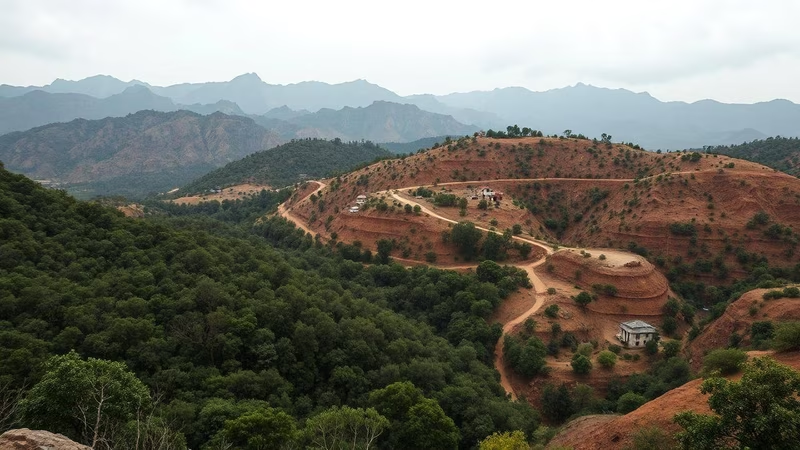
Stretching over 690 kilometers across Rajasthan, Haryana, Delhi, and Gujarat, the Aravalli Range is more than just a scenic backdrop—it’s India’s oldest geological formation and its most critical natural defense against the Thar Desert. But this ancient shield is crumbling. A damning new study reveals that decades of **encroachments, illegal mining, and explosive urban sprawl** have pushed the Aravallis to the edge of ecological collapse .
The data is stark: forest cover has plummeted, groundwater recharge zones are vanishing, and native species—from leopards to rare birds—are disappearing. What’s even more alarming is that the degradation isn’t just an environmental tragedy; it’s a direct threat to the water security and air quality of over 50 million people in the National Capital Region (NCR) and beyond. This isn’t a future risk—it’s happening now. And if we don’t act, the Aravallis may lose their ability to function as a life-sustaining ecosystem forever.
Table of Contents
- What Is Aravali Degradation and Why It Matters
- Aravali degradation: The Three Pillars of Destruction
- Ecological Consequences: Groundwater, Biodiversity, and Air Quality
- The Desertification Threat: How Aravalli Loss Accelerates Dust Storms
- A Path Forward: The Community-Inclusive Eco-Restoration Model
- Conclusion: Saving the Aravallis Is Saving Our Future
- Sources
What Is Aravali Degradation and Why It Matters
The Aravallis are estimated to be over 1.8 billion years old—older than the Himalayas. Historically, they’ve acted as a “green wall,” trapping moisture, recharging aquifers, and blocking desert winds from sweeping into fertile plains. But rapid development since the 1990s has turned this barrier into a construction site.
According to the recent study, nearly **30% of the Aravalli’s natural vegetation** in Haryana and Delhi has been lost in the last two decades alone . This isn’t just about trees; it’s about the entire hydrological and climatic balance of northern India.
Aravali degradation: The Three Pillars of Destruction
The study identifies three interconnected drivers behind the crisis:
- Illegal and Unregulated Mining: Despite Supreme Court bans and NGT orders, stone crushers and open-pit mines continue to operate, especially in Rajasthan and southern Haryana. Hills are literally being flattened for construction material .
- Real Estate Encroachments: Luxury housing projects, golf courses, and industrial parks have sprung up on protected forest land. The infamous “Aravalli Golf Course” in Gurgaon is just one example of how legal loopholes and weak enforcement enable destruction .
- Unplanned Urban Sprawl: Cities like Faridabad, Gurugram, and Alwar have expanded without ecological zoning, paving over catchment areas and wildlife corridors with concrete and asphalt.
These activities don’t just scar the landscape—they sever the ecological arteries that keep the region alive.
Ecological Consequences: Groundwater, Biodiversity, and Air Quality
The fallout from Aravali degradation is already visible:
- Groundwater Crisis: The Aravallis are a major recharge zone for aquifers feeding Delhi, Gurugram, and Jaipur. Deforestation and soil compaction have reduced percolation, causing water tables to drop by 1–3 meters annually in some districts .
- Biodiversity Collapse: Once home to leopards, hyenas, and over 150 bird species, fragmented habitats now isolate wildlife populations, increasing human-animal conflict and local extinctions.
- Air Quality Deterioration: With fewer trees to trap dust and pollutants, particulate matter (PM2.5 and PM10) levels in NCR cities have worsened, especially during summer dust storms originating from degraded western zones .
The Desertification Threat: How Aravalli Loss Accelerates Dust Storms
Perhaps the most urgent warning from the study is the link between Aravali degradation and advancing desertification. As the range’s vegetative cover thins, it loses its ability to anchor soil and block hot, dry winds from Rajasthan.
This has led to more frequent and intense dust storms in Delhi and Haryana—events once rare but now annual occurrences. Scientists warn that without intervention, parts of southern Haryana could become semi-arid within 20 years, mirroring conditions in western Rajasthan .
The Indian government’s own Desertification and Land Degradation Atlas confirms that Haryana has seen a 3% increase in degraded land since 2011—with the Aravalli belt being the epicenter .
A Path Forward: The Community-Inclusive Eco-Restoration Model
Amid the grim findings, the study offers hope: a proposed **community-inclusive eco-restoration model**. This approach moves beyond top-down conservation and empowers local villagers, farmers, and indigenous communities as stewards of the land.
Key elements include:
- Reviving traditional water harvesting structures like *johads* and *talabs* to boost groundwater.
- Planting native, drought-resistant species (e.g., *Prosopis cineraria*, *Acacia senegal*) instead of exotic ornamentals.
- Creating eco-sensitive village councils with legal authority to report encroachments and manage micro-watersheds.
- Linking restoration efforts to livelihoods through agroforestry and eco-tourism.
[INTERNAL_LINK:sustainable-land-management-india] shows that such models have succeeded in Rajasthan’s Alwar district—proof that regeneration is possible.
Conclusion: Saving the Aravallis Is Saving Our Future
The Aravali degradation crisis is not a regional issue—it’s a national emergency. The fate of India’s capital, its food bowls, and millions of citizens hinges on whether we can restore this ancient mountain chain. The science is clear, the solutions exist, and the time to act is now. Protecting the Aravallis isn’t about saving rocks and trees; it’s about securing water, air, and climate stability for generations to come.
Sources
- Times of India. (2026, January). Aravali degradation: Encroachments, mining & urban sprawl hit ecology – study.
- National Green Tribunal (NGT) Orders on Aravalli Mining.
- Supreme Court of India. (2019). Aravalli Ridge Protection Case (Writ Petition No. 71 of 2018).
- Central Pollution Control Board (CPCB). (2025). Air Quality Trends in NCR.
- Indian Institute of Remote Sensing (ISRO). Desertification and Land Degradation Atlas of India. https://www.nrsc.gov.in/ [[5], [6]]