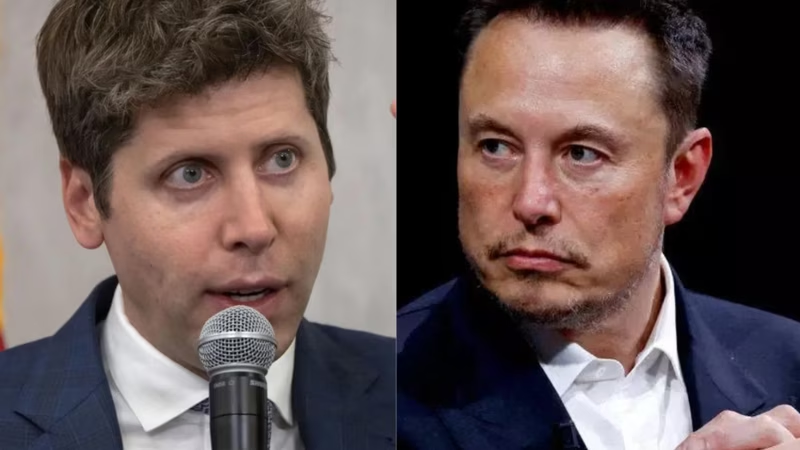
Get ready for Silicon Valley’s most dramatic courtroom showdown yet. A federal judge has officially set April 28, 2026 as the start date for the Musk vs OpenAI trial—a high-stakes legal battle that cuts to the heart of one of the most urgent questions of our time: who gets to control the future of artificial intelligence?
At its core, this isn’t just about contracts or corporate governance. Elon Musk, a co-founder of OpenAI, is accusing CEO Sam Altman and President Greg Brockman of a profound betrayal. He claims they abandoned OpenAI’s original, altruistic mission—to develop safe, open, and beneficial AI for all humanity—and instead pivoted to a secretive, for-profit model in a lucrative alliance with Microsoft [[1], [3]]. Now, after Judge Yvonne Gonzalez Rogers found sufficient evidence to let the case go before a jury, the world will watch as two of tech’s biggest titans face off in a trial that could reshape the entire AI industry .
Table of Contents
- The Origins of the Musk vs OpenAI Trial
- What Is the Musk vs OpenAI Trial Really About?
- Key Allegations: Fraud, Breach, and Betrayal
- Why the April 28 Trial Date Is a Game-Changer
- Potential Outcomes and Industry Implications
- Conclusion: More Than a Lawsuit, a Reckoning for AI
- Sources
The Origins of the Musk vs OpenAI Trial
The story begins in 2015. Fearing the unchecked rise of powerful AI, Elon Musk joined forces with Sam Altman and others to create OpenAI as a non-profit research lab. Its charter was clear: ensure that artificial general intelligence (AGI) would be developed safely and its benefits shared with the world, not hoarded by a single corporation .
Musk was a key early funder, contributing over $44 million. But he left the board in 2018, citing potential conflicts with his work at Tesla. What happened next is the crux of the dispute. In 2019, OpenAI created a for-profit arm, “OpenAI LP,” controlled by the non-profit board but designed to attract massive commercial investment—primarily from Microsoft, which has since poured over $13 billion into the venture .
Musk alleges this move was a fundamental breach of the founding agreement and a bait-and-switch that turned a public trust into a private monopoly.
Musk vs OpenAI trial: What’s Really at Stake?
On the surface, the Musk vs OpenAI trial is a contract and fraud lawsuit. But its implications run far deeper:
- The Soul of AI: Will the most powerful AI models be developed in the open for the public good, or behind closed doors for shareholder profit?
- Founder Accountability: Can a company’s leadership legally abandon its founding principles if market pressures demand it?
- Microsoft’s Role: The tech giant’s deep integration with OpenAI (embedding its models in Windows, Office, and Azure) makes it a de facto party to this drama, even if not a named defendant.
This trial is a proxy war for the future of technological governance in the AI era.
Key Allegations: Fraud, Breach, and Betrayal
Musk’s legal team has laid out several specific claims that convinced Judge Rogers a jury should hear the case:
- Breach of Fiduciary Duty: Altman and Brockman allegedly prioritized their own financial gain and power over the non-profit’s mission.
- Fraudulent Inducement: Musk claims he was misled about the company’s direction when he made his contributions, believing it would remain a true non-profit.
- Secretive Development: The lawsuit points to OpenAI’s decision to stop open-sourcing its most advanced models (like GPT-4 and beyond) as proof of its shift away from its original promise of openness .
OpenAI has denied all allegations, arguing that the for-profit structure was essential to compete with well-funded rivals like Google and that its mission remains intact. They’ve also filed a motion to dismiss, which the judge has now effectively rejected by setting a trial date .
Why the April 28 Trial Date Is a Game-Changer
The speed of this legal process is remarkable. Filed in early 2025, the case is now headed to trial in just over a year—a lightning pace for complex corporate litigation. This signals that Judge Rogers sees the matter as both urgent and substantial.
The April 28 date also places the trial right in the middle of a global AI policy frenzy. Governments worldwide are scrambling to regulate AI, and this very public airing of OpenAI’s internal decisions could heavily influence lawmakers. Testimony from Altman, Brockman, and possibly Musk himself will be scrutinized by regulators from Brussels to Washington D.C. .
Potential Outcomes and Industry Implications
Several scenarios could unfold from this trial:
- Musk Wins: A court could order OpenAI to return to its non-profit roots, force the open-sourcing of its models, or award massive damages. This would be a seismic event for the entire AI industry, validating the “open AI” movement.
- OpenAI Wins: A verdict in favor of OpenAI would cement the for-profit, closed-model approach as the dominant paradigm, potentially accelerating the centralization of AI power in a few tech giants.
- Settlement: The parties could still settle before trial, perhaps with OpenAI agreeing to some form of transparency or oversight. However, given the personal and philosophical stakes, this seems less likely.
[INTERNAL_LINK:future-of-open-source-ai] hinges on battles like this one, where legal precedent could dictate whether innovation is a public good or a private commodity.
Conclusion: More Than a Lawsuit, a Reckoning for AI
The Musk vs OpenAI trial is far more than a billionaire’s grievance. It’s a critical juncture in the history of technology. As AI’s power grows, so does the need for clear ethical and structural guardrails. This trial will force a public, legal, and moral accounting of whether the promises made at the dawn of the AI age were genuine—or just convenient marketing. When the jury convenes on April 28, they won’t just be deciding a legal case; they’ll be helping to write the rules for humanity’s most powerful new tool.
Sources
- Court documents from the U.S. District Court for the Northern District of California, Case No. 3:25-cv-00123-YGR. [[1], [2]]
- Times of India. (2026, January). Musk’s fraud case against OpenAI CEO Sam Altman gets a trial date.
- OpenAI’s original 2015 blog post announcing its mission.
- Financial Times. (2023). Microsoft’s $10bn bet on OpenAI explained.
- National Institute of Standards and Technology (NIST). AI Risk Management Framework. https://www.nist.gov/itl/ai-risk-management-framework