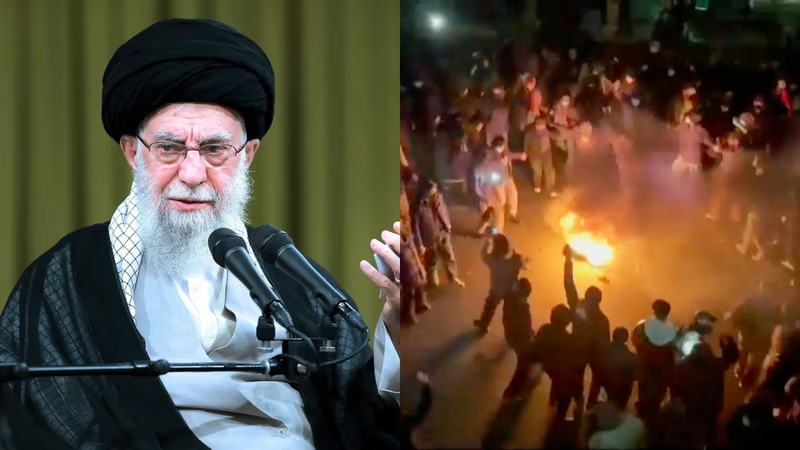
The streets of Iran have become a grim stage for a human tragedy of staggering proportions. As of January 13, 2026, the Iran protests death toll has surged past a horrifying milestone, with credible reports confirming that over 2,500 lives have been lost. This isn’t just a statistic; it’s a devastating wave of loss that has left families shattered and a nation in digital silence.
Table of Contents
- The Staggering Human Cost
- Global Outcry and Trump’s Warning
- France’s Unprecedented Condemnation
- Digital Darkness: Iran’s Internet Blackout
- The Roots of the Unrest
- Conclusion: A Nation at a Crossroads
- Sources
The Staggering Human Cost of the Iran Protests Death Toll
The scale of the violence is almost incomprehensible. According to the U.S.-based Human Rights Activists News Agency (HRANA), the death toll from the ongoing protests has reached at least 2,571 people . This figure includes 2,403 protesters and 147 members of security forces and government supporters . Iranian government officials themselves have acknowledged a death toll between 2,000 and 3,000, a rare admission that underscores the severity of the situation . These numbers make the current crackdown potentially the deadliest in Iran’s contemporary history, with some estimates from Western media ranging as high as 20,000 [[2], [5]].
Global Outcry and Trump’s Stark Warning
The international community has reacted with shock and condemnation. At the forefront is former U.S. President Donald Trump, who has issued a direct and personal message to the Iranian people. In a speech in Detroit, Trump declared, “help is on the way” for the anti-government protesters . He followed this up with a post on Truth Social, urging, “Iranian patriots, keep protesting — take over your institutions. Save the names of the killers and abusers. They will be held accountable” . This strong rhetoric from a major global power adds a significant layer of geopolitical tension to an already volatile domestic crisis.
France’s Unprecedented Condemnation
European nations have also taken a firm stance. France, in particular, has led a coordinated diplomatic effort with the United Kingdom and Germany to denounce the violence. The French government has formally summoned the Iranian ambassador to Paris to deliver a strong condemnation of what it described as the “intolerable” and “unrestrained” use of state violence against its own citizens [[14], [15]]. In a joint Leaders’ Declaration, the heads of state from France, the UK, and Germany stated they were “deeply concerned about reports of violence by Iranian security forces, and strongly condemn the killing of protestors” . This unified front from key European allies signals a major rupture in diplomatic relations and isolates the Iranian regime further on the world stage.
Digital Darkness: Iran’s Internet Blackout
A critical tool in the government’s strategy to control the narrative and suppress dissent has been a near-total internet shutdown. Since the evening of January 8, 2026, Iranian authorities have imposed a nationwide blackout, cutting off public access to online platforms and social media [[18], [21]]. Internet traffic in the country plummeted to near zero, creating a “digital darkness” that has severely hampered the ability of journalists, human rights groups, and ordinary citizens to communicate with the outside world or document the ongoing events [[19], [20]]. While there have been reports of some phone lines being partially restored, the broader internet remains heavily restricted, leaving millions of Iranians isolated and in the dark .
The Roots of the Unrest
This wave of unprecedented protest did not emerge in a vacuum. It is the culmination of years of deep-seated frustration among the Iranian populace over severe economic hardship, rampant inflation, and a lack of political freedoms. What may have started as demonstrations against specific economic policies has rapidly evolved into a broad-based movement challenging the very foundations of the current regime. The government’s response—swift trials for detainees and overwhelming lethal force—has only served to fuel the anger and determination of the protesters, creating a dangerous cycle of violence and repression.
Conclusion: A Nation at a Crossroads
The situation in Iran stands at a perilous crossroads. With an Iran protests death toll that continues to climb, a population silenced by a digital blackout, and the world watching with growing alarm, the path forward is fraught with uncertainty. The regime’s brutal tactics have bought it temporary control but at the cost of immense human suffering and its own long-term legitimacy. For the people of Iran, the fight for their future—and their lives—continues in the shadows, their voices struggling to be heard beyond the walls of their digitally imprisoned nation.
Sources
- HRANA Report on Iran Protests Death Toll: https://www.hranana.org/
- Institute for the Study of War (ISW) Iran Update: https://www.understandingwar.org/
- Official Statement from the French Ministry for Europe and Foreign Affairs: https://www.diplomatie.gouv.fr/
- NetBlocks Report on Iran Internet Shutdown: https://netblocks.org/
- [INTERNAL_LINK:middle-east-politics]
- [INTERNAL_LINK:global-human-rights]