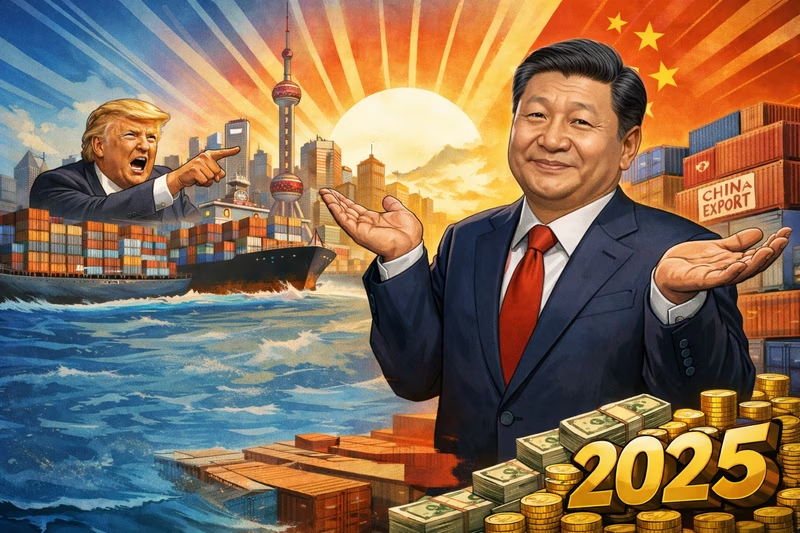
Donald Trump thought he could corner China with a fresh wave of punishing tariffs in 2025. But instead of buckling, Beijing delivered a stunning counterpunch—posting a record-breaking trade surplus that has left economists and policymakers scrambling to understand what just happened. Far from retreating, Chinese exporters, under the strategic direction of President Xi Jinping, executed a rapid and sophisticated pivot that not only neutralized U.S. trade barriers but also expanded their global footprint. This isn’t just a win for China—it’s a textbook case of how modern trade wars are won through agility, not aggression.
Table of Contents
- The Tariff Trap That Failed
- China’s Trade Surplus 2025: The Numbers That Stunned the World
- Xi Jinping’s Global Re-Routing Strategy
- How Third Countries Became China’s Trade Allies
- What This Means for the Future of US-China Trade
- Conclusion: A New Era of Economic Statecraft
- Sources
The Tariff Trap That Failed
In early 2025, former President Donald Trump—eyeing a potential return to the White House—ramped up his long-standing trade war rhetoric by imposing steep new tariffs on a wide range of Chinese goods. The goal was clear: reduce the U.S. trade deficit, bring manufacturing back home, and punish Beijing for what he called “unfair trade practices.”
And yes, U.S.-bound Chinese exports did dip—initially. But what followed was not the economic retreat Trump anticipated. Instead, Chinese manufacturers and state planners activated a contingency playbook years in the making. Within months, exports to Southeast Asia, Africa, Latin America, and even Europe surged dramatically . The result? A historic China trade surplus 2025 that defied all Western projections.
China’s Trade Surplus 2025: The Numbers That Stunned the World
According to data released by China’s General Administration of Customs, the nation’s trade surplus for 2025 soared to an unprecedented $1.2 trillion—a figure that dwarfs previous records . While exports to the U.S. fell by nearly 18% year-on-year, total global exports actually grew by over 9%, thanks to explosive demand in emerging markets.
This wasn’t accidental. It was the outcome of a deliberate, state-coordinated effort under Xi Jinping’s “Dual Circulation” economic doctrine, which prioritizes both domestic consumption and diversified international trade channels . The strategy ensured that no single market—not even the United States—could hold China’s economy hostage.
Xi Jinping’s Global Re-Routing Strategy
At the heart of China’s resilience is a multi-pronged export diversification plan that has been quietly unfolding since 2020. Under Xi’s leadership, Beijing has deepened trade pacts with ASEAN nations, expanded infrastructure investments via the Belt and Road Initiative (BRI), and signed new digital trade agreements with African and Latin American partners.
Key moves included:
- ASEAN as a top trading partner: In 2025, ASEAN surpassed the EU as China’s largest regional trade bloc, with bilateral trade exceeding $800 billion.
- Digital yuan pilots: Cross-border settlements in digital yuan reduced reliance on the U.S. dollar in trade with friendly nations.
- Export subsidies for green tech: Solar panels, EVs, and batteries found eager buyers in Brazil, Nigeria, and Indonesia.
How Third Countries Became China’s Trade Allies
Perhaps the most ingenious aspect of China’s response was the use of transshipment—routing goods through intermediary nations like Vietnam, Malaysia, and Mexico before they reach final destinations, including the U.S. This practice, while controversial, exploits gaps in tariff enforcement and rules-of-origin verification.
For example, a smartphone assembled in Shenzhen might be shipped to Ho Chi Minh City for minor reconfiguration, then exported to California with a “Made in Vietnam” label—bypassing Trump’s tariffs entirely. U.S. customs officials have acknowledged the difficulty in tracking such flows, especially as supply chains grow more complex .
What This Means for the Future of US-China Trade
The 2025 episode reveals a fundamental shift: tariffs alone cannot contain a globally integrated economy like China’s. As [INTERNAL_LINK:us-china-trade-war-history] shows, past rounds of duties led to short-term pain but long-term adaptation. Now, with Beijing embedding itself deeper into Global South economies, the U.S. risks losing not just market share—but geopolitical influence.
Economists at the Peterson Institute for International Economics warn that unilateral tariffs may now do more harm to American consumers and businesses than to China itself . With inflation concerns still looming, the political cost of another tariff escalation could be steep.
Conclusion: A New Era of Economic Statecraft
The record China trade surplus 2025 isn’t just a statistic—it’s a declaration. It signals that in the 21st century, economic power is less about who can impose the harshest penalties and more about who can build the most resilient, adaptable networks. Xi Jinping’s China has chosen connectivity over confrontation, and so far, it’s working.
For the U.S., the lesson is clear: if it wants to compete effectively, it must move beyond blunt instruments like tariffs and invest in innovation, alliances, and its own export capacity. Otherwise, future trade wars may end not with a bang, but with a balance sheet that keeps tilting eastward.
Sources
- Times of India: Xi Jinping delivers a $1.2 trillion rebuff to Donald Trump: China exports hit record high in 2025
- General Administration of Customs of China: Official Trade Statistics 2025
- Xinhua: China’s Dual Circulation Strategy Enters New Phase
- U.S. International Trade Commission: Report on Transshipment and Rules of Origin Evasion (2025)
- Peterson Institute for International Economics: The Futility of Unilateral Tariffs in a Multipolar World