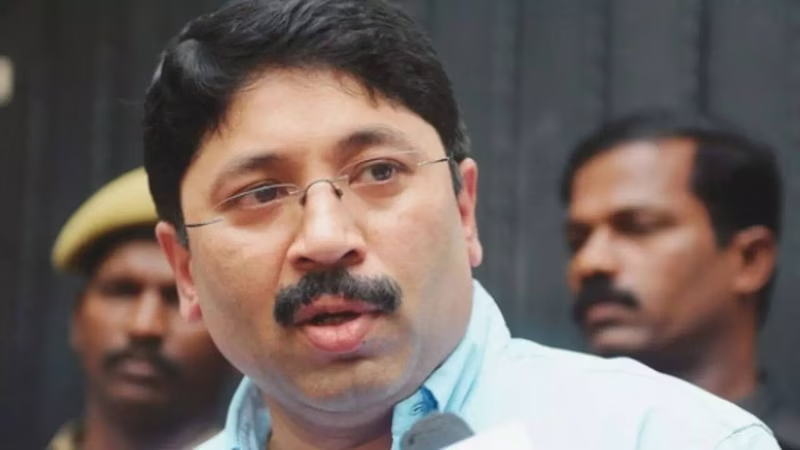
In a remark that has sent shockwaves across the political landscape, DMK MP Dayanidhi Maran recently drew a stark and controversial line between the educational opportunities for young women in South India versus those in the North. His comments, made while praising Tamil Nadu’s initiatives, have not only sparked a fierce political row but have also forced a much-needed national introspection into the persistent regional disparities in girls’ education in India.
Table of Contents
- The Controversial Claim That Started It All
- Tamil Nadu’s Response: A Showcase of Policy in Action
- Beyond the Headlines: The Reality of Regional Disparities
- The ‘Ulagam Ungal Kaiyil’ Scheme: A Digital Leap Forward
- Conclusion: A Call for National Dialogue, Not Division
- Sources
The Controversial Claim That Started It All
At a recent event in Chennai, Dayanidhi Maran, a prominent figure in the ruling DMK party, made headlines with his blunt assessment. He claimed that in many parts of North India, girls are effectively being told to “stay home and give birth,” implying their primary societal role is limited to domesticity and childbearing . He went further, stating that girls in the South are educated, while those in the North are treated as “slaves” . These incendiary remarks were intended to highlight what he sees as Tamil Nadu’s progressive stance, but they have been widely criticized for painting an entire region with a broad, negative brush.
The core of his argument seemed to hinge on language policy and its impact on employability. Maran suggested that restricting education to Hindi alone in some northern states contributes to higher unemployment, contrasting it with Tamil Nadu’s focus on English and Tamil, which he believes opens more doors for its youth, especially women .
Tamil Nadu’s Response: A Showcase of Policy in Action
Just days before or alongside these controversial remarks, the Tamil Nadu government, led by Deputy Chief Minister Udhayanidhi Stalin, was actively demonstrating its commitment to education through concrete action. At an event where 900 students received free laptops, Stalin emphasized the state’s dedication to empowering its youth, particularly women, by providing them with the tools for a modern education and a successful career .
This event wasn’t an isolated incident but part of a massive, state-wide initiative. The government’s actions speak to a larger philosophy that rejects regressive norms and champions equal opportunity. As Udhayanidhi Stalin has often stated, the state’s policies are deeply rooted in the Dravidian movement’s legacy of social justice and women’s rights, crediting reformers like Periyar for laying this foundation .
The ‘Ulagam Ungal Kaiyil’ Scheme: A Digital Leap Forward
The laptop distribution is a cornerstone of the ambitious ‘Ulagam Ungal Kaiyil‘ (The World is in Your Hands) scheme. Launched on January 5, 2026, the program aims to distribute a staggering 20 lakh (2 million) free laptops to college students across the state . The first phase alone targets 10 lakh students, marking a significant investment in digital literacy and bridging the tech gap for a new generation of learners .
This initiative is more than just a giveaway; it’s a strategic move to prepare Tamil Nadu’s youth for a competitive global job market. By ensuring students have access to essential digital tools, the state is directly addressing a key barrier to higher education and professional development, particularly for students from underprivileged backgrounds.
Beyond the Headlines: The Reality of Regional Disparities
While Maran’s comments were undeniably inflammatory and overly generalized, they inadvertently pointed towards a complex and well-documented truth: significant regional disparities in girls’ education in India do exist. Data from various sources, including the National Family Health Survey (NFHS), consistently shows variations in female literacy rates, school enrollment, and dropout rates between different states.
However, the solution is not to vilify one region while glorifying another. The real challenge for India is to understand the unique socio-economic, cultural, and infrastructural factors that influence educational outcomes in each state and to develop targeted, sensitive interventions. Tamil Nadu’s success with schemes like its free laptop program and its strong public education system offers valuable lessons, but they must be adapted, not simply copied, for other contexts.
The state’s new education policy, which notably rejects the central government’s three-language formula, is another example of its independent approach to crafting an educational environment it believes best serves its people . This autonomy allows for policies that are more closely aligned with local needs and aspirations.
Conclusion: A Call for National Dialogue, Not Division
The controversy ignited by Dayanidhi Maran’s remarks is a double-edged sword. On one hand, it has coarsened political discourse with sweeping generalizations. On the other, it has successfully placed the critical issue of equitable girls’ education in India back at the center of the national conversation. Instead of fostering a North vs. South narrative, this moment should be used to build a collaborative national framework.
Tamil Nadu’s proactive measures—its massive investment in digital infrastructure through the laptop scheme and its unwavering policy focus on women’s empowerment—serve as a powerful benchmark . Other states can learn from these successes, while the central government can play a crucial role in facilitating resource sharing and best practices. The ultimate goal must be to ensure that every girl in India, regardless of her postal code, has the same opportunity to learn, grow, and shape her own future. For more on national education strategies, you can explore resources from UN Women on global best practices for women’s empowerment through education.
Sources
- Times of India: ‘Girls in North India asked to stay home, give birth’: DMK MP Dayanidhi Maran sparks row
- The Hindu: CM Stalin to launch distribution of free laptops to govt college students on January 5
- Tamil Nadu Government Portal: Ulagam Ungal Kaiyil – College Students’ Laptop Scheme
- Tamil Nadu State Women’s Policy 2024: Social Welfare & Women Empowerment Department