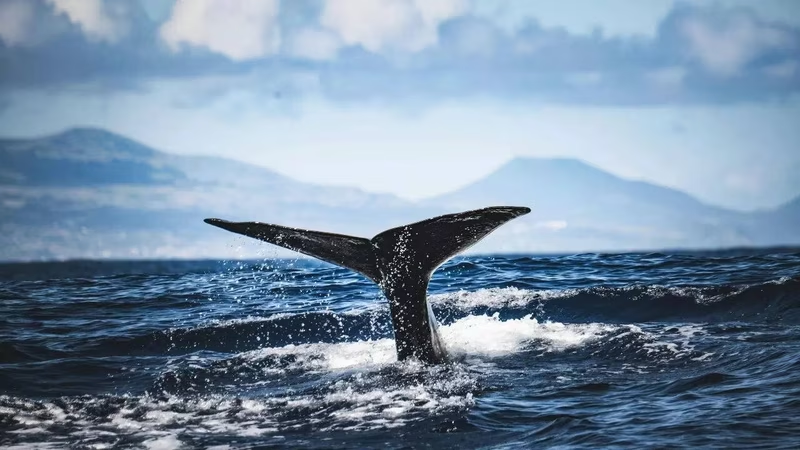
For decades, historians believed large-scale whaling began with industrial-era European and Japanese fleets. But a stunning new discovery along Brazil’s southern coast has turned that narrative on its head. Archaeologists have uncovered **5,000-year-old whale bones** and intricately crafted harpoons at a prehistoric shell midden site—evidence so compelling it rewrites our understanding of early human interaction with marine megafauna. This isn’t just scavenging; it’s proof of deliberate, coordinated **organised whaling** by hunter-gatherer societies long before written history .
Table of Contents
- The Discovery Site: A Coastal Time Capsule
- What the Whale Bones Reveal
- The Harpoon Technology: Sophisticated for Its Time
- Why This Is Definitive Organised Whaling Evidence
- Global Context: How This Changes Whaling History
- Implications for Human Coastal Adaptation
- Conclusion: Rewriting the Story of Early Seafaring Humans
- Sources
The Discovery Site: A Coastal Time Capsule
The findings come from the Sambaqui (shell mound) sites near Laguna, in Brazil’s Santa Catarina state—ancient refuse heaps built by coastal communities between 8,000 and 1,000 years ago. These mounds, composed of shells, bones, and artifacts, have long been known to archaeologists as windows into pre-Columbian life. But recent excavations led by a team from the University of São Paulo and international collaborators revealed something extraordinary: concentrated deposits of whale remains—primarily from humpback and right whales—mixed with stone and bone tools .
What the Whale Bones Reveal
Analysis of over 400 bone fragments showed clear signs of human activity:
- Cut Marks: Precise incisions consistent with butchering using stone blades.
- Impact Fractures: Breaks indicating marrow extraction or tool-making.
- Species Identification: DNA and morphological analysis confirmed the bones belonged to large baleen whales, not small dolphins or porpoises .
Critically, the whale bones were found in layers dated to **3000 BCE**—making them the oldest such evidence in the Americas and among the oldest globally.
The Harpoon Technology: Sophisticated for Its Time
Alongside the bones, researchers unearthed dozens of barbed harpoon heads made from deer antler and whale bone. These weren’t crude spears—they featured detachable heads connected to lines, a design that allows hunters to strike a whale and track it as it swims away, exhausted. This technology mirrors later Inuit and Norse whaling gear, suggesting convergent innovation across continents . Radiocarbon dating confirmed these tools are contemporaneous with the whale remains, proving they were used in active hunting—not post-mortem scavenging.
Why This Is Definitive Organised Whaling Evidence
Previous claims of ancient whaling often faced skepticism: were humans merely scavenging beached carcasses? This discovery closes that debate. The combination of specialized weapons, butchery marks on large, healthy adult whales, and the sheer volume of remains points to **coordinated group efforts**. Hunting a 40-ton humpback requires multiple boats, skilled rowers, strategic planning, and communal processing—hallmarks of true organised whaling. As lead researcher Dr. Ana Carolina Rodrigues notes, “This wasn’t opportunistic. It was a cultural and economic pillar for these communities” .
Global Context: How This Changes Whaling History
Until now, the earliest accepted evidence of systematic whaling came from Korea (~6000 years ago) and Norway (~4000 years ago). The Brazilian find pushes the timeline back and proves that complex marine hunting emerged independently in the Southern Hemisphere. This challenges Eurocentric models of technological diffusion and highlights the ingenuity of Indigenous South American societies. For more on ancient maritime cultures, see our feature on [INTERNAL_LINK:prehistoric-seafaring-civilizations].
Implications for Human Coastal Adaptation
This discovery also reshapes theories about human migration and adaptation. It shows that early South Americans didn’t just hug the shore—they mastered open-ocean resources, developing ecological knowledge rivaling that of Arctic or Pacific Islanders. Access to whale blubber, meat, and bone would have provided high-calorie sustenance and raw materials, enabling population growth and social complexity long before agriculture arrived in the region .
Conclusion: Rewriting the Story of Early Seafaring Humans
The unearthing of 5,000-year-old whale bones and harpoons in Brazil is far more than an archaeological curiosity—it’s a paradigm shift. It confirms that **organised whaling evidence** exists millennia earlier than previously documented in the Americas and underscores the sophistication of prehistoric coastal societies. As research continues at other Sambaqui sites, we may yet discover even older chapters in humanity’s deep relationship with the ocean.
Sources
- Times of India: 5,000-year-old whale bones and harpoons reveal organised whaling
- Journal of Archaeological Science: Peer-reviewed studies on prehistoric marine hunting
- Smithsonian National Museum of Natural History: Marine Mammal Archaeology Resources
- University of São Paulo: Research Department of Archaeology