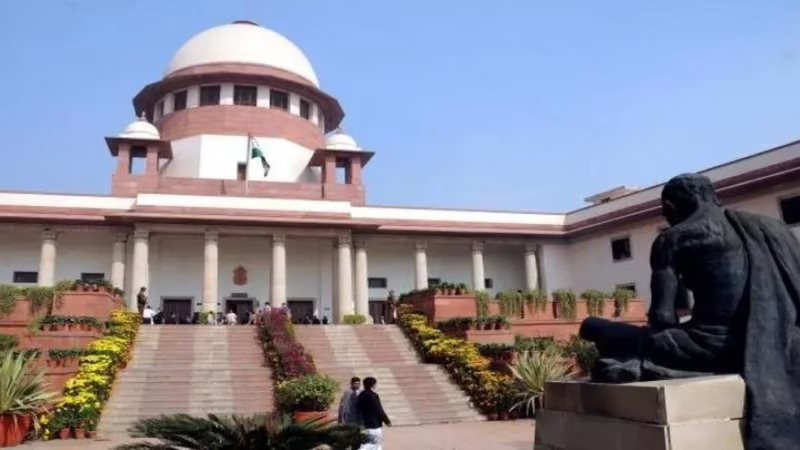
In a decision that blends ancient scripture with contemporary justice, the Supreme Court of India has made headlines by citing the Manusmriti—a 2,000-year-old Sanskrit text often criticized for its patriarchal views—to grant crucial relief to a vulnerable woman. The case centered on a widowed daughter-in-law who was denied residence and financial support by her in-laws after her husband’s death. In a move that has left legal scholars and social activists deeply divided, the Court invoked specific verses from the Manusmriti to affirm her right to shelter and maintenance within her matrimonial home . This Supreme Court Manusmriti ruling is not just a win for one woman; it’s a seismic event that forces us to confront the complex relationship between tradition, gender justice, and the evolution of Indian law.
Table of Contents
- The Case That Sparked a National Debate
- Supreme Court Manusmriti Ruling: The Legal Reasoning
- The Dual Nature of the Manusmriti: A Source of Guidance or Gender Bias?
- Modern Laws vs. Ancient Texts: The Legal Tension
- What This Ruling Means for Widowed Women in India
- Conclusion: A Step Forward or a Glance Backward?
- Sources
The Case That Sparked a National Debate
The petitioner, a woman whose name has been withheld for privacy, found herself homeless and destitute after her husband passed away. Her in-laws, who owned the family home, refused to let her stay, arguing she had no legal claim to the property. With no independent income or support system, she was left in a precarious position—a scenario all too common for countless widows across India. She filed a petition under Section 125 of the Code of Criminal Procedure (CrPC), which allows a magistrate to order maintenance for wives, children, and parents who are unable to maintain themselves. However, her in-laws contested her right to reside in their home, leading the case all the way to the apex court.
Supreme Court Manusmriti Ruling: The Legal Reasoning
In its judgment, the Supreme Court bench acknowledged the provisions of the Hindu Adoptions and Maintenance Act, 1956, which clearly states a widowed daughter-in-law is entitled to maintenance from her father-in-law if she is unable to support herself. However, to strengthen its moral and cultural argument for her right to residence, the Court reached into the past. It cited Chapter IX, Verse 57 of the Manusmriti, which states: “A sonless wife should not be expelled from her husband’s house; she should be maintained there as long as she lives” .
The Court used this verse not to endorse the entirety of the Manusmriti, but to highlight that even within traditional frameworks, a duty of care towards a widowed daughter-in-law was recognized. The judges framed it as evidence of an enduring social obligation that transcends time, using the ancient text to reinforce a principle already enshrined in modern statute.
The Dual Nature of the Manusmriti: A Source of Guidance or Gender Bias?
The invocation of the Manusmriti is where the controversy lies. While the specific verse cited is protective, the text as a whole is infamous for its regressive stance on women’s rights. It contains passages that advocate for female subjugation, restrict their autonomy, and deny them equal status. Critics argue that by legitimizing any part of this text in a modern courtroom, the judiciary risks validating a document that has been used for centuries to justify gender inequality .
Supporters of the judgment, however, contend that the Court was being pragmatic. They argue that in a country where cultural and religious sentiments hold immense sway, using a familiar scriptural reference can make the legal principle more palatable and enforceable at the grassroots level. It’s a strategic use of tradition to achieve a progressive outcome.
Modern Laws vs. Ancient Texts: The Legal Tension
This case exposes a fundamental tension in India’s legal system. On one hand, the Constitution guarantees equality and justice for all. On the other, personal laws and judicial interpretations often draw from religious and customary sources. The challenge for the judiciary is to navigate this space without allowing outdated norms to undermine constitutional values.
Legal experts point out that this isn’t the first time the Supreme Court has referenced ancient texts. However, doing so in a case concerning women’s rights is particularly sensitive. The fear is that it sets a precedent where future judgments might selectively quote from these texts in ways that could be detrimental. For a deeper understanding of India’s legal framework, the Ministry of Law and Justice provides resources on [INTERNAL_LINK:indian-constitutional-law-and-personal-laws].
What This Ruling Means for Widowed Women in India
Despite the controversy, the immediate impact of the ruling is profoundly positive for the petitioner and potentially for many others in similar situations. It sends a strong message that a widowed daughter-in-law cannot be simply cast out onto the streets. Her right to dignity, shelter, and basic maintenance is now backed by the highest court in the land, using both modern law and a carefully chosen piece of ancient wisdom.
This judgment could empower lower courts to be more assertive in enforcing maintenance claims and could encourage more women to come forward and seek their legal rights. It reinforces the idea that the family unit has a collective responsibility towards its vulnerable members.
Conclusion: A Step Forward or a Glance Backward?
The Supreme Court Manusmriti ruling is a paradox. It is a clear victory for a marginalized woman, achieved through a legal argument that relies on a text many view as a symbol of oppression. While the outcome is just, the methodology has opened a Pandora’s box of questions about the role of religious scripture in a secular democracy. The true test will be whether this judgment is remembered for the relief it provided or for the dangerous precedent it may have set. One thing is certain: it has reignited a vital conversation about how India reconciles its rich, complex past with its promise of an equitable future.