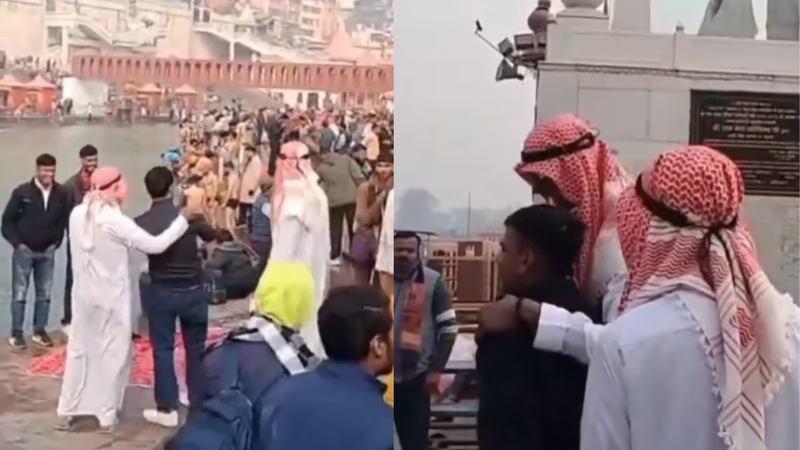
The serene banks of the Ganges at Har Ki Pauri have long been a beacon for spiritual seekers from across the globe. But a recent incident has cast a shadow over its universal appeal, sparking a heated national conversation about who has the right to access this hallowed ground. The detention of two men in ‘sheikh attire’ has become the flashpoint for a much larger, more complex debate—one that could fundamentally alter the character of one of Hinduism’s most sacred sites.
Table of Contents
- The ‘Sheikh Attire’ Incident That Sparked the Fire
- What Are the Proposed Har Ki Pauri Non-Hindu Entry Rules?
- Why Is This Happening Now? The Ardh Kumbh 2027 Factor
- What Does ‘Sheikh Attire’ Actually Mean?
- The Broader Impact on Tourism and Interfaith Relations
- Conclusion: Navigating Faith, Security, and Universal Access
- Sources
The ‘Sheikh Attire’ Incident That Sparked the Fire
In early January 2026, a video began circulating online showing two individuals dressed in what was described as ‘sheikh attire’—typically referring to a long white robe (kandura) and a head covering—walking around the iconic Har Ki Pauri ghat in Haridwar. The men, who later claimed to be Dubai-based YouTube influencers, were detained by local police for questioning .
While they were released shortly after, the incident acted like a lit match on dry tinder. It reignited long-simmering demands from certain religious groups to restrict access to the ghat for non-Hindus, citing concerns over the preservation of the site’s sanctity and potential security threats. The event quickly moved beyond a simple case of mistaken identity or cultural curiosity, becoming a potent symbol in a much larger political and religious discourse.
What Are the Proposed Har Ki Pauri Non-Hindu Entry Rules?
The core of the controversy lies in a serious proposal being considered by the Uttarakhand government. Reports indicate that authorities are actively exploring the possibility of banning non-Hindus from entering not just Har Ki Pauri, but all 105 Ganga ghats in Haridwar . This move is reportedly based on a century-old agreement or bylaw that has been cited as a legal foundation for such restrictions .
The stated goal is to preserve the religious sanctity of these spaces, especially in the lead-up to major events. The Shri Ganga Sabha, a prominent local religious body, has been a vocal proponent of this plan, urging the government to declare the entire Kumbh Mela area a restricted zone for non-Hindus . If implemented, this would mark a first-of-its-kind official policy for a major public religious site in India .
Key Points of the Proposed Restrictions:
- Scope: The ban could extend to all 105 ghats across nearly 120 sq km in Haridwar .
- Enforcement: There are discussions about using Aadhaar cards for verification to prevent non-Hindus from selling goods or services in the ghat areas .
- Status: The government is also considering granting Haridwar and Rishikesh the formal status of ‘Sanatan Holy Cities,’ which would legally enshrine these access rules .
Why Is This Happening Now? The Ardh Kumbh 2027 Factor
The timing of this debate is no coincidence. The next major religious gathering on the horizon is the Ardh Kumbh Mela in 2027, expected to draw tens of millions of pilgrims to Haridwar. In anticipation of this massive influx, local authorities and religious bodies are pushing for stricter controls to manage crowds, ensure security, and, as they argue, maintain the event’s purely Hindu religious character .
The fear is that unrestricted access could lead to incidents that might disrupt the peace and sanctity of the Kumbh. Proponents of the ban see it as a necessary, albeit controversial, measure for crowd control and religious preservation during an event of such immense scale and significance.
What Does ‘Sheikh Attire’ Actually Mean?
The term ‘sheikh attire’ used in the initial reports is a broad and somewhat ambiguous descriptor. In the Indian context, it generally refers to traditional Arab clothing, specifically the kandura or thobe (a long, ankle-length robe) often paired with a ghutra (headscarf) and agal (cord). It’s important to distinguish this from the attire of other faiths; for instance, Sikh religious dress (bana) includes a turban (dastaar) but is distinct in its own right [[22], [24]].
The ambiguity of the term itself fueled the controversy. For some, the sight of individuals in unfamiliar, non-Indian religious garb at such a sacred Hindu site was seen as a provocation or a sign of disrespect, regardless of the visitors’ actual intent. This highlights the deep sensitivity surrounding dress codes and visual symbols in spaces of intense religious significance.
The Broader Impact on Tourism and Interfaith Relations
Haridwar’s economy is profoundly intertwined with religious tourism . A formal ban on non-Hindus would have significant economic repercussions, potentially deterring international tourists and even domestic tourists from other faiths who visit out of respect and curiosity. Critics argue that such a policy contradicts India’s long-standing ethos of pluralism and could damage its global image as a welcoming destination.
Furthermore, the proposal raises serious questions about freedom of movement and access to public spaces. While private temples can set their own rules, the Ganga ghats are public thoroughfares along a national river. Restricting access based on religion in such a space sets a powerful and divisive precedent. This debate is not happening in a vacuum; it reflects wider national conversations about identity, secularism, and the management of shared sacred spaces.
Conclusion: Navigating Faith, Security, and Universal Access
The controversy surrounding the two men at Har Ki Pauri is far more than a simple news story. It’s a microcosm of the complex challenges facing modern India as it tries to balance deep-rooted religious traditions with the principles of a secular, democratic state. While the desire to protect the sanctity of a site as revered as Har Ki Pauri is understandable, the path forward requires careful, inclusive dialogue.
The proposed non-Hindu entry ban is a drastic measure whose long-term social and economic costs must be weighed against its perceived benefits. As the Ardh Kumbh 2027 approaches, the decisions made in Haridwar will be watched closely, not just for their local impact, but for what they signal about the future of India’s diverse and pluralistic society.
Sources
- Times of India: 2 held for roaming around at Har Ki Pauri in ‘sheikh’ attire
- India Today: Uttarakhand govt plans ban on non-Hindus entering 105 ghats in Haridwar [[7], [11], [16], [17], [19]]
- The Hindu: Uttarakhand: Govt mulls banning non-Hindus’ entry in 105 ghats of Haridwar
- [INTERNAL_LINK:religious-tourism-in-india]
- [INTERNAL_LINK:ardh-kumbh-mela-2027-guide]