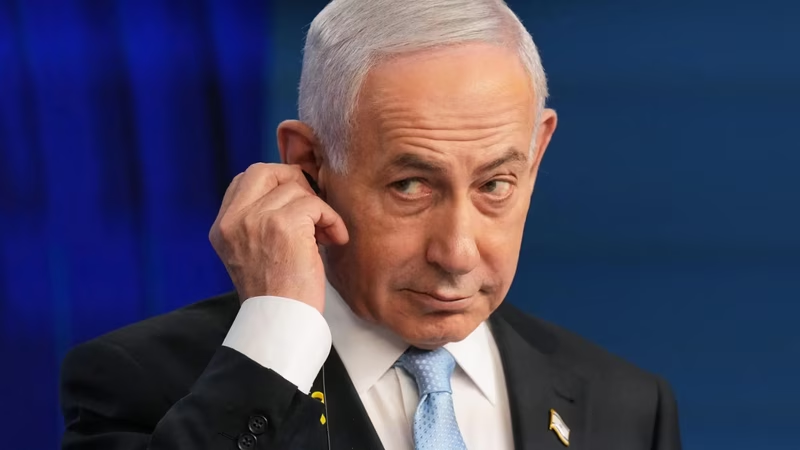
In a dramatic escalation of its long-standing grievances with the United Nations, Israel has officially announced it will sever all contact with several key UN agencies. The decision, described by Israeli officials as “immediate” and “unavoidable,” comes after a comprehensive government review triggered by the United States’ own withdrawals from similar international bodies . This isn’t just bureaucratic reshuffling—it’s a geopolitical statement with far-reaching consequences for global diplomacy, humanitarian coordination, and the future of multilateralism itself.
The core accusation? Persistent, institutionalized bias against Israel, particularly in how these agencies frame issues related to conflict, children, and sexual violence in the Middle East. For Tel Aviv, this move is about accountability; for critics, it’s a retreat from international cooperation at a time when it’s needed most.
Table of Contents
- Which UN Agencies Are Affected?
- The US Precedent That Sparked Israel’s Review
- Israel’s Specific Grievances: Beyond General Complaints
- Global Reactions: Support, Silence, and Condemnation
- Impact on Humanitarian and Development Work
- What This Means for Israel’s Global Diplomacy
- Conclusion: A Fractured Multilateral System
- Sources
Which UN Agencies Are Affected?
Israel’s withdrawal isn’t a blanket exit from the entire UN system but a targeted disengagement from specific bodies it deems irredeemably biased. The confirmed list includes:
- UN Women: Israel objects to the agency’s reports that, in its view, unfairly single out Israel regarding the treatment of women and children in conflict zones.
- UN Conference on Trade and Development (UNCTAD): Long criticized by Israel (and the US) for its economic analyses of the Israeli-Palestinian situation, which Tel Aviv claims are based on flawed premises.
- Other International Bodies: While not all have been publicly named, the Israeli government stated it is actively reviewing its participation in additional organizations, signaling this could be just the beginning .
The US Precedent That Sparked Israel’s Review
This move doesn’t happen in a vacuum. It directly follows a strategic shift initiated by the United States under previous administrations, which withdrew from UNESCO and the UN Human Rights Council, citing similar concerns about anti-Israel bias . Israel’s current action appears to be a continuation of this aligned policy, reflecting a shared belief between the two allies that certain UN mechanisms are structurally compromised and used as platforms for political attacks rather than constructive dialogue. The Israeli government’s review was explicitly “prompted by the US withdrawal,” according to official statements .
Israel’s Specific Grievances: Beyond General Complaints
While accusations of UN bias are not new, Israel has pointed to concrete examples to justify its drastic step. A primary flashpoint involves reports on children in armed conflict and conflict-related sexual violence. Israeli officials argue that these reports often present unsubstantiated allegations against Israeli forces while downplaying or ignoring documented abuses by groups like Hamas . They claim this creates a distorted narrative that fuels delegitimization campaigns against the state of Israel, making genuine cooperation impossible.
Global Reactions: Support, Silence, and Condemnation
The international response has been predictably divided. The United States has offered tacit support, aligning with its own historical stance on these agencies. Many Western European nations have expressed concern, urging Israel to remain engaged to reform the system from within. Arab and Muslim-majority countries, along with many in the Global South, have largely condemned the move as an abdication of responsibility and a rejection of international law. The UN Secretariat itself has issued a neutral statement expressing hope for continued dialogue, but the damage to trust is evident.
Impact on Humanitarian and Development Work
Beyond the political theater, there are real-world consequences. UN Women and UNCTAD are involved in critical development and gender-equality programs that can indirectly benefit Israeli civil society and regional partners. By cutting ties, Israel may limit its access to data, collaborative frameworks, and funding channels. Furthermore, this isolation could complicate coordination on cross-border humanitarian issues, especially concerning Gaza. As noted by experts at International Crisis Group, such moves often harden positions and make conflict resolution more difficult .
What This Means for Israel’s Global Diplomacy
This decision is a double-edged sword for Israel’s foreign policy. On one hand, it resonates strongly with its domestic base and key allies like the US, projecting strength and a refusal to tolerate perceived injustice. On the other, it risks further isolating Israel in international forums, potentially strengthening the very resolutions and coalitions it seeks to oppose. It’s a high-stakes gamble that prioritizes principle over participation, betting that its bilateral relationships can compensate for a diminished multilateral presence.
Conclusion: A Fractured Multilateral System
Israel’s move to withdraw from UN agencies is more than a bilateral dispute; it’s a symptom of a deeper crisis within the international order. When major member states feel compelled to abandon key institutions because they believe those institutions are weaponized against them, it signals a profound failure of the system’s foundational promise of impartiality and fairness. Whether this leads to much-needed reform or accelerates the fragmentation of global governance remains the central question hanging over this bold and controversial decision.
Sources
[1] Times of India: ‘Immediately sever all contact’: After US, Israel withdraws from several UN agencies. https://timesofindia.indiatimes.com/world/middle-east/immediately-sever-all-contact-after-us-israel-withdraws-from-several-un-agencies-reviews-other-international-bodies/articleshow/126516496.cms
[2] Web Search Results on Israel’s UN agency relations, US foreign policy precedents, and expert analysis on multilateralism.