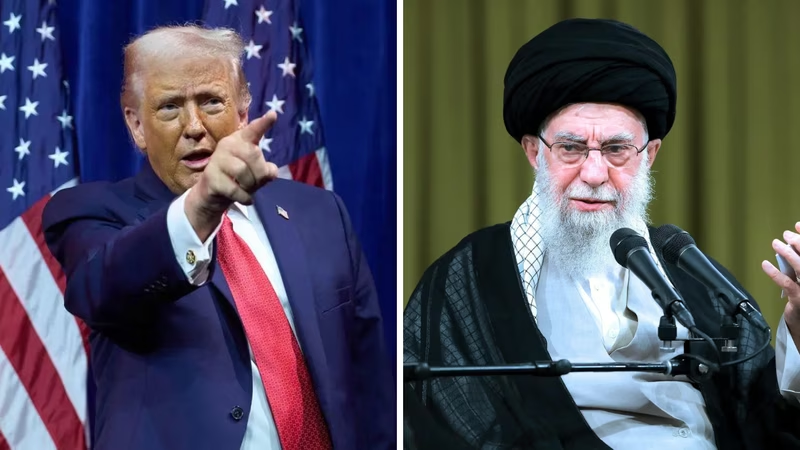
The geopolitical chessboard between the United States and Iran just got a lot more complex. While headlines often fixate on the threat of airstrikes, newly revealed intelligence suggests that former President Donald Trump’s team was actively exploring a far more sophisticated—and covert—arsenal to counter Tehran. This isn’t just about bombs; it’s about bytes, narratives, and economic levers designed to fracture Iran’s command structure from within .
Amid widespread anti-government protests inside Iran, U.S. officials presented Trump with an expanded set of options that blend military precision with digital disruption and psychological influence. At the heart of this evolving Trump Iran strategy is a clear message: if diplomacy fails, America has tools that don’t require a single jet to leave the tarmac.
Table of Contents
- The Full Spectrum of Trump’s Iran Strategy
- Military Options: Nuclear and Missile Targets
- Cyber Warfare: Disrupting Iran’s Digital Spine
- Psychological Operations: Winning Hearts or Sowing Chaos?
- Diplomacy and Economic Pressure: The Softer Tools
- Risks and Global Implications
- Conclusion: A Multilayered Playbook
- Sources
The Full Spectrum of Trump’s Iran Strategy
The Trump Iran strategy under discussion wasn’t a monolithic plan but a layered approach designed to apply maximum pressure while minimizing direct U.S. casualties and global escalation. According to reports, the National Security Council and Pentagon developed a menu of options ranging from overt military strikes to clandestine cyber campaigns—all calibrated to exploit Iran’s internal vulnerabilities during a period of domestic unrest .
This holistic view reflects a shift in modern statecraft, where influence is wielded not just through tanks and jets, but through data, perception, and economic choke points. The goal? To degrade Iran’s ability to project power without triggering a full-scale regional war.
Military Options: Nuclear and Missile Targets
While airstrikes remain on the table, they are no longer the default. Should kinetic action be deemed necessary, U.S. planners have identified high-value targets tied to Iran’s strategic capabilities:
- Nuclear facilities: Sites like Natanz and Fordow, which house uranium enrichment centrifuges.
- Ballistic missile production centers: Factories and storage depots linked to Iran’s long-range missile program.
- Revolutionary Guard command nodes: Key infrastructure used by the Islamic Revolutionary Guard Corps (IRGC) to coordinate operations across the Middle East .
However, even these strikes would likely be surgical—designed to send a message rather than initiate regime change. The real innovation lies in what happens before and after the bombs fall.
Cyber Warfare: Disrupting Iran’s Digital Spine
One of the most potent tools in the U.S. arsenal is its cyber capability. U.S. Cyber Command, in coordination with the NSA, has reportedly developed offensive operations aimed at:
- Disabling Iran’s air defense radar systems ahead of any potential strike.
- Corrupting or erasing data from nuclear research servers.
- Disrupting internal communications between military and political leadership during moments of crisis .
These actions mirror past operations like Stuxnet—a joint U.S.-Israeli cyberattack that damaged Iranian centrifuges in 2010. But today’s tools are faster, stealthier, and more scalable. The advantage? Plausible deniability. A sudden blackout at a missile base could be blamed on technical failure, not foreign sabotage.
Psychological Operations: Winning Hearts or Sowing Chaos?
Perhaps the most controversial element is the use of psychological operations (PSYOPs). These aren’t just propaganda—they’re targeted information campaigns designed to influence behavior. In the Iranian context, this could include:
- Flooding social media with content that amplifies public anger toward the regime.
- Hacking state-run media outlets to broadcast messages of dissent or confusion.
- Using encrypted channels to provide protesters with real-time coordination tips—effectively turning citizens into force multipliers .
Critics warn such tactics risk civilian harm and could backfire, painting the U.S. as an instigator rather than a supporter of democracy. Yet proponents argue that in an authoritarian state, information is the ultimate weapon.
Diplomacy and Economic Pressure: The Softer Tools
Despite the aggressive options, the administration emphasized that diplomacy remains the preferred path. Alongside covert measures, the U.S. is escalating “soft” pressure:
- Imposing new tariffs on countries that trade with Iran.
- Working with tech firms to ensure Iranians retain internet access during government blackouts—a move both humanitarian and strategic .
- Leveraging alliances with Gulf states to isolate Tehran economically and politically.
This dual-track approach—carrot and stick, seen and unseen—is classic Trump-era statecraft: maximum pressure, maximum flexibility.
Risks and Global Implications
Deploying cyber or psychological tools carries significant risks. Iran has its own formidable cyber units, capable of retaliating against U.S. infrastructure or allies. Escalation could spiral quickly, especially if an operation is exposed. Moreover, blurring the line between protest support and regime subversion could undermine the moral authority of U.S. foreign policy.
As [INTERNAL_LINK:middle-east-geopolitics] experts note, the region is already a tinderbox. One miscalculation could ignite a wider conflict involving Israel, Saudi Arabia, or even Russia.
Conclusion: A Multilayered Playbook
The Trump Iran strategy reveals a new doctrine in American foreign policy—one where warfare is no longer confined to battlefields. By integrating military, cyber, psychological, and economic tools, the U.S. aims to achieve strategic objectives with minimal boots on the ground. Whether this approach deters aggression or invites chaos remains to be seen. But one thing is certain: the era of simple airstrikes is over. The future of conflict is hybrid, hidden, and hyper-targeted.
Sources
- Times of India: Beyond airstrike: Trump weighing military, cyber, psychological tools against Iran
- Council on Foreign Relations: U.S.-Iran Relations
- U.S. Department of Defense: Cyber Command Overview