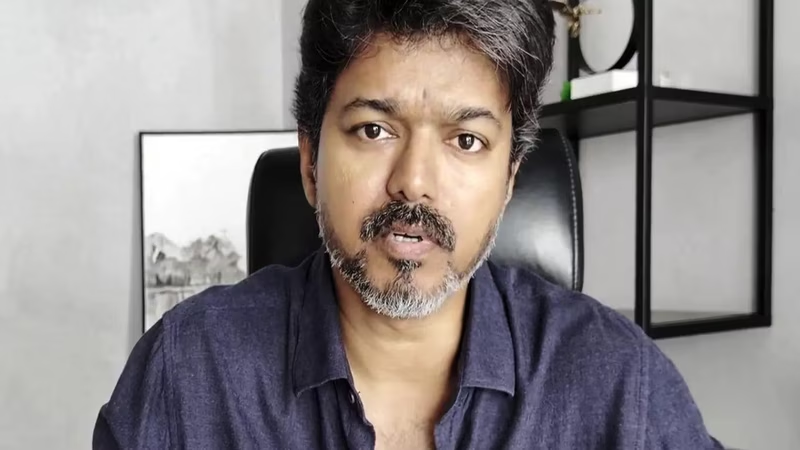
The tragic Karur stampede that claimed dozens of lives during a religious festival has now exploded into a full-blown political and legal storm. In a major development, the Central Bureau of Investigation (CBI) has summoned Tamil cinema icon and political figure Vijay for a second round of questioning on January 19, 2026—deepening speculation about his role or knowledge related to the event.
But the legal drama is only half the story. The ruling Tamilaga Vazhvurimai Katchi (TVK) has launched a blistering attack on the BJP, branding it an “ideological foe” and accusing the central government of using the CBI to target regional leaders. With elections looming and public anger simmering, the Karur tragedy is no longer just about accountability—it’s become a flashpoint in India’s federal power struggle.
So, what really happened in Karur? Why is Vijay being questioned again? And how did a stampede turn into a national political battleground? Let’s unpack the facts, the factions, and the high-stakes game unfolding in Tamil Nadu.
Table of Contents
- What Was the Karur Stampede? A Timeline of Tragedy
- Why Is Actor Vijay Being Questioned by the CBI?
- CBI Summons on January 19: What to Expect
- TVK vs BJP: The ‘Ideological Foe’ Declaration
- Political Implications in Tamil Nadu
- Public Reaction and Demands for Justice
- Conclusion: Justice, Politics, and the Shadow of Power
- Sources
What Was the Karur Stampede? A Timeline of Tragedy
On December 28, 2025, a massive crowd gathered at the Arulmigu Kalyana Pasupatheeswarar Temple in Karur, Tamil Nadu, for a year-end religious procession. As thousands surged forward, panic erupted near a narrow bridge, triggering a deadly stampede.
Official figures confirm **47 deaths** and over 120 injuries—many of them women and children . Survivors described scenes of chaos, with people trampled underfoot and emergency exits blocked.
Initial state probes pointed to poor crowd management, lack of barricades, and alleged negligence by local authorities. Public outrage forced the Tamil Nadu government to recommend a CBI investigation—a rare move that handed control to the central agency.
Why Is Actor Vijay Being Questioned by the CBI?
Vijay, one of India’s biggest film stars and founder of the newly formed Tamilaga Vazhvurimai Iyakkam (which later merged into TVK), was present at the temple hours before the stampede. While he did not attend the main event, his visit drew large crowds, raising questions about whether his presence contributed to the congestion.
The CBI’s interest stems from witness statements suggesting that security arrangements were diverted to manage Vijay’s entourage, potentially weakening crowd control elsewhere. Though Vijay has denied any wrongdoing, the agency is probing whether there was coordination—or miscoordination—between his team and local officials.
His first questioning on January 10 lasted over six hours. The January 19 summons indicates the CBI seeks clarification on new evidence or inconsistencies.
CBI Summons on January 19: What to Expect
The upcoming session is expected to focus on:
- Communication logs between Vijay’s security team and district police.
- Video footage from CCTV cameras near the temple entrance.
- Testimonies from temple trust members about event planning approvals.
Legal experts note that while Vijay is currently a witness, his status could change if evidence points to criminal negligence under Section 304A (causing death by negligence) of the IPC.
TVK vs BJP: The ‘Ideological Foe’ Declaration
Amid the investigation, TVK chief T. Ramachandran made a fiery statement: “The BJP remains our ideological foe. They are using central agencies to destabilize Dravidian rule in Tamil Nadu” .
This isn’t just rhetoric. The comment reflects deep mistrust between Tamil Nadu’s regional parties and the BJP-led Centre—a tension that has flared over issues like NEET, Hindi imposition, and now, the CBI’s role in state matters.
TVK alleges that the timing of Vijay’s summons—just months before crucial urban local body elections—is politically motivated, aimed at tarnishing the party’s image and its charismatic leader.
Political Implications in Tamil Nadu
Vijay’s political journey is at a crossroads. Once seen as a unifying figure above partisan fray, his association with TVK has drawn him into the electoral arena. The Karur stampede case could either galvanize public sympathy or erode his clean-image brand.
Meanwhile, the BJP is trying to gain a foothold in Tamil Nadu but faces stiff resistance due to its perceived cultural insensitivity. By pushing the CBI probe aggressively, critics say it risks reinforcing its “outsider” label.
Public Reaction and Demands for Justice
Families of the victims are demanding transparency—not politics. “We don’t care about parties,” said M. Lakshmi, who lost her daughter in the crush. “We want to know who allowed this to happen—and why no one has been punished yet.”
Civil society groups have called for an independent judicial commission, arguing that both state and central agencies are compromised by political agendas.
For more on citizen-led justice movements in India, see our feature on [INTERNAL_LINK:grassroots-activism-in-disaster-accountability].
Conclusion: Justice, Politics, and the Shadow of Power
The Karur stampede began as a human tragedy. But in India’s polarized climate, it has become a proxy war over federalism, celebrity influence, and the weaponization of investigative agencies. While Vijay’s January 19 appearance may yield legal clarity, the deeper battle—for trust, autonomy, and accountability—will rage long after the headlines fade.
One thing is clear: the victims deserve truth, not theater.
Sources
- Times of India. “Karur stampede case: CBI summons Vijay again on January 19; TVK says BJP remains ideological foe”. https://timesofindia.indiatimes.com/city/chennai/karur-stampede-case-cbi-summons-vijay-again-on-january-19-tvk-says-bjp-remains-ideological-foe/articleshow/126512736.cms
- National Crime Records Bureau (NCRB). “Public Order & Disaster Management Statistics 2025”. https://ncrb.gov.in/
- Supreme Court of India. “Guidelines on Use of Central Agencies in State Matters”. https://main.sci.gov.in/