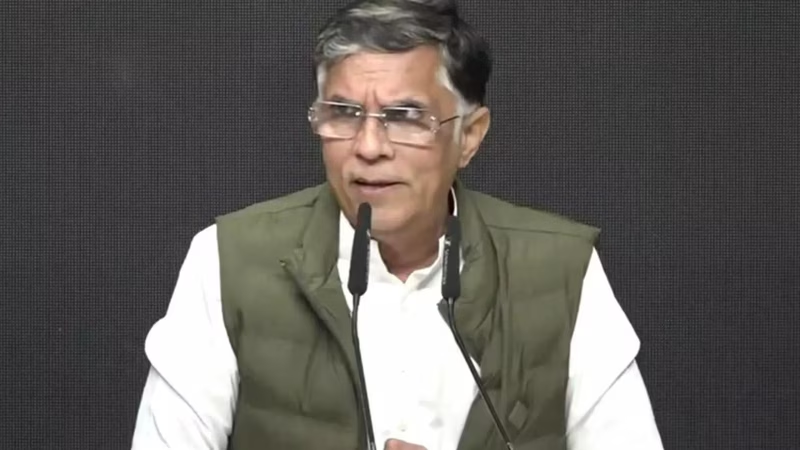
When a delegation from the Communist Party of China (CPC) arrived in New Delhi for closed-door talks, it didn’t just spark diplomatic whispers—it ignited a full-blown political firestorm. The Congress party launched a scathing attack, accusing the BJP-led government of treating Chinese officials to a “red carpet instead of red eyes.” The saffron party fired back, calling the criticism “hypocritical” and “detrimental to national interest.”
At the heart of this clash is a fundamental question: How should India engage with its powerful, often adversarial neighbor? And more importantly—should such engagements be shrouded in secrecy, or subject to public scrutiny?
The CPC meeting India controversy isn’t just about protocol; it’s a proxy war over India’s China strategy, transparency in foreign policy, and the very definition of patriotism in an era of complex geopolitics.
Table of Contents
- What Happened? Inside the CPC Delegation’s Visit
- Congress’s ‘Red Carpet’ Charge: What They’re Really Saying
- BJP’s Defense: Why Engagement ≠ Appeasement
- The Broader India-China Context: From Galwan to Geneva
- Transparency vs. National Security: Where’s the Line?
- Public Opinion and the Political Fallout
- Conclusion: Diplomacy Needs Both Dialogue and Accountability
- Sources
What Happened? Inside the CPC Delegation’s Visit
In early January 2026, a senior-level delegation from the Communist Party of China visited New Delhi for what Indian officials described as a “routine exchange” under the framework of the India-China High-Level Mechanism on Cultural and People-to-People Exchanges .
The delegation met with officials from the Ministry of External Affairs and reportedly held discussions with members of the ruling BJP. While the exact agenda remains undisclosed, such meetings typically cover trade, border management, cultural cooperation, and regional security.
Crucially, the visit occurred amid ongoing military standoffs along the Line of Actual Control (LAC), where over 60,000 troops remain deployed on both sides—a tense stalemate since the 2020 Galwan Valley clash.
Congress’s ‘Red Carpet’ Charge: What They’re Really Saying
Congress leaders seized on the visit to accuse the BJP of soft-pedaling on China. Senior leader Jairam Ramesh quipped, “While our soldiers freeze at -40°C on the border, the government rolls out a red carpet for Beijing’s emissaries” .
The party demanded full disclosure of:
- Who attended the meetings on the Indian side?
- Was the issue of Chinese transgressions raised?
- Were any concessions made on trade or border issues?
“Engagement is fine,” said another Congress spokesperson, “but not at the cost of silence on aggression. Diplomacy without backbone is surrender.”
BJP’s Defense: Why Engagement ≠ Appeasement
The BJP hit back hard, framing the Congress’s stance as “emotional nationalism” that ignores ground realities. “Should we cut off all dialogue because of disputes?” asked a senior MEA official aligned with the government. “Even during the Cold War, the US and USSR talked.”
The ruling party emphasized that formal channels with China remain essential to de-escalate tensions and prevent miscalculations. “Backchannel talks saved lives after Galwan,” a BJP strategist noted. “Public grandstanding won’t bring our soldiers home faster.”
They also pointed out that the Congress itself engaged with China during its tenure—highlighting former PM Manmohan Singh’s multiple visits to Beijing—as evidence that dialogue is bipartisan necessity, not partisan weakness.
The Broader India-China Context: From Galwan to Geneva
To understand the sensitivity around the CPC meeting India, one must look at the bigger picture:
- Military Standoff: Over 50 rounds of military talks have failed to fully disengage troops from friction points like Depsang and Demchok.
- Trade Imbalance: Despite tensions, bilateral trade hit $136 billion in 2025—with India importing far more than it exports .
- Strategic Rivalry: China’s deepening ties with Pakistan, Iran, and Russia directly challenge India’s regional influence.
In this climate, every diplomatic gesture is scrutinized for hidden meaning. A handshake can be seen as weakness; silence, as strength—or vice versa.
Transparency vs. National Security: Where’s the Line?
This episode raises a critical democratic dilemma: How much should citizens know about sensitive foreign engagements?
On one hand, foreign policy shouldn’t be a political football. Premature leaks can derail delicate negotiations. On the other, unchecked executive power risks eroding accountability—especially when national security is invoked too broadly.
Experts suggest a middle path: periodic parliamentary briefings (in closed session) or redacted summaries released after a cooling-off period. As the Centre for Policy Research notes, “Trust requires both competence and openness” .
For deeper insights into India’s foreign policy machinery, see our explainer on [INTERNAL_LINK:how-india-makes-foreign-policy-decisions].
Public Opinion and the Political Fallout
Public sentiment toward China remains deeply negative post-Galwan, with over 70% of Indians viewing it as a threat, per a 2025 CSDS survey. The BJP, which built its 2014–2019 brand on “strong leadership,” risks appearing inconsistent if seen as too conciliatory.
Meanwhile, the Congress is trying to reposition itself as the vigilant opposition—not anti-engagement, but pro-accountability. Whether this narrative sticks will depend on how voters weigh pragmatism against principle in an election year.
Conclusion: Diplomacy Needs Both Dialogue and Accountability
The row over the CPC meeting India reveals a truth often ignored in polarized debates: effective foreign policy requires both quiet diplomacy and democratic oversight. Rolling out a red carpet isn’t inherently wrong—but doing so without explaining why to the people who bear the cost of conflict is a failure of leadership.
India doesn’t need to choose between talking to China and standing up to it. It needs leaders who can do both—with clarity, consistency, and courage.
Sources
- Times of India. “‘Red carpet instead of red eyes’: Cong targets BJP over CPC meeting”. https://timesofindia.indiatimes.com/india/red-carpet-instead-of-red-eyes-congress-targets-bjp-over-cpc-meeting-saffron-party-hits-back/articleshow/126509085.cms
- Ministry of Commerce and Industry, Government of India. “India-China Trade Statistics 2025”. https://commerce.gov.in/
- Centre for Policy Research (CPR). “Transparency in India’s Foreign Policy: A Democratic Imperative”. https://www.cprindia.org/