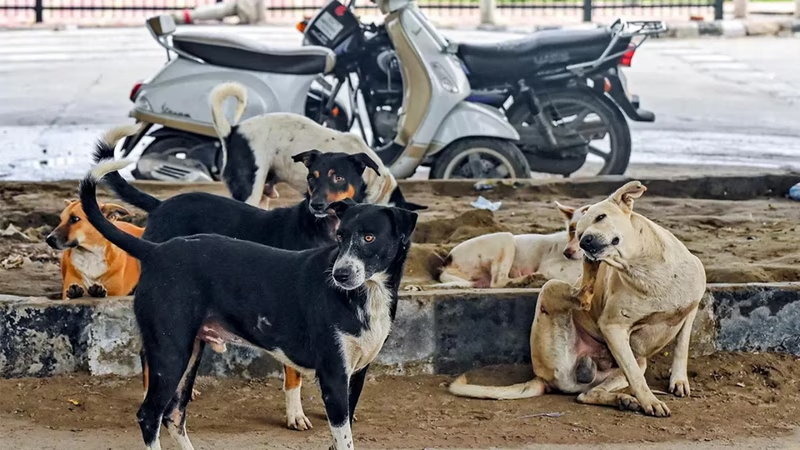
The age-old debate over stray dogs in India has taken a dramatic legal turn. In a powerful and unambiguous directive, the Supreme Court of India has ruled that people who routinely feed stray dogs—but fail to take full responsibility for them—can be held legally liable if those animals attack or injure someone. Even more significantly, the Court has ordered that heavy compensation must be paid to victims of such incidents.
“If you feed them, you own them,” the Court effectively declared, urging citizens to go beyond casual feeding and instead formally adopt the animals they care for. This isn’t just a moral nudge—it’s now a matter of legal accountability.
With dog bite cases rising across urban and semi-urban India, this ruling could reshape how communities interact with strays. But what does it mean for the average citizen? Could your morning act of kindness land you in court? Let’s unpack the judgment, its implications, and what responsible animal care really looks like in 2026.
Table of Contents
- The SC Ruling: What Exactly Did the Court Say?
- Why This Ruling Matters: The Growing Crisis of Stray Dog Attacks
- Who Is Considered a ‘Feeder’ Under the Law?
- ‘Adopt, Don’t Just Feed’: The Court’s Clear Alternative
- How Will Compensation Be Determined?
- Balancing Compassion and Accountability
- Conclusion: Responsibility Over Ritual
- Sources
The SC Ruling: What Exactly Did the Court Say?
While hearing a public interest litigation (PIL) concerning recurring stray dog attacks, a Supreme Court bench issued a stern warning: “We will hold feeders liable and fix heavy compensation for dog bites” .
The Court emphasized that sporadic or habitual feeding creates a de facto relationship of care and control. Once you assume that role—even informally—you also assume legal responsibility for the animal’s behavior. This principle aligns with tort law doctrines seen in other countries, where “keepers” of animals are liable for damages caused by them.
Critically, the Court dismissed the notion that feeding is a purely charitable act with no strings attached. “Compassion cannot come at the cost of public safety,” the judges noted.
Why This Ruling Matters: The Growing Crisis of Stray Dog Attacks
The context is urgent. According to data from the National Crime Records Bureau (NCRB), over 20,000 cases of dog bites were reported in India in 2024 alone—many involving children and elderly pedestrians . Rabies, often transmitted through such bites, remains a leading cause of death in several states.
Cities like Chennai, Mumbai, and Lucknow have seen intense public protests demanding better management of stray populations. Yet, solutions have been stalled by polarized debates: animal rights activists vs. resident welfare associations, compassion vs. safety.
The Supreme Court’s intervention cuts through this deadlock by placing responsibility squarely on those who choose to engage with strays—without offering real care.
Who Is Considered a ‘Feeder’ Under the Law?
This is where things get nuanced. The Court didn’t target occasional feeders—like someone who gives scraps once in a while. Instead, it focused on individuals who:
- Feed the same group of dogs regularly (e.g., daily or multiple times a week).
- Provide water, shelter, or medical aid consistently.
- Are recognized by neighbors or local authorities as the “caretaker” of specific strays.
In such cases, courts may now consider the feeder the “de facto owner” under Section 3 of the Prevention of Cruelty to Animals Act, 1960—and thus liable under civil and criminal provisions if an attack occurs.
‘Adopt, Don’t Just Feed’: The Court’s Clear Alternative
Rather than discourage compassion, the Supreme Court offered a constructive path forward: formal adoption. “If you care enough to feed them, care enough to adopt them,” the bench urged .
Adoption brings structure:
- Vaccination: Adopted dogs can be vaccinated against rabies.
- Neutering: Helps control population growth humanely.
- Behavioral Training: Reduces aggression and improves public interaction.
- Legal Clarity: Clear ownership means clear responsibility—and protection under animal welfare laws.
For those unable to adopt, the Court suggested supporting registered NGOs that run sterilization and vaccination drives—a model proven effective in cities like Pune and Bengaluru.
Learn more about responsible pet ownership in our guide on [INTERNAL_LINK:how-to-adopt-a-stray-dog-in-india].
How Will Compensation Be Determined?
The phrase “heavy compensation” suggests amounts far beyond nominal damages. Courts are likely to consider:
- Medical expenses (including post-exposure rabies prophylaxis).
- Loss of income due to injury.
- Pain, suffering, and emotional trauma.
- Punitive damages in cases of gross negligence (e.g., feeding aggressive dogs near schools).
Previous judgments have awarded anywhere from ₹5 lakh to ₹20 lakh in severe cases. With the SC’s new stance, these figures could rise significantly.
Balancing Compassion and Accountability
This ruling doesn’t vilify animal lovers—it elevates their role. True compassion isn’t just about giving food; it’s about ensuring the animal’s well-being and its peaceful coexistence with society.
As the Animal Welfare Board of India (AWBI) has long advocated, sustainable stray management requires a “four-pronged approach”: Adopt, Vaccinate, Sterilize, Educate . Feeding alone addresses none of these.
Conclusion: Responsibility Over Ritual
The Supreme Court’s warning on dog bite liability marks a turning point in India’s relationship with stray animals. It shifts the narrative from passive charity to active stewardship. If you’re moved to help a stray, do it fully—adopt, vaccinate, and integrate. Otherwise, your good intentions could lead to devastating legal and human consequences.
In the end, justice isn’t just for humans—it’s for every living being. And that includes holding us accountable when our actions, however well-meaning, put others at risk.
Sources
- Times of India. “Will hold feeders liable, fix heavy compensation for dog bites, warns SC”. https://timesofindia.indiatimes.com/india/will-hold-feeders-liable-fix-heavy-compensation-for-dog-bites-warns-sc/articleshow/126513478.cms
- National Crime Records Bureau (NCRB). “Accidental Deaths & Suicides in India 2024”. https://ncrb.gov.in/
- Animal Welfare Board of India (AWBI). “Guidelines for Stray Dog Management”. https://awbi.org/