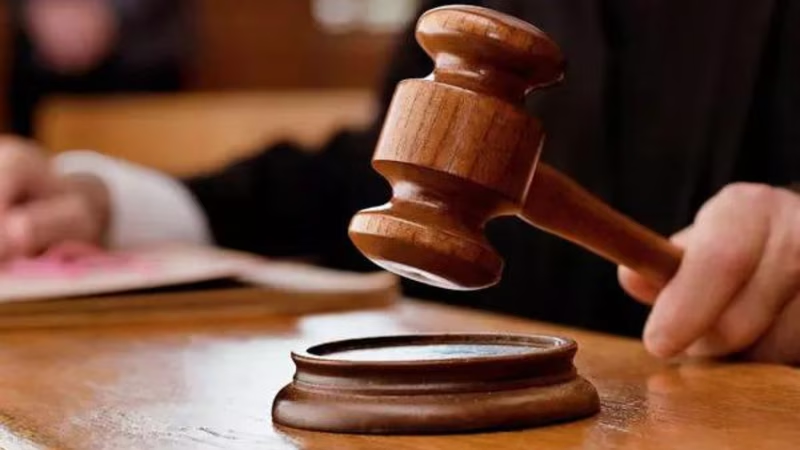
In a landmark moment that sent shockwaves through India’s legal corridors, the Supreme Court has issued a stark warning: judicial corruption can no longer be tolerated—and it will take “harsh orders” to cleanse the system. This isn’t just another bureaucratic memo; it’s a direct, urgent call from the highest court in the land to protect the very soul of Indian democracy.
Coming amid growing public skepticism and high-profile allegations of misconduct, the Court’s statement is both a confession of systemic vulnerability and a promise of action. But what exactly triggered this unprecedented stance? And more importantly—what happens next?
Let’s cut through the legalese and explore what this historic declaration means for judges, lawyers, litigants, and every citizen who relies on the judiciary as the last bastion of justice.
Table of Contents
- The SC’s Explosive Statement on Judicial Corruption
- Why Now? A Timeline of Recent Scandals
- Existing Accountability Mechanisms—and Why They’ve Failed
- What Could ‘Harsh Orders’ Actually Look Like?
- Public Trust at Stake: The Bigger Picture
- Conclusion: A Crossroads for Indian Justice
- Sources
The SC’s Explosive Statement on Judicial Corruption
During a recent hearing on judicial misconduct, a Supreme Court bench led by Chief Justice of India (CJI) made a blunt and unambiguous declaration: “Soft measures have failed. Harsh orders are needed to curb corruption in the judiciary” .
The remark came while reviewing a case involving alleged bribery and favoritism in lower courts—a case that exposed how easily justice can be bought and sold when oversight is weak. The Court emphasized that corruption among judges isn’t just a professional lapse; it’s a betrayal of the Constitution itself.
“When a judge takes a bribe, he doesn’t just steal money—he steals justice,” the bench observed, underscoring that such acts erode the foundation of the rule of law.
Why Now? A Timeline of Recent Scandals
The SC’s frustration didn’t emerge in a vacuum. Over the past two years, India has witnessed a disturbing series of allegations:
- 2024: A district judge in Maharashtra was caught on video accepting cash in exchange for favorable rulings.
- 2025: Whistleblowers exposed a “bench-fixing” racket in Delhi, where litigants allegedly paid to have their cases assigned to sympathetic judges.
- January 2026: An RTI activist revealed that over 120 complaints of judicial misconduct were pending with the CJI’s office—with zero resolved in the past 18 months .
These incidents, once dismissed as isolated, now appear to be symptoms of a deeper rot—one the Supreme Court can no longer ignore.
Existing Accountability Mechanisms—and Why They’ve Failed
India does have systems to address judicial misconduct, but they’re widely criticized as toothless and opaque:
- In-House Procedure: Complaints against judges are reviewed internally by a committee of senior judges. Critics call it a “club protecting its own.”
- Parliamentary Impeachment: Theoretically possible, but politically fraught and never successfully used against a Supreme Court judge.
- Vigilance Cells: Most High Courts lack dedicated anti-corruption units with real investigative power.
As the Law Commission of India noted in its 2023 report, “The current framework lacks independence, transparency, and deterrence” . Without external oversight or public scrutiny, accountability remains a mirage.
What Could ‘Harsh Orders’ Actually Look Like?
The phrase “harsh orders” is deliberately open-ended—but legal experts suggest several concrete steps the SC could take:
- Mandatory asset declarations for all judges, published online.
- Fast-track disciplinary tribunals with non-judicial members (e.g., retired civil servants, legal academics).
- Whistleblower protection for court staff and litigants reporting corruption.
- Public hearings for serious misconduct allegations, barring national security concerns.
Some even speculate the Court might push for a new Judicial Accountability Bill—a long-pending proposal that has stalled in Parliament for over a decade.
For more on past reform attempts, see our analysis on [INTERNAL_LINK:judicial-accountability-bill-india-history].
Public Trust at Stake: The Bigger Picture
Beyond legal technicalities, this is about public faith. A 2025 survey by the Centre for the Study of Developing Societies (CSDS) found that only 38% of Indians trust the judiciary “a great deal”—down from 56% in 2015 .
When people believe justice is for sale, they stop seeking it. They turn to vigilantes, settle disputes through bribes, or simply give up. That’s not just a legal crisis—it’s a democratic one.
The Supreme Court knows this. Its call for “harsh orders” isn’t just about punishing bad actors; it’s about saving the institution from irrelevance.
Conclusion: A Crossroads for Indian Justice
The Supreme Court’s admission that judicial corruption demands “harsh orders” is a watershed moment. It’s an acknowledgment that self-regulation has failed and that the time for gentle nudges is over.
But words must be followed by action. Will the Court establish independent oversight? Will it demand legislative backing for real reform? Or will this bold statement fade into another footnote of unfulfilled promises?
For now, the ball is in the judiciary’s court—literally. And millions of Indians are watching.
Sources
- Times of India. “Harsh orders needed to curb corruption in judiciary: SC”. https://timesofindia.indiatimes.com/india/harsh-orders-needed-to-curb-corruption-in-judiciary-sc/articleshow/126515247.cms
- Right to Information Act filings, 2026. Data on pending judicial misconduct complaints.
- Law Commission of India. “Report No. 274: Judicial Accountability and Transparency”. https://lawcommissionofindia.nic.in/
- Centre for the Study of Developing Societies (CSDS). “State of the Indian Judiciary Survey, 2025”. https://www.csds.in/