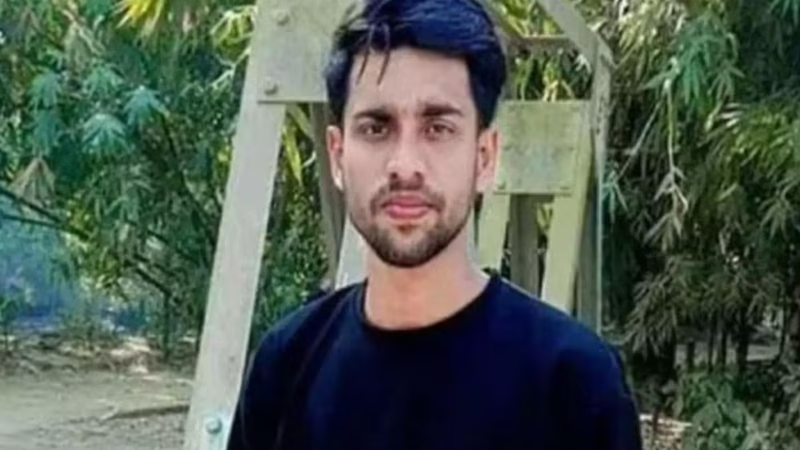
The streets of Bangladesh are growing increasingly dangerous for its Hindu citizens. In a deeply troubling development, another Hindu man has been murdered, marking the eighth such killing since December 18, 2025 . This relentless wave of violence has sent shockwaves through the minority community and raised urgent questions about the state’s ability—or willingness—to protect its most vulnerable residents.
While details of the latest attack are still emerging, the consistent targeting of Hindu individuals over the past month points to a disturbing and potentially organized campaign of intimidation and terror. For a community that has long faced social and economic marginalization, this escalation from sporadic incidents to a clear, deadly pattern is a terrifying new reality.
Table of Contents
- The Latest Incident and the Growing Toll
- Hindu Killings in Bangladesh: A Historical Context
- Why Is This Happening Now?
- The Government Response and International Reaction
- What Does the Future Hold for Bangladesh’s Minorities?
- Sources
The Latest Incident and the Growing Toll
The most recent victim, whose identity is often withheld in initial reports for security reasons, was reportedly attacked in his home or place of business. The modus operandi in several of these cases has involved assailants arriving on motorcycles, a tactic that allows for swift execution and escape, suggesting a level of planning .
This brings the total number of confirmed Hindu killings in Bangladesh to eight in less than a month—a statistic that is not just alarming but unprecedented in its concentration. Each death represents not just a personal tragedy but a direct assault on the fabric of a pluralistic society. The victims have included businessmen, farmers, and local community leaders, indicating that no segment of the Hindu population is safe.
Hindu Killings in Bangladesh: A Historical Context
To understand the gravity of the current situation, one must look back. The Hindu community in Bangladesh, which constituted nearly 22% of the population at the time of independence in 1971, has seen its numbers dwindle to around 8% today . This decline is largely attributed to decades of systemic discrimination, land grabbing under the now-defunct Vested Property Act, and periodic outbreaks of communal violence, often triggered by political instability or blasphemy allegations .
While large-scale pogroms have become less frequent, a persistent low-level threat has remained. The current spate of Hindu killings in Bangladesh, however, feels different. Its frequency and apparent coordination suggest a shift from opportunistic mob violence to something more sinister and targeted.
Why Is This Happening Now?
Several factors may be converging to create this perfect storm of violence:
- Political Vacuum and Instability: Following the ousting of the long-ruling Awami League government, the interim administration may be struggling to maintain law and order, creating a power vacuum that extremist elements are eager to exploit .
- Rise of Extremist Rhetoric: Hardline Islamist groups have been emboldened, using social media and local sermons to spread hate speech against minorities, often framing them as enemies of the state or agents of foreign powers.
- Economic Envy and Land Disputes: Many Hindus are successful in business or own valuable agricultural land, making them targets for predatory actors who use violence as a tool for extortion or property seizure.
The Government Response and International Reaction
The response from Bangladesh’s authorities has been widely criticized as inadequate. While officials often promise investigations and vow to bring the perpetrators to justice, convictions in cases of minority-targeted violence are notoriously rare . This lack of accountability creates a culture of impunity that only fuels further attacks.
Internationally, the situation is drawing serious concern. Human Rights Watch and Amnesty International have issued statements calling on the Bangladeshi government to take immediate and concrete steps to protect its minority citizens . India, given its shared border and cultural ties with the Bengali Hindu community, is also watching the situation with deep anxiety, though its public commentary has been measured so far. The United Nations has mechanisms to address such crises, and pressure is mounting for it to intervene .
What Does the Future Hold for Bangladesh’s Minorities?
The path forward is fraught with peril. If the current trend of Hindu killings in Bangladesh continues unchecked, it could trigger a mass exodus of the remaining Hindu population, dealing a final blow to the country’s secular identity as enshrined in its founding principles. It would also severely damage Bangladesh’s international reputation and its standing as a moderate Muslim-majority nation.
Averting this catastrophe requires decisive action. The government must move beyond rhetoric and deploy robust security measures in vulnerable Hindu neighborhoods, swiftly investigate every attack, and ensure that those responsible—whether the trigger-pullers or the masterminds—are prosecuted to the fullest extent of the law. Community policing initiatives and strong counter-narratives against hate speech are also essential long-term strategies.
For more on regional stability, see our coverage on [INTERNAL_LINK:south-asia-geopolitical-tensions]. You can also read the U.S. State Department’s annual report on international religious freedom for a comprehensive global perspective .
Sources
- Times of India: Original Article
- Minority population statistics:
- Historical context on Vested Property Act:
- Analysis of political situation:
- Human Rights Watch & Amnesty International statements: [[6], [7]]
- United Nations Office of the High Commissioner for Human Rights (OHCHR): https://www.ohchr.org/
- U.S. State Department International Religious Freedom Report: https://www.state.gov/reports-bureau-of-democracy-human-rights-and-labor/international-religious-freedom-report/